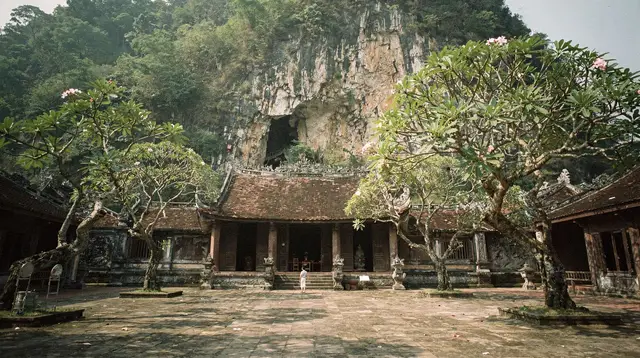
Group Tour or Private Tour in Northern Vietnam?
Should I book a group tour or a private tour in northern Vietnam?
A group tour is cheaper per person and runs on a fixed schedule set by the organiser, while a private tour costs more but lets you adjust the timing and stops. Neither format is automatically faster: boat and cable transfers, ferry queues and boarding times apply to everyone regardless of tour type.
Two ways to see the same places
Almost everything covered on this site — a day trip to Ninh Binh, an overnight cruise on Halong Bay, a loop through Ha Giang — can be booked in two formats: a group tour, where you join other travellers on a fixed schedule at a shared price, or a private tour, where the vehicle, guide and itinerary are yours alone at a higher cost. Neither format is universally better.
The right choice depends on how much you value flexibility, how you feel about sharing a vehicle and meals with strangers, and how much control you want over the pace of the day. This page sets out how the two formats actually differ, corrects a common misconception about speed, and gives you a way to decide without needing to compare specific companies or itineraries, which are covered on the destination and guides pages for each place.
How group tours work
A group tour is organised around a fixed departure time, a set itinerary and a shared vehicle, usually a minibus seating anywhere from a handful to several dozen travellers depending on the operator and route. The price is mutualised across everyone booked on that departure, which is what makes group tours the more affordable option for a given itinerary. In exchange, you accept the schedule as it is set: the pickup window, the order of stops, the time allotted at each site and the return time are fixed in advance and shared by the whole group.
This works well for popular, well-defined circuits close to Hanoi, such as a day trip combining Hoa Lu and Tam Coc or a Perfume Pagoda excursion, where the stops and rough timing are standard regardless of operator.
It also works well for Halong Bay cruises, most of which are run as small-group departures by design: cabins are sold individually, meals are shared in a common dining area, and the excursion schedule (kayaking, cave visits, cooking demonstrations) is set for the whole boat rather than negotiated cabin by cabin. Booking a cruise as a “group tour” in the everyday sense simply means booking a cabin on a boat that other travellers are also booked on — it does not usually mean a noticeably larger crowd than a private charter would carry to the same sites.
Group tours are led by a single guide responsible for the whole party, which means pacing decisions (how long to linger at a viewpoint, whether to add an unplanned stop) are made for the group as a whole rather than adjusted for one traveller’s preference. For travellers who would rather not plan logistics themselves, this is a feature, not a drawback: someone else has already worked out the order of stops, the timing, and the transfers.
How private tours work
A private tour books the vehicle, driver and guide exclusively for one traveller or one travelling party. The itinerary can usually be adjusted within reason — starting earlier to beat the heat, spending longer at a temple that particularly interests you, skipping a stop that doesn’t, or rerouting around a closure. Meals, rest stops and even the overall pace of the day can be discussed with the guide rather than fixed by a printed schedule.
This flexibility comes at a price premium, since the full cost of the vehicle, fuel and guide is carried by one party rather than split across a busload of travellers. It tends to matter most on trips where timing genuinely varies by traveller: a Ninh Binh day trip that also needs to work around a flight, a Ha Giang loop where riding pace differs sharply between confident and cautious riders, or a family trip where nap times and shorter attention spans don’t fit a fixed schedule. It also suits travellers who simply prefer not to share a vehicle with strangers, independent of any logistical need.
The speed misconception
It’s tempting to assume a private tour is always the faster option, since there’s no waiting for other travellers to reboard the van or finish browsing a market stall. That assumption holds only for the parts of a trip that are genuinely elastic — how long you linger somewhere, how quickly the group reassembles after a stop. It does not hold for the parts of a day that are fixed by the site itself.
Rowing boats at Trang An or Tam Coc move at the pace of the rower, not the pace of the tour format; a queue to board is a queue whether you arrive in a shared minibus or a private car. Cable cars to Fansipan run on their own departure intervals. Cruise boats to Halong Bay, Lan Ha Bay or Bai Tu Long Bay board and depart on a fixed schedule set by the port and the boat operator, not by whether the cabin was booked privately or as part of a group departure.
A private guide can time your arrival to avoid the worst of a queue, and can cut the idle time between stops that a shared itinerary sometimes carries, but cannot make a boat row faster or a cable car run more frequently. Choosing a private tour to “save time” on a route where the bottleneck is a boat, a cable car, or a ferry crossing will not deliver the time saving you might expect — the saving mainly comes from cutting the waiting time around other travellers, not the transfer times built into the site itself.
Comparing the two formats
| Group tour | Private tour | |
|---|---|---|
| Cost per person | Lower, shared across the group | Higher, covers the full vehicle and guide |
| Schedule | Fixed departure and stop timings | Adjustable within the day’s constraints |
| Vehicle | Shared minibus or coach | Exclusive car or van for your party |
| Pace | Set for the whole group | Set with your guide, stop by stop |
| Meals | Usually shared, set menu or buffet | Can often be discussed or adjusted |
| Best suited to | Standard circuits, cruises, solo travellers on a budget | Families, mixed-ability riding groups, tight personal schedules |
| Site transfer times (boats, cable cars) | Same for everyone on site | Same for everyone on site |
When the format matters more than usual
A handful of situations tend to make the choice between group and private tours more consequential than usual, and are worth weighing before booking either format.
Riding or trekking ability that varies within a party. On something like a Pu Luong trek or a multi-day motorbike loop, a group moving at the pace of its slowest or most cautious member can frustrate stronger riders and walkers, while a private booking lets the day be paced to the people actually on it.
A tight connecting schedule. If a day trip needs to end in time for a flight or an onward train departure, a private tour offers more room to adjust the return time than a fixed group departure will.
Photography or a strong interest in one specific site. Travellers who want an extended, unhurried stop at one temple, viewpoint or market — rather than an even amount of time at every stop on a printed itinerary — tend to be better served by a private booking.
Budget-conscious solo travel. For a solo traveller on a standard circuit like a Bat Trang pottery village visit or a well-trodden Halong Bay day trip, a group tour delivers the same sights at a lower cost, and the fixed schedule is rarely a real constraint since the standard circuit is already well suited to the site.
A first overnight cruise. For most travellers booking their first overnight cruise, a small-group departure works well precisely because the operator has already solved the logistics — embarkation, meal timing, excursion order — and there is little practical benefit to paying a premium for a private charter unless privacy itself is the goal.
What doesn’t change between formats
A few things stay constant no matter which format you book, and it’s worth being clear about them before assuming a private tour buys more than it does.
Ticketing and entrance queues at heritage sites, boat-loading procedures, and cable car intervals are set by the site operator, not the tour company, and apply equally to group and private bookings. Guide quality is a function of the individual guide and the operator’s training, not of whether the tour is shared or exclusive — a private tour with a disengaged guide is no better than a well-run group tour, and vice versa. And weather-driven disruptions, most relevant on cruise cancellations during typhoon season, affect group and private departures alike, since the underlying safety decision is made by the port authority or the boat operator rather than by the traveller’s booking type.
Where the two formats blur
The group-versus-private split is not always as clean as “shared minibus” against “exclusive car.” A growing number of products sit somewhere in between, and it’s worth knowing they exist before assuming your only choice is a large coach or a private charter.
Small-group cruise boats. Some Halong Bay, Lan Ha Bay and Bai Tu Long Bay operators run boats capped at a handful of cabins rather than the dozens found on larger vessels. These are still technically group departures — you share the boat, the dining room and the excursion schedule with other cabins — but the smaller headcount changes the feel of the trip considerably.
The guide to choosing a cruise boat category goes into how boat size affects the experience independently of whether the booking itself is “group” or “private.” a small-group boutique cruise in Lan Ha Bay is an example of this middle ground: a shared boat, but a deliberately limited one.
Private transport with a shared itinerary. A private Hanoi tour with a driver can sometimes follow a fairly standard route through the city’s sights while still giving you the exclusive vehicle and flexible timing of a private booking — useful if what you actually want is privacy and pace control rather than a genuinely customised itinerary.
Food tours. The choice between a private and a group food tour works slightly differently from a sightseeing day trip, since part of the appeal of a group food tour is trying a wider spread of dishes split among more people, while a private food tour lets you skip stops you’re not interested in — a trade-off worth thinking about separately from the general group-versus-private decision.
Sidecar and motorbike formats. A sidecar motorbike tour is private by nature — one or two passengers per bike and driver — but is often priced and marketed close to a standard group tour of the same route, since the “group” in this case is several sidecars travelling together rather than one shared vehicle. It’s a useful reminder that “private” describes who’s in the vehicle, not necessarily how much the trip costs relative to a minibus tour of the same sights.
None of these hybrid formats change the underlying rule from earlier: a boat still rows at the pace of the rower, and a cable car still runs on its own interval, whichever category of product got you there.
Cost, and what the price difference is actually paying for
It helps to think about the price gap between the two formats as paying for two different things, not one. Part of it is the vehicle and guide being dedicated to your party alone rather than shared across a busload of other travellers — that portion of the premium is straightforward and scales roughly with the number of people who would otherwise have split the cost. The other part is flexibility itself: the ability to leave earlier, linger longer, or swap a stop, which has value even on a day where you end up following more or less the same route a group tour would have taken.
This second part is easy to overpay for if your itinerary was always going to follow the standard circuit anyway. If you know in advance that you want to see exactly what a Perfume Pagoda or Bat Trang pottery village day trip normally covers, in roughly the order it’s normally covered, a private booking is mostly paying for the empty seats next to you rather than for meaningfully more control over the day. It’s worth being honest with yourself about which part of the premium you actually want before paying it.
How to decide
Start from the trip itself rather than a general preference for one format. For a standard circuit near Hanoi — Ninh Binh, a cruise, the well-known heritage sites in Ba Dinh district — a group tour usually covers the same ground at a lower cost, and the fixed schedule is rarely a real constraint since these circuits are already built around the sites’ own timing.
For a trip where your party’s pace, interests or schedule genuinely diverge from a standard itinerary — mixed riding ability, young children, a tight connection, or simply a strong preference for privacy — the flexibility of a private tour is worth the premium. Either way, remember that the format changes who sets the schedule and how much it can flex, not the underlying time a boat ride, a cable car or a boarding queue takes; budget your day around the site’s own pace, not around the tour type you book.
a Hanoi city highlights tour bookable as a group or private departure is a good example of how the same route is sold in both formats side by side. For a fixed-schedule option outside the city, a one-day Mai Chau nature and culture group tour shows the shared-vehicle format at work.
If your priority is an adjustable pace, a private Ninh Binh heritage tour with a dedicated guide or a private boat tour of Halong Bay illustrate what a private booking adds on the water and on land.
For the logistics of specific circuits, see the day trips from Hanoi and multi-day tours from Hanoi overviews, and for a narrower look at how this same group-versus-private question plays out on single-day itineraries, see group day trip vs private day trip.
Tour Comparisons
Verified deep-linked GetYourGuide tours. Book through these links and we earn a small commission at no cost to you.
GetYourGuide does not provide a product photo for this activity — the image shows the meeting point, photographed by us.