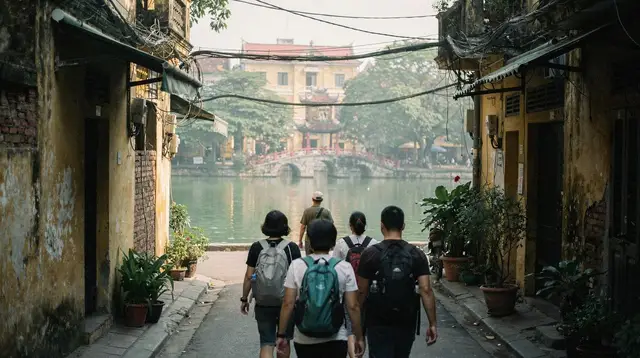
Perfume Pagoda: A Working Pilgrimage Site in the Karst Southwest of Hanoi
What is Perfume Pagoda and how do you get there from Hanoi?
Perfume Pagoda (Chua Huong) is a complex of Buddhist shrines built into limestone cliffs southwest of Hanoi. Visitors travel by road to the Yen stream, then take a rowing boat upriver before continuing on foot or by cable car to the main sanctuary at Huong Tich Cave. It remains an active pilgrimage site, busiest during its spring festival period.
A Boat Ride Into the Limestone
Southwest of Hanoi, the flat rice country of the Red River delta gives way to sudden limestone hills, and tucked into one of these outcrops is Perfume Pagoda — Chua Huong in Vietnamese, meaning something closer to “fragrant temple” than a literal pagoda. It is not a single building but a scattered complex of shrines, grottoes and pavilions built into the cliffs above a small river, and it has drawn Buddhist pilgrims for centuries. The approach is part of the experience: a road journey from Hanoi to a boat landing, a slow row upstream between karst walls, and then a climb, or a cable car ride, up to the main sanctuary inside a limestone cave.
For anyone exploring the Caves and Karst Nature side of northern Vietnam, Perfume Pagoda is one of the closest and most accessible examples of the region’s limestone landscape to Hanoi itself — a way to see karst scenery and a working religious site in a single day, without the longer drive south to the Ninh Binh area.
Where Perfume Pagoda Fits in the Karst Southwest
Northern Vietnam’s limestone country stretches across a wide arc, from the hills immediately around Hanoi down through Ninh Binh and out to the bays of the coast. Perfume Pagoda belongs to the northern, closer edge of that arc — a set of karst hills southwest of the capital, distinct from the Trang An and Tam Coc landscapes that sit further south around Ninh Binh. The two areas share a geology, limestone shaped by water over millions of years into towers, caves and cliffs, but they are separate destinations with separate access roads, and a single day trip typically covers only one of them.
This matters for planning: Perfume Pagoda is not a stop on the way to Ninh Binh, and treating it as an add-on to a Ninh Binh itinerary usually means giving neither site enough time. It stands on its own, closer to Hanoi, with its own boat ride and its own rhythm.
Getting There from Hanoi
Perfume Pagoda lies to the southwest of the city, reached by road rather than rail. Independent travellers can arrange a private car or driver, but the more common approach is a guided day tour that bundles the road transfer, the boat and, often, the cable car into a single booking — useful given how many moving pieces the visit has.
a full-day trip to Perfume Pagoda that covers the road transfer, boat ride and climb or cable carBecause the site sits outside the city and involves a river crossing on top of the drive, it is not the kind of stop that fits neatly into a half-day itinerary. Most people set aside a full day, in line with general guidance on day trips from Hanoi.
The Boat Ride Up the Yen Stream
From the road, the journey continues by water. Small rowing boats, usually paddled by local boatwomen, carry visitors up the Yen stream toward the base of the karst hills. The stream winds between limestone outcrops and rice paddies, and this stretch of river is as much a part of the site’s identity as the shrines themselves — a slow, quiet approach that sets the tone before the climb.
a day trip built around the river approach and the walk up to the main caveThe boat is typically arranged as part of a guided tour, or booked locally at the landing by independent travellers. It is worth allowing time here rather than treating it as a mere transfer: the pace is unhurried by design.
Trail and Cable Car to Huong Tich Cave
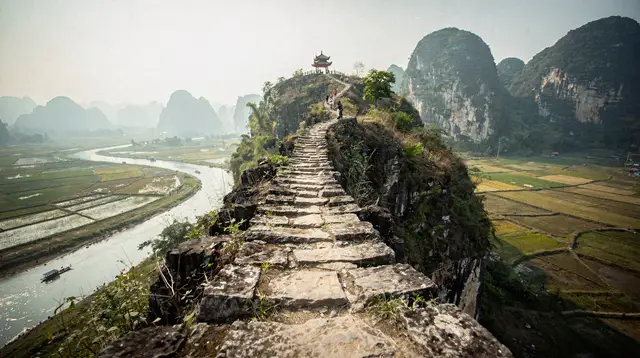
From the point where the boat journey ends, two routes lead up to the main sanctuary at Huong Tich Cave. A stone trail climbs through the hillside past smaller shrines and viewpoints, a walk that takes real effort on stepped sections and can be humid and slippery depending on the weather. A cable car runs a parallel route, covering roughly the same stretch of hillside in a fraction of the time.
Neither option is objectively better; they suit different visitors. Walkers get a closer look at the smaller pagodas and grottoes along the way and a stronger sense of the terrain, while the cable car suits anyone short on time, travelling with children or older relatives, or simply preferring not to climb in humid conditions. Many visitors combine the two, going up by cable car and walking down, or the reverse.
| Route to Huong Tich Cave | What it involves | Best suited to |
|---|---|---|
| Walking trail | Stepped stone path through the hillside, passing smaller shrines | Visitors who want a closer look at the site and are comfortable with a sustained climb |
| Cable car | A short ride covering most of the elevation gain | Visitors short on time, travelling with children, or avoiding the climb |
| Combination | Cable car one way, trail the other | Visitors who want to see the trailside shrines without climbing both ways |
Inside the Sanctuaries: What You’ll See
The name “Perfume Pagoda” covers a cluster of individual sites rather than one building. Along the trail and around the boat landing are smaller pagodas and shrine gates, each with its own dedication, and the climb passes several of these before reaching the main sanctuary. The centrepiece is Huong Tich Cave itself, a large natural cavern partly fitted out as a temple space, with stalactites, incense smoke and devotional statues inside. It is this cave, rather than any single freestanding building, that pilgrims travel to reach.
The overall effect is closer to a walk through a religious landscape than a single-monument visit — shrines set into cliffs, gates spanning the trail, and the cave at the top functioning as the spiritual centre of the whole complex.
A Living Pilgrimage Site, Not Just a Viewpoint
It is worth being direct about one point: Perfume Pagoda is not primarily a scenic overlook built for visitors to photograph. It is an active place of Buddhist worship, and the shrines, incense and ritual objects seen along the way belong to a living practice rather than a historical display. Visitors are welcome, but the site functions first as a pilgrimage destination for Vietnamese Buddhists, and behaviour, dress and noise should reflect that — the same expectations that apply at other active religious sites such as the Temple of Literature or the pagodas around Ho Chi Minh Mausoleum and Ba Dinh.
This also explains why the site’s atmosphere and crowding change so much through the year: it follows a religious calendar, not a tourist season.
When to Go
Perfume Pagoda has a pilgrimage period each spring, tied to the lunar calendar, during which large numbers of Vietnamese visitors travel to the site to pray and take part in the festival. Exact dates shift every year with the lunar calendar, in the same way Tet does, so no fixed month or date should be treated as reliable from one year to the next — check current festival dates closer to travel rather than relying on a figure from a previous year.
Outside that pilgrimage window the site is markedly quieter, and the boat ride and climb feel more like a nature and heritage outing than a crowd experience. Broader seasonal patterns for the region, including the wetter summer months and the cooler, greyer winter, are covered in the general guidance on the best time to visit Hanoi and on festivals and public holidays in Vietnam.
No ticket price, exact boat fare or visitor count is given here, since these figures move from year to year and are best checked against a current source or a booking page at the time of travel rather than repeated from an outdated one.
Practicalities: What to Wear and Bring
Because Perfume Pagoda is an active religious site reached partly on foot, a few practical points matter more here than at a purely scenic stop:
- Modest clothing that covers shoulders and knees, appropriate for entering shrine spaces.
- Comfortable, closed, non-slip shoes for the stepped trail sections, which can be uneven and damp.
- A light rain layer, since both the boat and the outdoor trail offer no cover.
- Cash for the boat fare, cable car ticket and any small offerings, in line with general guidance on money and payments in dong — note that small local operators rarely take cards.
Nearby: Pairing Perfume Pagoda With Other Day Trips
Perfume Pagoda is usually a full day on its own, given the road transfer, the boat and the climb or cable car. Travellers who want to see more of the countryside southwest of Hanoi sometimes pair it, on separate days, with the craft villages of Bat Trang for ceramics or Duong Lam, an ancient village of laterite houses — both covered in more detail in the guides to the Bat Trang pottery village day trip and the Duong Lam ancient village day trip.
a combined day tour taking in Duong Lam village and nearby pagodasTravellers with more time, or an interest in the wider countryside west of the city, might instead look at the forested hills and viewpoints of Ba Vi National Park, reached on a separate excursion rather than combined with Perfume Pagoda in a single day.
a jeep tour into the countryside and forest of Ba Vi National ParkFor a wider view of how these countryside excursions compare, the guide to craft villages and workshop day trips and the broader day trips from Hanoi hub set Perfume Pagoda alongside the other short excursions from the capital, while group versus private day trips and booking in advance or on arrival cover the logistics of choosing and arranging any of them, including what to book ahead before travelling.
Frequently Asked Questions About Visiting Perfume Pagoda
Is Perfume Pagoda part of Ninh Binh?
No. Perfume Pagoda sits in the karst hills southwest of Hanoi, in a different area from the Trang An and Tam Coc landscapes further south around Ninh Binh. Both are limestone country, but they are separate destinations with separate access routes.
How do you get from Hanoi to Perfume Pagoda?
Most visitors go by road from Hanoi to the boat landing on the Yen stream, either on a guided day tour or with a private driver. From the landing, the site itself is reached by boat and then on foot or by cable car.
Do you have to walk, or is there a cable car?
Both options exist. A marked trail climbs through the limestone hills to the main cave, and a cable car covers roughly the same stretch of the route. Many visitors go up one way and down the other.
Is Perfume Pagoda crowded all year?
Attendance varies a great deal depending on the Buddhist pilgrimage calendar, which follows the lunar year rather than fixed dates. Outside the main pilgrimage period the site is far quieter, while the festival weeks draw large numbers of Vietnamese visitors.
Is Perfume Pagoda just a scenic viewpoint?
No. It is an active complex of temples and shrines used for worship, not a lookout point built for tourism. Visitors should expect prayer, incense and religious ritual alongside the scenery, and dress and behave accordingly.
What should I wear and bring?
Modest clothing that covers shoulders and knees is appropriate at the shrines, along with comfortable closed shoes for the trail and cliff steps. A light rain layer is useful, since the boat and outdoor sections offer no shelter.
Can Perfume Pagoda be combined with other day trips from Hanoi?
It is usually visited on its own, since the boat ride and the climb or cable car already fill most of a day. Combinations with craft villages such as Bat Trang or Duong Lam are possible but make for a long day.
Is the boat ride included in an organised tour?
On most guided day tours the boat, and often the cable car, are arranged as part of the itinerary. Independent travellers arrange and pay for the boat locally at the landing.
Museums and Culture in Hanoi
Verified deep-linked GetYourGuide tours. Book through these links and we earn a small commission at no cost to you.
GetYourGuide does not provide a product photo for this activity — the image shows the meeting point, photographed by us.