A village built entirely around clay
Bat Trang sits on the eastern side of the Red River, and its whole identity is shaped by a single material: clay. This is not a landscape of karst towers or a bay dotted with limestone islets — there is no water to cruise here and no cave system to explore. What Bat Trang offers instead is a working craft village, one of the oldest and best known in northern Vietnam, where households have thrown, glazed and fired ceramics for generations.
The distinction matters, because Bat Trang is sometimes lumped together in itineraries with Ninh Binh or the bays simply because it is described as a “day trip from Hanoi” — but the appeal here is entirely different, closer in spirit to the silk village of Van Phuc or the ancient houses of Duong Lam than to anything scenic.
The village grew up around deposits of good clay and easy river access, which let potters ship their wares to Hanoi and beyond. Over time, family workshops multiplied along the same lanes, kilns were built onto the backs of houses, and the whole settlement organised itself around production, drying, glazing and sale. That layered, working character is still the main reason to come: Bat Trang rewards travellers who want to see a craft practised, not just admire a finished object behind glass.
Walking the village
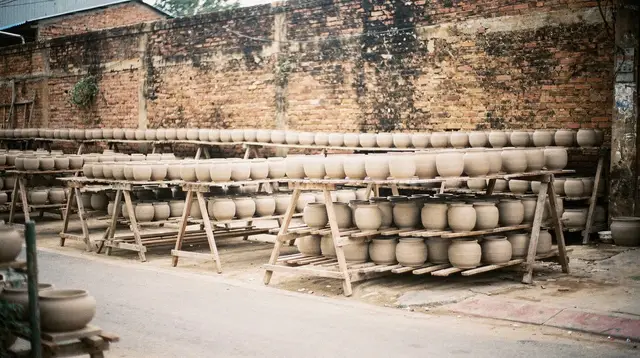
The oldest part of Bat Trang is a maze of narrow brick lanes, walled on both sides by workshop houses whose ground floors double as showrooms. Stacks of drying pots, trays of glazed tiles and half-finished vases spill out into doorways, and it is common to see potters’ wheels turning in full view of the street. Some households still fire with traditional coal-brick kilns, recognisable by their honeycomb-patterned chimneys, though many workshops have moved to gas or electric kilns for consistency. Either way, the smell of wet clay and the low hum of pottery wheels are the village’s real soundtrack.
Away from the lanes, a large covered ceramics market brings together stalls from dozens of workshops under one roof, arranged loosely by style — everyday tableware, decorative vases, tea sets, garden pottery and the blue-and-white ware that Bat Trang is particularly associated with. Wandering here is less about a single landmark and more about the accumulation of detail: a potter trimming a bowl on a foot-powered wheel, a courtyard stacked floor to ceiling with terracotta pots, a shopfront where the same family has sold the same glazes for decades.
Several workshops welcome visitors to sit at a wheel and shape a small piece themselves, glazed and fired later for collection or shipping. This hands-on element is one of the things that sets Bat Trang apart from most heritage sites around Hanoi, and it is a large part of why the village works well for families and for anyone who would rather make something than simply photograph it.
Beyond the ceramics themselves, Bat Trang keeps the layout and rhythms of an old riverside village: a communal house (dinh) honouring the settlement’s founders and guild patrons, small family shrines tucked between workshops, and a warren of alleys where daily life — laundry hung between houses, motorbikes threading past stacked pottery — continues alongside the trade that has defined the place for centuries.
Getting to Bat Trang
Bat Trang sits on the eastern side of the Red River, which puts it on a different axis from most of the countryside sites travellers pair with a Hanoi stay — it is closer to the city than the karst country around Ninh Binh or the bays further east, and closer still than the mountain routes north-west toward Sapa. Independent travellers generally reach the village by taxi, ride-hailing app or, for the more adventurous, motorbike across one of the river crossings; there is no need to cross into the Old Quarter’s densest lanes to start the trip, since the village lies on the opposite bank from central Hanoi.
For anyone without their own transport, or who would rather not navigate river crossings and village back lanes solo, a driver or a guided outing removes that friction entirely — worth weighing against the appeal of arriving under your own steam and wandering without a set itinerary. Our broader guide to getting around Hanoi covers the options in more detail for travellers weighing up taxis, ride-hailing and self-drive across the wider city and its fringes, and the private tour with driver guide is worth a look for anyone who wants door-to-door transport without joining a fixed-departure group.
For travellers who would rather have someone else handle the logistics of the river crossing and the village lanes, a Bat Trang-focused outing is also available as its own dedicated trip rather than bundled with other countryside stops.
a guided walk through Bat Trang’s workshops and ceramics marketWhat Bat Trang is not
Because “Bat Trang” appears on so many Hanoi countryside itineraries, it is worth being direct about what the village is not. It is not a nature reserve, and there are no trails, waterfalls or viewpoints here in the way there are at Mua Cave or Cuc Phuong. It is not a boat trip — nothing here resembles the river journeys at Trang An, Tam Coc or the Perfume Pagoda.
And it should not be confused with a bay: Bat Trang shares no geography at all with Halong Bay or Lan Ha Bay beyond both being reachable from the capital. The village’s appeal is craft, commerce and everyday village life, concentrated and easy to absorb in a single visit.
How Bat Trang fits into the Hanoi countryside
Bat Trang belongs to the loose ring of villages and rural sites that sit within reach of the capital, alongside the silk-weaving village of Van Phuc and the laterite houses of Duong Lam. These places are usually visited as a change of pace from central Hanoi’s temples and museums — a chance to see production rather than heritage architecture, and rural life rather than colonial or dynastic history. Compared with Duong Lam, whose interest lies in its preserved communal architecture and village gates, Bat Trang’s draw is industrial in the best sense: an entire community still making a living from a single craft, sold on-site rather than displayed as a museum piece.
Some visitors treat Bat Trang as a standalone half-day outing; others fold it into a broader loop through the countryside villages on the capital’s fringes, pairing pottery in the morning with silk weaving or another craft settlement later the same day. Either approach works, and neither requires more than comfortable shoes and a willingness to wander without a fixed route — the village rewards getting a little lost in its lanes as much as it rewards seeking out any one workshop.
Shopping in Bat Trang
Ceramics are, unsurprisingly, the main thing to buy. The range runs from small souvenir-sized bowls and teacups to large decorative vases and full dinner sets, and workshops are generally happy to arrange shipping for bulkier or fragile pieces bought on the spot, since carrying a full dinner service home in hand luggage is rarely practical.
Bargaining is customary in the open market stalls in a way it usually is not inside individual workshops, where prices tend to be fixed. Beyond pottery, some stalls sell related homeware — woven baskets, lacquerware and small decorative pieces — picked up by traders looking to round out a stall rather than produced in the village itself, so it is worth asking where a piece was actually made if that matters to you.
Making the most of a visit
The village rewards an unhurried pace more than a checklist. Rather than trying to see every workshop, most visitors do better picking one or two ceramic-making demonstrations to watch properly, trying a hands-on wheel session if one is on offer, and then giving the market itself real time — it is large enough that a quick pass barely scratches the surface. Comfortable, closed shoes help on the uneven brick lanes, and a tote bag or spare space in a daypack is useful for anything bought along the way.
Timing a visit around the market’s quieter stretches also helps: the covered ceramics hall can fill up around midday, and workshop demonstrations are generally easier to watch properly with a bit of breathing room rather than jostling for a view. None of this requires much planning — Bat Trang is forgiving of a loose schedule in a way that boat trips and cave visits, with their fixed departure times, are not.
Because Bat Trang sits within the wider ring of Hanoi’s countryside excursions, several tours bundle it with other nearby sights rather than treating it as a destination on its own. If you would rather explore the villages and rural landscapes around the capital with a guide handling the logistics, a countryside tour is often the simplest way to do it.
a guided day among the craft villages and river scenery on Hanoi’s rural fringeFor travellers who want a broader taste of the greenery west of Hanoi rather than village lanes specifically, a jeep excursion into the hills and farmland at Ba Vi offers a different kind of countryside outing.
an open-air jeep ride through the countryside and forest of Ba Vi National ParkAnd if a boat journey through limestone scenery appeals more than a craft village, the river route up to the Perfume Pagoda remains the classic alternative excursion on this side of the capital.
the rowing-boat journey and pilgrimage climb to the Perfume PagodaPlanning notes
Bat Trang works well alongside a broader look at Hanoi’s craft and market culture, and pairs naturally with a stop at the capital’s own Dong Xuan Market for travellers curious about how Bat Trang’s wares eventually reach the city’s shops and stalls. For a wider view of what else sits within reach of the capital, the day trips hub groups Bat Trang alongside Duong Lam, the Perfume Pagoda and the karst country further south, while the things to do in Hanoi hub covers the city sights that pair naturally with a countryside morning like this one.
Travellers building a first visit around the capital often use a short one-day highlights itinerary or a fuller two-day Old Quarter itinerary as a frame, adding a village outing like Bat Trang once the city’s core sights are covered.
If craft villages are the main draw for you, it is worth reading a dedicated guide to Bat Trang’s ceramic tradition and comparing it with the ancient village of Duong Lam and the silk and incense villages closer to the city, since each offers a distinct flavour of rural life around the capital.
A broader guide to visiting craft villages and workshops is useful if you are trying to decide how many of these outings to fit into a single trip, and general notes on etiquette and customs in Vietnam are worth a glance before stepping into any working household workshop.
Bat Trang Ceramic Village: frequently asked questions
Is Bat Trang a natural attraction like a bay or a cave?
No. Bat Trang is a craft village built around pottery production, with workshops, kilns and a dedicated ceramics market. It has no karst scenery, boat trip or cave system, unlike sites such as Halong Bay, Trang An or Mua Cave.
What is there to actually do in Bat Trang?
The main activities are walking the workshop lanes to watch potters at work, browsing or shopping in the covered ceramics market, and, in many workshops, sitting at a wheel to shape a piece yourself. It is a hands-on, browsing-led visit rather than a sightseeing checklist.
Is Bat Trang suitable for children?
Yes, generally. The hands-on pottery experiences, in particular, tend to appeal to children, and the flat, walkable village lanes are easy to manage with a family group, though the market itself can get crowded at busy times.
Can I ship ceramics home from Bat Trang?
Many workshops that sell larger or more fragile pieces are used to arranging shipping for travellers, since carrying bulky pottery in hand luggage is impractical. Arrangements and reliability vary by workshop, so it is worth asking directly at the point of purchase.
How does Bat Trang differ from Duong Lam?
Duong Lam is known for its preserved laterite houses, village gates and communal architecture — essentially a heritage village. Bat Trang is a working production village centred entirely on ceramics, with far less historic architecture and far more workshop and market activity.
Is bargaining expected in Bat Trang?
In the open-air ceramics market, bargaining is common practice, much as it is in other Vietnamese markets. Inside individual family workshops, prices are more often fixed, though this varies from one workshop to the next.
Can Bat Trang be combined with other countryside sights in one day?
Yes, it’s commonly paired with other villages or rural sights on Hanoi’s fringe as part of a broader countryside loop, rather than visited as a single isolated stop, though how much ground that covers depends on the specific itinerary chosen.
Does Bat Trang have its own temple or historic buildings?
Yes, the village has a communal house honouring its founding and guild patrons, along with smaller family shrines woven through the workshop lanes — modest compared with Duong Lam’s architecture, but part of the village’s everyday fabric rather than a curated sight.