A village built from stone, not a craft town or a shrine
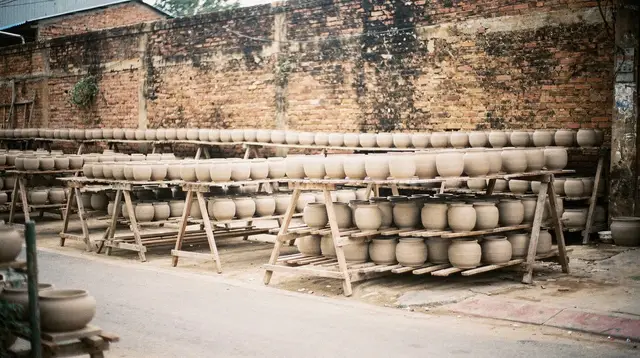
Duong Lam is easy to mix up with two other things it is not. It is not a pottery village — that is Bat Trang, on the opposite side of the city, where the draw is workshops and kiln-fired ceramics. And it is not a single religious site like a pagoda or temple complex, where the visit is built around one building and its shrine.
Duong Lam is a settlement: a loose cluster of hamlets where several hundred families still live in and around houses that, in some cases, are three centuries old. The reason it appears on itineraries at all is the density and condition of its domestic architecture, and the fact that daily rural life — chickens in the lane, rice drying on woven mats, incense burning at a family altar — carries on around the old walls rather than being staged for visitors.
The village sits in the Red River Delta countryside west of central Hanoi, in flat farmland threaded with irrigation channels, betel-nut palms and communal ponds. Nothing about the setting is dramatic in the way the karst country or the northern mountains are. The appeal is closer in, in the texture of a single wall or gateway, and in the pace of a place that has not been rebuilt.
Most visitors set out from a base in Hanoi itself, and Duong Lam is one of the standard answers to the broader question of what to do on a day trip from Hanoi: close enough for a half-day or full-day outing, and different enough in character from the city center to feel like a genuine change of pace. It is also a natural stop on a wider craft village and workshop day trip through the countryside west of the city, since several of the other villages in that band — pottery, silk, incense — sit within a similar radius.
The material that defines it: laterite
The single detail that separates Duong Lam from almost anywhere else near Hanoi is the building stone. Local builders quarried a reddish-brown, porous rock — laterite — cut it into rough blocks, and used it for house walls, boundary walls, wells and the bases of gates. Laterite darkens and pits with age in a way that fired brick does not, so the oldest walls in the village have a rough, almost sponge-like surface, deep ochre to near-black depending on the light and the season. Newer repairs, done in the same material, read paler and more even until they weather in turn. Walking the lanes, it is possible to read a wall’s age roughly by its color and texture alone, long before checking a date on a lintel.
Roofs are traditional terracotta tile, laid over timber frames, often with a low profile and deep eaves that shade the walls from the delta’s strong summer sun. Courtyards are enclosed rather than open to the lane — a house presents a blank or near-blank laterite face to the street, with the living space and its shrine facing inward onto a small private yard. That inward-facing plan, common across the rural delta, is part of why the village photographs so differently from the shophouse streets of central Hanoi: from outside, a lane can look almost fortified; step through a gate and it opens into a domestic world of tiled floors, wooden columns and family altars.
What a walk through the village actually takes in
There is no single monument to tick off. A visit is a walk — through a network of narrow lanes, some barely wide enough for two people, connecting several distinct hamlets that together make up what is loosely called Duong Lam. The oldest and best-preserved of these hamlets has a name of its own, and it is here that most of the village’s landmark houses and its principal communal house stand.
The communal house (dinh) is the closest thing the village has to a centerpiece: a large timber-framed hall on a raised stone platform, used historically for village meetings and communal ceremonies and still the setting for festivals and rites tied to the agricultural calendar. Its scale — broad tiled roof, thick lacquered columns, an open front — sets it apart from the domestic houses around it, and it is usually the easiest building in the village to find your bearings from.
Village gates mark the entrances to several of the hamlets: modest laterite arches, sometimes topped with a small tiled roof of their own, that once served as the formal, defensible boundary between the settlement and the surrounding fields. A handful of the oldest private houses, still occupied by descendants of the families who built them, are open for a look inside their courtyards; the families who keep them open generally welcome a modest gift or a small purchase of tea or local snacks in return for the visit, more a courtesy than a formal transaction.
Two other recurring features are worth watching for while walking: the large communal banyan trees that mark old gathering points near wells and ponds, their aerial roots grown thick over generations, and the village wells themselves, stone-rimmed and still occasionally in use. Together with the laterite walls, these are the elements that give the village its layered, unhurried look rather than any one standout building.
A birthplace claimed by two kings
Local tradition credits the area with producing two historical rulers: Phung Hung, an 8th-century leader remembered for resisting Chinese Tang-dynasty rule, and Ngo Quyen, who ended a millennium of Chinese domination with his 10th-century victory on the Bach Dang River and is regarded as one of the founding figures of independent Vietnam.
Shrines and family temples connected to both men stand in and around the village, and this dual claim — “the land of two kings” — is part of the local identity and of why the village carries some historical weight beyond its architecture. These are small, local shrines woven into the village fabric rather than a major pilgrimage site, and they reinforce the character of the place as a lived settlement with a long memory rather than a monument built for visitors.
Village life, not a performance
What distinguishes an ancient-village visit from most other stops near Hanoi is that nothing here has been relocated, reconstructed from scratch, or built to a visitor brief. The houses are inhabited; the lanes are used for daily errands, not just for walking tours; and the rhythms on view — someone sweeping a courtyard, drying rice or chili on a mat, tending an altar — are ordinary household activity rather than a demonstration staged for a tour group.
That also means visiting comes with the obligations of a guest in someone’s home neighborhood: keep voices down near open house doors, ask before photographing people or stepping into a private courtyard, and treat any house that welcomes a look inside as a favor rather than an entitlement. A small purchase — tea, rice wine, a local sweet made in the village — is the customary way to thank a family for opening their door.
The contrast with a workshop-based craft village is worth being explicit about, since the two are often paired on the same day trip and are easy to conflate afterward. At a craft village the point of the stop is watching or trying a hands-on process — throwing a pot, weaving silk — and buying what comes out of it. At Duong Lam there is no equivalent activity to take part in; the point is simply walking through and looking closely at a built environment that has not been altered for tourism. Visitors expecting a workshop, a demonstration or a fixed sequence of “sights” sometimes come away underwhelmed for exactly that reason — it rewards slow, attentive walking rather than a checklist.
Photography and the light
Because the appeal is textural — weathered stone, timber, tile, shadow — the time of day matters more here than at most stops in the region. Flat midday light washes out the color contrast between old and newer laterite and flattens the deep eaves and gateways that give the lanes their character. Early morning and late afternoon light rakes across the pitted stone surfaces and picks out the texture that is the whole point of visiting, and the lanes are also quieter and cooler to walk at those hours. Rainy weather, which slicks the laterite and tile a darker shade and pools in the courtyards, has its own appeal for anyone less concerned with bright conditions.
Seasonal character
The village does not have a single dramatic seasonal spectacle the way the rice-terrace regions to the north do, but the surrounding delta farmland changes noticeably through the year, and that backdrop is part of the experience of walking between hamlets. Green paddy in the growing months gives way to golden fields at harvest, and bare, water-filled paddy in between plantings; a walk through the village reads differently depending on what the fields around it are doing.
Cool, dry weather in autumn and spring is the most comfortable for an unhurried walk through the lanes; the delta’s hot, humid summer months make the shadeless stretches of the walk considerably more tiring, and the region’s rainy-season downpours can turn unpaved sections muddy.
Combining a visit with other stops
Because the village itself does not fill a full day on its own, it is almost always paired with something else in the same countryside pocket west of Hanoi — another old village, a craft village, or a half-day loop through the wider Son Tay and Ba Vi area. Several tour options bundle Duong Lam with these neighboring stops rather than treating it as a stand-alone destination, which suits the village’s scale: enough to fill a morning or an afternoon of walking, not a full day of activity in its own right.
a guided day trip from Hanoi that walks the old hamlets and includes a home-cooked lunch and a hands-on workshop session is the most direct way to see the village with some local context and without navigating the lanes unguided. For travelers who want to combine it with a well-known craft stop on the same day, a day tour pairing craft villages with a walk through Duong Lam covers both in a single outing.
Those with more time can look at a two-day countryside itinerary that includes Duong Lam alongside a nearby lake, while a broader look at delta village life is covered by a Red River Delta village tour that includes a farmhouse lunch and a bike ride. Travelers focused on the wider Son Tay and Ba Vi countryside rather than the village alone might instead consider a two-day tour taking in Ba Vi and the Son Tay villages.
Fitting Duong Lam into a longer trip
Travelers building a longer route through the north sometimes wonder where a village stop like this fits against the region’s bigger draws — the karst scenery around Ninh Binh, or the bays on the coast. It is not a substitute for either; it belongs earlier in a trip, close to Hanoi, as a contrast to city sightseeing rather than as a rival to a multi-day itinerary.
Readers mapping out a full plan around the capital can see how a stop like this sits alongside the bigger set pieces in guides such as three days in Hanoi and Ninh Binh or the longer four-day Hanoi, Ninh Binh and Halong Bay loop, neither of which requires visiting Duong Lam but both of which leave room for a countryside half-day like this one before heading further afield.
For the practical side of arranging a visit — whether to go independently or with a guide, and how a day built around the village typically runs — see the dedicated Duong Lam Ancient Village guide and the companion Duong Lam day trip guide. Anyone still deciding where to base themselves for countryside excursions like this one can check where to stay in Hanoi, and general notes on cash and small purchases — relevant given the customary gift or purchase when a family opens its courtyard — are covered in the guide to money and payments in dong.
Planning notes specific to the village
A visit rewards comfortable, closed shoes rather than sandals — the laterite lanes are uneven, and some house thresholds and courtyard steps are worn smooth. Modest dress is appropriate given that the walk passes through family homes and past shrines; nothing here requires the formality of a major pagoda, but this is a residential area rather than a tourist attraction built for foot traffic.
Because most of what is on view belongs to private families, this is one of the few stops in the region where slowing down, asking permission and accepting or politely declining an invitation into a courtyard matters more than covering ground quickly. For readers assembling a wider view of craft and heritage villages within reach of the city, Bat Trang and the broader cluster of silk and incense villages near Hanoi sit in the same general countryside band and are commonly compared against Duong Lam when deciding which village stop suits a given day.
Duong Lam Ancient Village: frequently asked questions
Is Duong Lam a pottery village like Bat Trang?
No. Duong Lam has no ceramics tradition and no pottery workshops. Its interest is architectural and residential — houses, gates and a communal house built from laterite stone — not craft production. Bat Trang is the region’s pottery village, and the two are separate destinations with different reasons to visit, even though they are sometimes combined on the same day trip.
Is Duong Lam a temple or pagoda complex?
No. It is a settlement of family homes, several hamlets in total, still inhabited today. It does contain small local shrines and family temples, including ones connected to two historical kings said to have been born in the area, but these are woven into the village rather than being the reason for a visit, unlike a dedicated pagoda site.
What makes the architecture here different from other old villages?
The defining material is laterite, a reddish-brown, porous local stone used for house walls, boundary walls and village gates. It weathers and darkens with age in a distinctive way, and the contrast between old, deeply pitted laterite and newer repairs is one of the more noticeable details for anyone walking the lanes closely.
Can visitors go inside the old houses?
Some of the oldest private houses, still lived in by descendants of the families who built them, welcome a look into their courtyards. This is a courtesy extended by the household, not a standard attraction with fixed access, and a small purchase of tea or a local snack is the usual way to thank the family.
How does a visit here differ from visiting Bat Trang on the same day?
Bat Trang is built around an activity — watching or trying pottery-making, then shopping for ceramics. Duong Lam has no equivalent workshop component; the visit is a walk through a preserved residential landscape. Several tours combine both stops in a single day precisely because they offer different kinds of experiences.
Is Duong Lam worth visiting if time near Hanoi is limited?
It suits travelers specifically drawn to vernacular architecture, quiet rural lanes and photography rather than a checklist of major sights. Visitors with only one countryside outing to spare and a preference for craft workshops or dramatic landscapes may get more from Bat Trang or the karst country around Ninh Binh instead.
What should visitors wear or bring?
Comfortable closed shoes for uneven stone lanes and worn thresholds, and modest clothing appropriate for walking past family shrines and homes. Little else is specific to the village beyond the usual countryside precautions of sun protection and water.
Does the village look different depending on the season?
The village’s architecture itself does not change with the seasons, but the surrounding delta farmland does — green, golden or bare paddy depending on the point in the growing cycle — and that backdrop shifts the character of a walk between hamlets. Cool, dry weather in autumn and spring generally makes for the most comfortable walking conditions.