Two Days in Hanoi: Old Quarter, Train Street and Bat Trang
Is two days enough to see Hanoi properly?
Two full days cover the Old Quarter, a passage by Train Street and a half-day out to the ceramic village of Bat Trang, with room left for the lake, a temple or two and an evening meal. It is a taste of the city rather than an exhaustive tour, and most visitors pair it with a trip further afield afterwards.
How These Two Days Fit Together
Hanoi rewards a slow pace more than a checklist, and two days is enough time to get a real feel for the capital without racing between sights. This itinerary keeps things simple: one day rooted in the Old Quarter, with a possible detour past Train Street, and one day that reaches slightly further out to the ceramic village of Bat Trang. It deliberately does not lock activities into a fixed morning-to-evening order — pick what suits your pace on the day, and lean on the dedicated Old Quarter guide and Bat Trang guide for the practical detail of opening access, workshops and shopping streets, which is their job, not this itinerary’s.
A quick currency note before you start: the Vietnamese dong (VND) is the only currency you’ll actually use day to day — for a bowl of noodles, a cyclo ride, a market stall or a bottle of water. US dollars are sometimes accepted at a hotel desk or a larger tour operator as a convenience, but that is the exception. Come with dong in your pocket, not dollars, and see the money and payments guide for more on cash versus cards in Hanoi.
Day 1: The Old Quarter and Hoan Kiem Lake
Give this day over to the historic core of the city. The Old Quarter — the “36 streets” — is where Hanoi’s trading guilds set up centuries ago, and it still works as a dense grid of narrow shopfronts, street food stalls and motorbike traffic. Walking is the way to see it; a map is almost beside the point once you’re in among the lanes.
Hoan Kiem Lake sits at the edge of the Old Quarter and makes a natural anchor for the day, with Ngoc Son Temple reachable across its red bridge. South of the lake, the French Quarter offers a different register entirely — wide boulevards, the Opera House and colonial-era villas — and is an easy add-on if you want a contrast to the Old Quarter’s density.
This is also the day to consider Train Street, where a working railway line runs between houses lined with cafés. It’s one of the more photographed corners of Hanoi, but access to the trackside cafés is periodically closed by the authorities, so treat it as something to check on the ground rather than plan around firmly. If it’s open, it’s a short, striking detour; if it’s not, the Old Quarter has plenty else to fill the gap.
For the evening, the Thang Long Water Puppet Theatre is a long-running Hanoi tradition worth working into either evening of the trip, and the water puppet show guide covers what the performance involves. Food is arguably the Old Quarter’s strongest draw after dark — the street food walking tour guide and the pho and bun cha tasting guide both cover how to approach eating your way through the neighbourhood, whether guided or on your own.
If you’d rather not plan the food side yourself, an evening scooter food tour is a popular way to cover several stops with someone who knows the stalls — see the evening scooter food tour guide for how that works.
A gentler alternative for Day 1
Travellers who prefer structure over wandering can swap some of the above for a guided half-day or full-day city tour, which typically threads together the lake, a temple and a stretch of the Old Quarter with a driver or guide handling the logistics. The private tour with driver guide is worth a look if you’d rather not navigate Hanoi traffic yourself on day one.
Day 2: Bat Trang and the Wider City
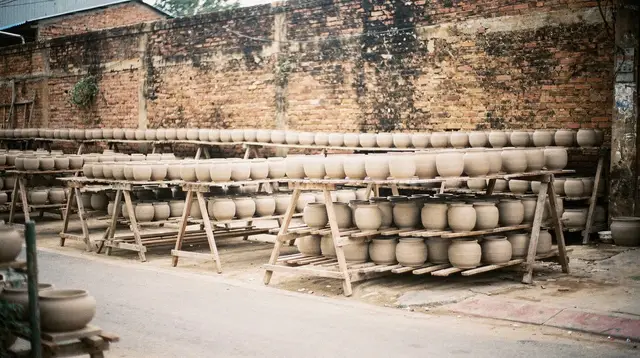
With the Old Quarter under your belt, the second day is a good moment to step just outside central Hanoi to Bat Trang, the ceramics village on the far bank of the Red River. This itinerary won’t walk you through which workshops to visit or which shopping streets to browse — that detail belongs to the Bat Trang ceramic village guide, which covers the village itself in depth. What matters here is that it’s a realistic half-day addition to a Hanoi stay, easily combined with time back in the city afterwards.
Getting to Bat Trang and back is straightforward with a ride-hailing app or taxi, and some travellers prefer to fold it into a wider half-day countryside outing rather than a standalone trip — the craft village and workshop day trip guide and the silk and incense villages near Hanoi guide cover nearby villages that sometimes get paired with it.
If you’d rather have transport and a broader countryside loop arranged for you, a jeep tour out toward Ba Vi National Park is one option for travellers who want a half-day out of the city with the driving handled. It sits outside the strict “two days in Hanoi” frame of this itinerary, but it’s a reasonable way to use spare time on day two if Bat Trang alone doesn’t fill it.
Back in the city for the remainder of Day 2, Ba Dinh district holds some of Hanoi’s most significant sights — the Temple of Literature, Vietnam’s first university, founded in 1070, and the area around the Ho Chi Minh Mausoleum, the One Pillar Pagoda and the Imperial Citadel of Thang Long. None of these need a full morning each, but picking one or two rounds out the day well if you have the energy left after Bat Trang.
What to Leave for Later
Two days is a city introduction, not a full trip. Once the Old Quarter and Bat Trang are done, most visitors move on to something further out — the karst scenery of Ninh Binh, a cruise through Halong Bay, or the mountains around Sapa.
If a boat trip is on your list, the full-day trip out to Halong Bay from Hanoi is one way to fit it in without an overnight commitment, while the two-day Halong Bay cruise with an overnight on board suits travellers with an extra day to spare. For a trip that combines craft villages with Ninh Binh’s rivers and caves in one outing, the day tour taking in incense and hat villages alongside Ninh Binh’s Trang An is worth comparing against doing Bat Trang and Ninh Binh as separate days.
For how these pieces fit into a longer stay, see the how many days in northern Vietnam guide and the day trips from Hanoi guide.
The Two Days at a Glance
| Focus | Pace | |
|---|---|---|
| Day 1 | Old Quarter, Hoan Kiem Lake, optional Train Street, evening food and water puppets | Mostly on foot |
| Day 2 | Bat Trang, plus a Ba Dinh sight or a countryside add-on | Mixed: transfer plus walking |
This split isn’t a fixed script — some travellers reverse it, or spread the Old Quarter across both mornings and keep Bat Trang to an afternoon. The point is to leave Hanoi having walked its oldest streets and reached at least one place just outside them, without trying to force a rigid hour-by-hour plan onto a city that rewards wandering.
FAQ: Two Days in Hanoi, the Old Quarter and Bat Trang
Is two days enough to see Hanoi properly?
Two full days cover the Old Quarter, a passage by Train Street and a half-day out to the ceramic village of Bat Trang, with room left for the lake, a temple or two and an evening meal. It is a taste of the city rather than an exhaustive tour, and most visitors pair it with a trip further afield afterwards.
Can I pay in US dollars in Hanoi?
No, not as a matter of course. The Vietnamese dong is the currency people actually use for taxis, street food, markets and small cafés, and that is what to carry. A handful of upmarket hotels or tour operators may quote a price in dollars for convenience, but that is the exception, not the rule, and it is never a reason to leave dong out of your wallet.
Do I need cash for two days in the Old Quarter?
Yes. Street food stalls, cyclo rides, small shops and most cafés in the Old Quarter expect dong in cash. Larger restaurants, hotels and tour desks usually take cards, but plan to carry enough dong for a normal day out.
Is Train Street open to visitors right now?
Access changes without much notice. The trackside cafés have been closed by the authorities more than once for safety reasons, and there is no guarantee they are open on the day you visit. Treat a look at the working railway line as a possibility to check locally, not as a fixed stop.
Should I visit Bat Trang on a guided tour or by myself?
Both work. Bat Trang is a straightforward outing from central Hanoi, and travellers who prefer not to plan transport themselves can join a countryside or river tour that takes in villages around the city. The workshops and shopping streets of the village itself are covered in the dedicated Bat Trang guide.
Can I fit Halong Bay into these same two days?
Not comfortably. Halong Bay is a separate trip east of Hanoi, usually done as its own day trip or overnight cruise once the city days are done. Treat the two Hanoi days and a bay excursion as separate legs of a longer stay rather than trying to merge them.
What’s the best way to get around between the Old Quarter and Bat Trang?
Most visitors use a ride-hailing app, a taxi, or a half-day tour that handles transport for them. The Old Quarter itself is compact and best covered on foot once you’re there.
tours.2 days
Verified deep-linked GetYourGuide tours. Book through these links and we earn a small commission at no cost to you.
GetYourGuide does not provide a product photo for this activity — the image shows the meeting point, photographed by us.