Old Quarter Street Food Walking Tour: A Guide to Choosing One
What is an Old Quarter street food walking tour in Hanoi?
It is a guided walk through Hanoi's Old Quarter that stops at a handful of small, established eateries and street vendors chosen by the guide, tasting dishes along the way rather than sitting down for one full meal. It differs from wandering alone in the ordering, translation, and context a guide provides, and from other formats such as evening scooter tours or single-dish tastings, which cover different ground.
Why the Old Quarter is Hanoi’s street food centre
Hanoi’s food culture is not confined to any one neighbourhood, but the Old Quarter is where it concentrates most densely. This is the historic core of the city, a tight grid of streets — the “36 streets” — that grew up around specialised guilds, each one originally trading a single craft or good. That guild history is still faintly visible in some street names, and the same density that once suited silk merchants and silversmiths now suits food vendors: short blocks, heavy foot traffic, and generations of families running the same stall or shopfront.
It is worth being precise about scale here, because it is a common point of confusion: the Old Quarter is a neighbourhood inside Hoan Kiem district, not the whole of Hanoi. The capital sprawls well beyond it, from the lakeside calm of Tay Ho to the government quarter around Ba Dinh. A street food walking tour based in the Old Quarter is, by design, a tour of one small, walkable slice of the city — an efficient one, but not a survey of Hanoi’s food scene as a whole.
The other confusion worth clearing up is about the word “street” itself. Street food in Hanoi describes a format — cooking done at a stall, cart, or small open-fronted shop, often with plastic stools set out on the pavement — not a judgement on cleanliness. Some of the most respected kitchens in the city operate exactly this way, sometimes for decades, building a loyal local following long before any guidebook mentions them. A tour is not a way of avoiding “risky” food; it is a way of finding the good version of food that is, by its nature, informal.
What a guided walking tour actually looks like
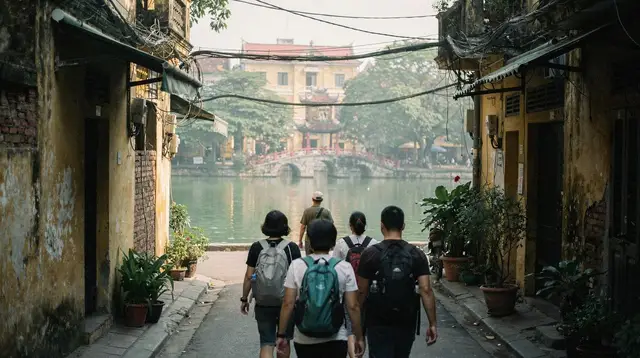
Most Old Quarter street food walks share a basic shape, even though details vary widely by operator. A guide, usually a Hanoi local, leads a small group — or a single traveller or family, on private formats — on foot through a set route, stopping at a sequence of vendors along the way. At each stop, the group tastes a dish or a small portion of one rather than sitting down to a full plate, which is what allows a single outing to cover several different foods without anyone leaving stuffed after the first stop.
The guide’s role goes beyond simply pointing at a stall. In practice it usually includes:
- Ordering and translation. Menus at small stalls are often handwritten, Vietnamese-only, or nonexistent — the vendor just knows what they serve. A guide removes the friction of figuring out what to ask for.
- Context on the dish. Why a particular broth takes hours to prepare, why a certain herb accompanies a certain noodle, or how a dish differs between the north and the south of the country.
- Local etiquette. How dishes are traditionally eaten, whether hands or chopsticks are expected, and small customs around a plastic-stool meal that are easy to miss without guidance.
- Route logic. Sequencing stops so the flavours and textures vary — something savoury followed by something sweet, a noodle dish followed by something grilled — rather than repeating.
This is the core distinction between a guided tour and simply wandering the Old Quarter on your own with a food blog open on your phone. Independent exploration can turn up excellent finds, and plenty of visitors do it happily. What it lacks is the local knowledge that gets a guide into the smaller, unmarked places that do not show up in searches, and the ordering confidence that comes from someone who has eaten there a hundred times before.
The many formats on offer, and how they differ
Search for a street food tour in Hanoi and the number of options can be overwhelming — dozens of listings, often with overlapping names, that are not all offering the same experience. Rather than treating them as interchangeable, it helps to sort them by a few axes.
Daytime walking tour vs. evening tour. A daytime walk through the Old Quarter moves through the neighbourhood while its markets and shopfronts are in full swing. An evening scooter-based food tour covers more ground by motorbike after dark, when the Old Quarter’s food stalls take on a different character under string lights and neon signage. These are genuinely different experiences, not the same tour at a different hour — walking suits close-up exploration of one area, while a scooter format ranges further afield in the same evening.
Broad tasting vs. single-theme focus. Some walks are built as a general introduction, sampling a handful of different dishes and drinks across the outing. Others narrow in on one theme entirely — a walk built around pho and bun cha specifically, one centred on Vietnamese coffee culture, or one focused on bia hoi, the fresh draught beer sold by the glass on Old Quarter corners. Knowing which kind you are booking matters if you have a specific dish in mind.
Private vs. group. As with most tours in Hanoi, both formats exist side by side, and the choice between them comes down to budget, flexibility, and whether you want an itinerary tailored to your pace and preferences or a more affordable, sociable outing with other travellers.
Dietary focus. A general tasting tour may or may not suit vegetarians well, given how central certain broths and proteins are to northern Vietnamese cooking. Operators who run dedicated vegetarian or vegan food tours build their route around dishes that work without adjustment, rather than substituting on the fly.
This page intentionally does not list prices, exact durations, or a fixed number of stops for any given tour, because these details vary by operator and change over time. Always check the specific listing for what is actually included before booking.
Getting oriented before you go
A little orientation makes the walk itself more legible, whichever tour you choose. The Old Quarter’s streets are historically arranged by trade, and food vendors tend to cluster in particular pockets rather than spread evenly — some streets lean toward grilled and barbecue dishes, others toward noodle soups, others toward sweets and drinks. A guide will already know this geography, but it helps to understand that a tour’s route is not arbitrary; it is threading together a handful of specialisms scattered across a small area.
It is also useful to arrive with a rough sense of the neighbourhood’s edges. To the south, the Old Quarter gives onto Hoan Kiem Lake and the calmer, colonial-era streets of the French Quarter — a useful landmark if your tour starts or ends near the water. Dong Xuan Market, the Old Quarter’s largest covered market, is a common reference point on many routes, both for its own food stalls and as a place to see the wholesale trade that feeds the neighbourhood’s restaurants.
One specific spot worth flagging in advance: Train Street, where a working railway line runs directly between houses, sits at the edge of the Old Quarter and draws enormous attention online. Access to the trackside cafés has been restricted at various points by the authorities, and it is not something to build a tour itinerary around expecting guaranteed access — treat any mention of it on a walking route as a possible detour, not a fixed stop.
Practical notes for the walk itself
Comfortable, closed shoes suit the Old Quarter better than sandals; pavements double as parking for motorbikes and can be uneven. Expect to be seated on low plastic stools at several stops — part of the genuine street food experience, not a sign of a corner-cut tour. Crossing the road in the Old Quarter is done at a steady, predictable walking pace rather than by waiting for a gap in traffic that may never fully arrive; a guide leading a group will typically manage crossings for you, which is one of the underrated conveniences of going guided rather than solo.
Cash still matters here. Even where a tour is fully prepaid, having a modest amount of Vietnamese dong on hand is useful for drinks, a second helping, or a small souvenir along the route, since many stalls do not take cards. Tap water is not drinkable in Vietnam, so most tours provide or point out bottled water; ice at established stalls used on organised tours is generally the industrially made kind and considered safe.
If mobility is a concern, note that Old Quarter walking tours involve a genuine amount of walking and standing on narrow, sometimes crowded pavements, and low-stool seating is common rather than table-and-chair dining throughout. It is worth asking an operator directly about the route’s demands if this is a concern, or looking at options built around accessibility in northern Vietnam more broadly.
Combining a food walk with the rest of the Old Quarter
Because the Old Quarter is compact, a food walk often sits naturally alongside other short activities in the same neighbourhood, either before or after. A short visit to Hoan Kiem Lake and Ngoc Son Temple pairs easily with an evening tour that starts or ends nearby, and travellers building a fuller day around the area sometimes combine a food walk with a look at the markets and shops that give the neighbourhood its daytime energy. For those who prefer to see the Old Quarter by cyclo rather than on foot, a cyclo tour around Hoan Kiem is a different but complementary way to take in the same streets.
Travellers with only a short window in Hanoi — a layover, or the first evening of a longer trip — often use a food walk as their introduction to the city precisely because it doubles as orientation: by the end of the walk, the Old Quarter’s grid starts to feel navigable rather than bewildering, which pays off on every subsequent visit to the neighbourhood.
Choosing between the specific tours
With the general shape of a street food walking tour established, choosing between specific listings comes down to a few practical questions: daytime or evening, broad tasting or single theme, private or group, and whether dietary needs are a factor. A handful of well-reviewed Old Quarter street food walks are bookable directly.
For a broad first introduction to the neighbourhood’s food, a guided walk through the Old Quarter with a local guide covers the essentials of the format described above — ordering handled, stops sequenced, context given at each one.
Travellers who want a tour built around a curated, higher-end selection of stops can look at a walking tour following Michelin Guide recommendations around the Old Quarter, which applies an external quality benchmark to the stop selection.
For a version of the walk that includes drinks alongside the tastings, an Old Quarter street food walking tour paired with drinks stops folds a bia hoi or coffee stop into the same outing rather than treating food and drink separately.
And for those keen to see the Train Street area alongside the Old Quarter’s quieter corners, a walking tour combining Old Quarter back streets with the Train Street area extends the format beyond food alone into a broader neighbourhood walk.
Where to go next
This page has focused on the shape of the Old Quarter street food walking tour as a category — what it is, how it differs from wandering alone, and how the various formats on offer differ from one another. For the dishes themselves, the pho and bun cha guide and the Vietnamese coffee and egg coffee guide go into more depth than a single walking tour can.
For a different way of covering the same ground after dark, the evening scooter food tour guide explains how that format differs from walking. And if the Old Quarter is your first stop in Hanoi, the Old Quarter neighbourhood guide and the wider things to do in Hanoi hub are useful starting points for planning the rest of a visit.
Frequently asked questions about Old Quarter street food tours
Is the Old Quarter the same thing as Hanoi?
No. The Old Quarter, often called the “36 streets”, is one historic neighbourhood inside Hoan Kiem district, at the centre of a much larger capital. It is dense, walkable, and food-rich, which is why most walking tours are based there, but it is a small fraction of the city.
Does “street food” mean the hygiene standards are lower?
Not inherently. Street food refers to where and how a dish is cooked and served, often at a stall, cart, or small shopfront, not to how clean it is. The vendors used on organised tours are typically ones the guide or operator has vetted and returns to repeatedly, which is itself a form of quality control.
How is a guided walking tour different from just wandering the Old Quarter and eating what looks good?
A guide handles ordering and any language barrier, explains what a dish is and how it is traditionally eaten, and sequences the stops so flavours and textures vary rather than repeat. Wandering alone can turn up excellent food too, but without local knowledge it is easy to miss the smaller, unmarked places or to end up only at spots aimed at tourists.
Should I book a private tour or join a group?
Both formats exist for Old Quarter food walks. A private tour moves at your pace and can adjust to dietary needs more easily; a group tour is usually more affordable per person and can be a sociable way to meet other travellers. The right choice depends on budget, flexibility, and how much you want the itinerary tailored to you.
Are there vegetarian options on these tours?
Northern Vietnamese cuisine has a strong tradition of meat-free dishes, and some tours are built specifically around them, while others can adapt stops on request. It is worth confirming dietary needs with the operator before booking rather than assuming a standard tour will accommodate them.
Do these tours cover pho, bun cha, and egg coffee in one outing?
Formats vary by operator, and this page does not fix a set list of dishes or stops for any specific tour. Some walks are broad tastings that might include several iconic dishes, others focus narrowly on one theme, such as coffee or a single dish. Check the specific tour’s description for what it actually includes.
Is the Old Quarter safe to walk around in the evening?
The Old Quarter is heavily trafficked by visitors and locals alike well into the evening, and violent crime is rare. The more common issues are overcharging and the general chaos of motorbike traffic, both of which a guided tour helps manage simply by having someone who knows the area leading the way.
Do I need to book in advance?
Popular food walks, especially smaller-group or private formats, can fill up during peak travel seasons and around public holidays. Booking a few days ahead is a reasonable habit, particularly if travelling around Tet, when many family-run eateries close for several days.
Street Food Tours and Vietnamese Cuisine Tastings
Verified deep-linked GetYourGuide tours. Book through these links and we earn a small commission at no cost to you.
GetYourGuide does not provide a product photo for this activity — the image shows the meeting point, photographed by us.