Accessible Activities in Northern Vietnam: What Actually Works
Which activities in northern Vietnam work well for travellers with reduced mobility?
Motorised boat cruises on Halong Bay, Lan Ha Bay or Bai Tu Long Bay, vehicle-accessible temples and museums in Hanoi, and cable car ascents such as Fansipan tend to work well. Rowed sampan trips through low cave entrances, multi-day treks and steep pagoda stairways are structurally difficult regardless of how the tour is marketed.
Which activity types actually work
A companion page on this site, getting around northern Vietnam with a mobility difficulty, covers the physical obstacles you’ll meet — kerbs, stairs, uneven pavements, the lack of ramps. This page starts from the other direction: instead of listing obstacles, it groups the region’s most-booked activities by whether the activity type itself is structurally workable, and leaves accommodation entirely to other pages, since a hotel’s own accessibility has nothing to do with what happens once you’re out on a tour.
The short version is that vehicle-based sightseeing and motorised boats tend to hold up well, while anything built around a rowed sampan, a cave crawl or a multi-day trek does not change character no matter which operator runs it.
Boats: motorised cruise versus rowed sampan
This is the single biggest distinction in the region, and it’s easy to miss because both get called “boat trips.”
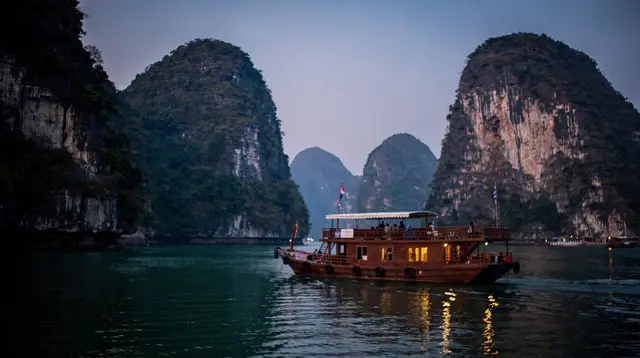
A motorised cruise — on Halong Bay, Lan Ha Bay or Bai Tu Long Bay — puts you on a boat with a deck, a saloon and a cabin, and most of the day is spent seated or standing on a stable, flat surface. The Halong Bay cruise guide and the day cruise versus overnight cruise comparison are useful background before booking.
The one genuine difficulty is the transfer between the pier and the boat: it’s usually a tender boat and a gangway, the arrangement differs by port and by vessel, and a larger cruise ship with a fixed dock berth is generally easier than a smaller boat that anchors offshore. Whether departing from Hanoi or from Cat Ba changes the transfer logistics too — see cruise departure from Hanoi versus Cat Ba.
Rowed sampans are a different activity entirely. At Trang An and Tam Coc, a local boatman rows or paddles a narrow wooden boat close to the waterline, and at Trang An several of the route’s cave passages have a roof low enough that everyone leans back or ducks.
There’s no motorised alternative on these specific routes, and no version of the trip that removes the low seat or the cave crossings — see the Trang An boat guide and the Tam Coc boat guide for what the seating and cave sections actually involve. If getting into a low, narrow boat is difficult, this is a category to plan around rather than one where a particular operator will solve it for you.
The Perfume Pagoda trip also uses a rowed boat up the Yen stream before a walk or cable car to the cave temple, so it sits in the same category as Trang An rather than with the bay cruises.
Vehicle-accessible temples, pagodas and museums
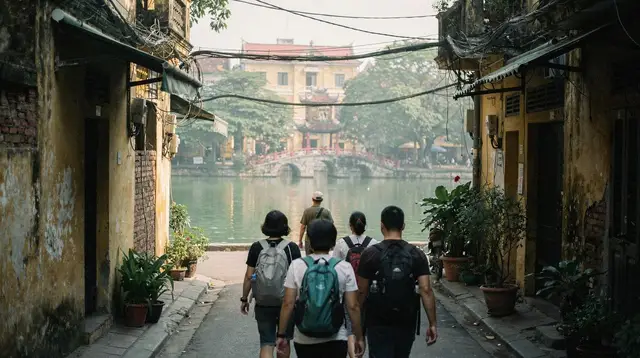
Hanoi’s main heritage sites cluster in Ba Dinh and around Hoan Kiem, and most of them can be reached by car right up to or very near the entrance, which removes a lot of the walking that a self-guided day would otherwise involve.
The Ho Chi Minh Mausoleum complex, the One Pillar Pagoda and the grounds around them sit on flat, paved land — see the Ho Chi Minh Mausoleum and Ba Dinh district guide. The Temple of Literature is similarly flat courtyard-to-courtyard, though individual gateways have raised wooden thresholds that are easy to step over but not ideal for a wheelchair without assistance. The Thang Long Imperial Citadel is more mixed, with excavated areas and some uneven ground between buildings.
Hanoi’s museums — covered together in the Hanoi museums guide — are generally the easiest single stop of a day, since they’re indoor, flat and built for foot traffic rather than the outdoor terrain of a temple complex. The old quarter itself is the opposite case: narrow pavements crowded with parked motorbikes, kerbs of inconsistent height on almost every street, and pavements that regularly disappear altogether.
A slow half-day around Hoan Kiem Lake on the wider lakeside path is more manageable than the old quarter’s interior streets. Practical notes on taxis, ride-hailing and the metro are in the getting around Hanoi guide.
Cable cars, viewpoints and the mountains
The northern mountains are where trekking dominates the region’s marketing, but a few specific sights swap the trail for a vehicle or a cable car.
The Fansipan cable car reaches the upper station of Vietnam’s highest peak without any hiking at all, which makes it the clearest example on this page of an activity that keeps the view while removing the physical demand — full detail is in the Fansipan hike versus cable car comparison. The last stretch from the upper station to the summit marker still involves a set of steps, so treat the cable car as removing the mountain, not the entire walk.
Elsewhere in Sapa and Ha Giang, the appeal is largely the trekking itself — through the Muong Hoa valley or along the Dong Van plateau — and there’s no vehicle shortcut that preserves the experience, since the terraces and villages are only reached on foot or by motorbike over unpaved sections. Mua Cave’s viewpoint is a further example on the difficult side: the climb is several hundred steps up a steep hillside with no vehicle or cable car option, described in the Mua Cave climb guide.
Food, culture and city-based experiences
Away from the big landscape sights, a number of northern Vietnam’s most popular activities are seated, indoor or short-distance, which makes them easier to slot into a day that also includes something more demanding.
Cooking classes are a good example — most run in a fixed kitchen space with seated demonstration and prep stations, such as a Sapa cooking class built around pho or a Sapa home-style cooking class, both of which stay in one location rather than moving through a market or a set of streets. The water puppet show is theatre seating, fixed and level. By contrast, street-food walking tours and market visits are built around standing and moving between stalls, which is closer in character to the old quarter’s uneven pavements than to a seated cooking class.
A private multi-day itinerary through the villages and countryside north of Hanoi, such as a private 3-day tour of northern Vietnam’s villages, keeps most transitions inside a car rather than on foot, which suits a difficult-walking day better than a group itinerary built around fixed stops and a shared bus schedule.
Gentler alternatives when the classic route is too demanding
Not every part of the northern mountains is built around a multi-day trek. Mai Chau and Pu Luong sit closer to Hanoi than Sapa or Ha Giang and are generally gentler landscapes: valley floors and lower terraces rather than the steep switchbacks around the Muong Hoa valley, with village roads that a car or a slow motorbike can cover without committing to a full trekking itinerary. Moc Chau’s tea hills are similar in character — rolling rather than sheer, and reachable by road. None of these remove uneven ground entirely, but they trade the steepest sections of Sapa or the Ha Giang loop for something closer to a scenic drive with short stops.
The same logic applies south of Hanoi. Ninh Binh’s Bai Dinh Pagoda is one of the largest pagoda complexes in the country, and while it spans a large hillside site, the main approach road and lower courtyards are built for vehicle and cart access rather than a single unassisted climb, which sets it apart from a site like Mua Cave. Hoa Lu, the ancient capital near Trang An, is a flatter, more contained site than the boat routes nearby, with its temples reachable on foot from a car park rather than by sampan.
North of Hanoi, Ba Vi National Park and sites tied to the Hung Kings — reachable on a guided day such as the Ba Vi Temple of the Hung Kings and Au Co Temple tour — combine vehicle access with shorter, optional walks, which again suits a day where the itinerary needs to flex around what a particular member of the group can manage.
For anyone building a longer trip who wants variety without depending on multi-day trekking, an itinerary such as the 7-day, 6-night northern Vietnam itinerary or the 12-day northern Vietnam trip by train can be discussed with the operator in advance so that the harder legs — a steep pagoda stair, a longer trek — are marked as optional rather than fixed.
A slower, food- and craft-focused day is another way to fill a demanding trip with something lower-effort: a seated coffee workshop in Hanoi covering six brews asks nothing of the legs and works well the day after a harder outing such as a cave visit or a long transfer.
Family-friendly is not the same claim as accessible
It’s worth stating plainly, because tour listings often blur the two: an activity described as “family-friendly” is being judged on whether children enjoy it and whether it’s safe for them, not on whether an adult with a wheelchair, a walking frame or a significant mobility limitation can manage it. A boat trip through Trang An’s low cave passages is genuinely a family favourite and, at the same time, one of the harder activities on this page for reduced mobility, because the low seat and the ducking under rock are unrelated to whether it suits an eight-year-old.
The reverse also holds: a flat, paved museum visit can be accessible and still fairly unremarkable for children looking for an active day out. Treat the two labels as separate questions, and check the activity type — cable car, motorised boat, rowed sampan, flat museum, steep pagoda — rather than the marketing description.
Planning a day around what’s vehicle-accessible
The activities above sort fairly cleanly once you group them by transport type rather than by destination name:
| Activity type | Typical accessibility pattern |
|---|---|
| Motorised bay cruise (Halong, Lan Ha, Bai Tu Long) | Stable on board; pier-to-boat transfer is the main variable |
| Rowed sampan (Trang An, Tam Coc, Perfume Pagoda) | Low seating and, at Trang An, low cave roofs; no motorised alternative |
| Vehicle-accessible heritage site (Mausoleum complex, Temple of Literature) | Flat paved ground with occasional raised thresholds |
| Museums (Hanoi museums, Ethnology, Fine Arts) | Indoor, flat, generally the easiest single stop |
| Cable car ascent (Fansipan) | Removes the trek; the final approach still has steps |
| Multi-day trekking (Sapa valleys, Ha Giang loop, Mu Cang Chai) | No vehicle shortcut preserves the experience |
| Steep unassisted climbs (Mua Cave) | Several hundred steps, no alternative route |
A private tour with a driver generally makes more sense than a scheduled group tour once you’re working around this kind of unevenness, since the car can wait at a spot that turns out to be too difficult and the rest of the day can be reshuffled on the spot. Longer, multi-region trips such as an 4-day private itinerary through Vietnam’s northern hidden gems follow the same logic across several days rather than one, which is usually more forgiving than a fixed group schedule when a single site or activity needs to be dropped.
None of this replaces a direct conversation with a tour operator about a specific boat, vehicle or site on the day you plan to visit — conditions, tide, and the exact vessel assigned all vary. What this page offers instead is the category-level pattern: which kinds of activity are structurally workable, and which ones stay difficult regardless of how they’re advertised.
FAQ: accessibility by activity type in northern Vietnam
Is Halong Bay accessible for someone who can’t walk long distances?
The cruise itself is largely fine, since most time is spent on a boat deck or cabin. The difficulty is usually the tender transfer and gangway between the pier and the boat, which varies by port and vessel and isn’t something a general guide can promise in advance.
Can Trang An or Tam Coc be visited without rowing or stepping into a small boat?
No. Both are sampan trips rowed by a local boatman, with a low seat close to the waterline and, at Trang An, cave passages with a low roof. There is no motorised or wheelchair-accessible alternative on these specific routes.
Is the Temple of Literature or the Ho Chi Minh Mausoleum complex manageable with a walking difficulty?
Both sit on flat, paved ground reachable by car, which makes them easier than most heritage sites in the region. Individual buildings still have raised thresholds and some courtyards are gravel or uneven stone, so it helps to see the site as a series of short, flat walks rather than one continuous path.
Does the Fansipan cable car remove the need to trek?
Yes, the cable car reaches the upper station without any hiking, which is the main reason it’s recommended over the trekking route for anyone who can’t manage a multi-hour mountain trail. The final approach to the summit marker itself still involves steps.
Are craft villages like Bat Trang or Duong Lam accessible by vehicle?
Bat Trang’s main pottery market area is reachable by car or minibus and is relatively flat and paved. Duong Lam’s older laterite lanes are narrower, uneven and only partly vehicle-accessible, so it suits a shorter, slower visit rather than an extended walking tour.
Is a family-friendly tour automatically suitable for a wheelchair user or someone with limited mobility?
No, and this is a common mix-up. A tour can be marketed as family-friendly because children enjoy it, while still involving boat transfers, cave crawls or uneven ground that have nothing to do with how easy it is for an adult with a mobility difficulty.
What kind of tour format tends to work best for reduced mobility?
A private car-based itinerary that lets the pace and stops be adjusted on the spot generally works better than a fixed-schedule group tour, since it allows a difficult site to be shortened or skipped without affecting anyone else.
Accessibility Guide
Verified deep-linked GetYourGuide tours. Book through these links and we earn a small commission at no cost to you.
GetYourGuide does not provide a product photo for this activity — the image shows the meeting point, photographed by us.