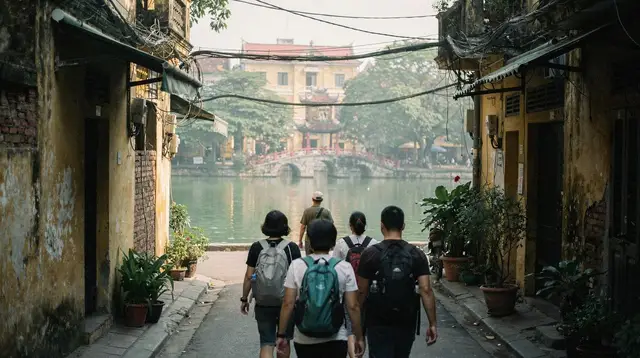
Northern Vietnam with Kids: How to Plan a Family Itinerary
Is northern Vietnam suitable for a family trip with young children?
Yes, but the itinerary has to be built around children's limits rather than an adult pace. The main constraints are long overland or overnight transfers, uneven mountain trails, and a rainy, typhoon-prone summer that is best avoided rather than sought out.
Building an itinerary around your children, not the map
Northern Vietnam looks compact on paper: Hanoi in the middle, Ninh Binh a short hop south, the bays to the east, the mountains to the north-west. On the ground it is a region of long transfers — buses, sleeper trains, boats and mountain roads — connecting places that each reward a slow, unhurried visit. For a family, the question is not which destinations to see, since how many days you need in the north already sets a realistic scope, but how to sequence them so that no single day asks more of a child than they can give.
This guide does not walk through what to do in Hanoi, Ninh Binh or Ha Long Bay — the things to do in Hanoi pages and each destination’s own guide cover that in detail, and the bay cruises specifically have a dedicated family guide to Ha Long Bay. What follows instead is the layer above that: which constraints actually shape a family trip through the north, and how to plan around them so the destinations you do choose go smoothly.
The transfer problem
Almost every itinerary in the north involves a transfer of some kind between Hanoi and wherever you are headed next, and those transfers are the single biggest variable in how a family trip feels. A night train to Lao Cai for Sapa can be an adventure for children old enough to enjoy a berth and a rocking carriage, and a genuine ordeal for a toddler who needs a normal bedtime routine. A limousine minibus to Ninh Binh or the coast is more predictable and lets you stop, but it is still hours of a child strapped into a seat on a winding road.
There is no universally right answer here — it depends entirely on the age and temperament of your children — but there is a wrong approach: booking transfers the way an adult itinerary would, back to back, with an activity planned immediately on arrival. Build in a buffer. A family arriving late from a night train needs a slow morning, not a full day of sightseeing. A family arriving by road after several hours needs the same. The pace and transfer times that a multi-day tour advertises are usually calculated for adults; treat them as a minimum, not a target, when children are involved.
Comparing the main transfer options helps set expectations before you book anything:
| Transfer type | Works well for | Harder for |
|---|---|---|
| Overnight train (Hanoi–Lao Cai) | Older children who sleep in a moving berth, families who want to save a daytime hour | Toddlers, light sleepers, anyone needing a strict bedtime routine |
| Daytime road transfer / limousine bus | Younger children, families who want windows and rest stops | Anyone prone to motion sickness on winding mountain roads |
| Short internal flights (where relevant) | Long north–south distances outside this region | Rarely relevant within the northern loop itself |
| Boat transfer (bay cruise embarkation) | Most ages, generally calm and scenic | Choppier days, and any itinerary depending on good weather (see below) |
Why summer is not the season to aim for
It is tempting to plan a family trip around the school summer holidays, but in northern Vietnam summer is the region working against you rather than for you. This is a genuinely rainy season, with heavy downpours and a real typhoon risk that can disrupt road transfers and, further east, suspend bay cruises altogether — see the rainy season in northern Vietnam and the specific typhoon and cruise cancellation guidance before locking in summer dates.
None of this is a minor inconvenience for a family: a cancelled cruise night or a flooded mountain road with children in tow is a much bigger problem than it would be for a solo traveller who can simply rebook.
If your travel dates are flexible at all, this is the single highest-leverage decision you can make for a family trip to the north. Outside summer, transfers are more predictable, trekking trails are drier and safer, and the bays run their normal cruise schedules. The trade-off is that some of the best conditions — clear autumn skies, for instance — also happen to be the busiest weeks, so book accommodation and multi-day tours well ahead if you are travelling then.
Winter brings its own consideration for families heading to the mountains: it turns genuinely cool and grey in the lowlands, and markedly colder in places like Sapa and the far north, with warm layers a real requirement rather than an afterthought — see mountain climate in Sapa and Ha Giang for what to expect and pack for. None of that argues against a winter trip with children; it argues for packing properly and not assuming a tropical climate, which this part of Vietnam simply is not.
Choosing how much mountain to attempt
The mountains are where family itineraries most often overreach. An adult itinerary treats Sapa or the Ha Giang loop as trekking or motorbiking destinations first; a family itinerary has to ask what a specific child can actually manage on a given day. Not all mountain destinations ask the same of you.
Mai Chau and Pu Luong sit closer to Hanoi, on gentler terrain, with homestays that suit a family base far better than a moving multi-day loop — a comparison worth reading is Mai Chau versus Pu Luong if you are choosing between the two. Sapa and Ha Giang are further, higher and more demanding, and the loop through Ha Giang in particular is built around motorbike or long car travel on mountain roads that suits older children and teenagers far better than younger ones — see Sapa versus Ha Giang for how the two compare as family options.
Whatever you choose, check the trail rather than assuming: not every walk billed as a trek is the same length or steepness, and the trekking difficulty levels guide is worth reading before booking anything with young children in the group. A short, flat valley walk from a homestay is a completely different proposition from a full-day ridge trek, even though both might appear on the same tour operator’s list under “trekking.”
Ninh Binh as a gentler alternative
For families who want the visual drama of karst landscapes without the demands of a mountain trip, Ninh Binh is usually the easier choice, close enough to Hanoi to visit without an overnight transfer and largely explored by boat rather than on foot — a real advantage with tired legs in the group. It is a natural comparison point against the bays further east, and Ninh Binh versus Ha Long Bay is worth reading if you are trying to decide which to prioritise with limited time, since attempting both on a tight schedule is exactly the kind of overreach that wears a family itinerary thin.
A realistic scope, not an ambitious loop
The single most common mistake in family planning for this region is attempting the same scope as a solo or couple’s itinerary — Hanoi, Ninh Binh, a bay cruise and a mountain stop, all inside one or two weeks. That works for an adult traveller who can absorb a rough transfer day and recover by the next morning. It rarely works as well for children, who tend to need more recovery time after a long day than the itinerary allows for.
A more realistic approach is to pick two or three areas rather than four, and to accept that this means leaving some well-known names for a future trip. A base in Hanoi with day trips to Ninh Binh, plus one further stop — either a bay cruise or a gentler mountain base like Mai Chau or Pu Luong — covers a genuine range of landscapes without stacking transfer days back to back. Families with more time and older children can extend further into the mountains; a five-day family itinerary for the north sets out one way to sequence that scope without overreaching.
Comfort details that matter more with children
A few practical points come up repeatedly with families in this region and are easy to overlook when planning is focused on destinations rather than daily logistics. Facilities away from the main tourist towns are more basic than in Hanoi or Sapa itself, and toilets in particular can be a real adjustment for children used to Western standards — see toilets and comfort in the mountains for what to expect and how to prepare. Food is rarely a problem: northern Vietnamese cooking is mild by regional standards and rice, noodles and simple grilled dishes are available almost everywhere, but it is still worth learning a few basic phrases and having a fallback snack supply for long transfer days.
Booking hands-on, low-stakes activities near your base also tends to work better with children than a full day of sightseeing. In Hanoi itself, a kids’ art class or a family cooking session where everyone helps prepare a Vietnamese meal gives children something active and short rather than another temple or museum. Further out, a home-cooked meal with a local family in the Ninh Binh countryside works the same way on a day trip.
For families building a longer multi-day trip through the north, a guided small-group option such as this three-day tour through northern villages from Hanoi or, for families with more time and older children, a four-day tour into the region’s less-visited corners can take the transfer planning off your hands entirely, which is often worth the trade-off in flexibility when travelling with children.
Putting it together
None of this argues against bringing children to northern Vietnam — families do it successfully year-round, and the region’s mix of cities, countryside and mountains genuinely suits a curious child. It argues for planning around their limits rather than an adult’s: fewer regions, longer buffers around transfers, a season chosen for stability rather than school-holiday convenience, and mountain activities matched to what a specific child can actually do. Read the destination-specific guides for what to actually see and do once you have settled on where to go; this page is only about getting the shape of the trip right first.
Frequently asked questions about family travel in northern Vietnam
What is the biggest planning mistake families make in northern Vietnam?
Copying an adult itinerary and simply adding children to it. The region rewards a slower pace: fewer destinations, more time built around transfers, and rest days after any night train or long drive.
Is summer a good time to visit northern Vietnam with kids?
No. Summer is the rainy season, with heavy downpours and a typhoon risk that can disrupt road transfers and cancel bay cruises. It is not the season to favour for a family trip, despite the school-holiday timing.
Are night trains a good option with young children?
They can work well for children old enough to sleep in a moving berth and settle in a shared cabin, but they are demanding for toddlers and light sleepers. Consider a daytime road transfer instead for very young children.
Can young children handle trekking in Sapa or Pu Luong?
Some can, on short, well-graded routes with a homestay base, but steep valley trails and long days are better suited to older children and teenagers. Check the difficulty level of any specific trek before booking.
Should a family go all the way to Ha Giang with young children?
It is possible but demanding: the loop is built around motorbike or long car travel on mountain roads, which suits older children and teenagers far better than toddlers or preschoolers.
How many regions should a family try to cover in one trip?
Fewer than an adult itinerary would attempt. Two or three areas, such as Hanoi, Ninh Binh and one mountain or bay destination, usually work better than an ambitious loop through the whole north.
Do children need any particular preparation for the mountains?
Warm layers for cool, damp weather outside summer, comfortable walking shoes, and realistic expectations about basic facilities away from the main towns are the main things to plan for.
Family Trip Guide
Verified deep-linked GetYourGuide tours. Book through these links and we earn a small commission at no cost to you.
GetYourGuide does not provide a product photo for this activity — the image shows the meeting point, photographed by us.