Hanoi with Kids: What Actually Works, and What Doesn't
Is Hanoi manageable with young children?
Yes, but the city rewards a slower pace than adults might choose alone. The main friction points are sidewalks often blocked by parked motorbikes and street stalls, and traffic that requires a steady, confident approach to crossing rather than waiting for a gap. Families who build in rest stops and accept a shorter daily radius tend to have an easier time than those who try to cover a full sightseeing itinerary.
What makes Hanoi easy, and what makes it tiring, for families
Hanoi is not a difficult city to bring children to, but it is a city that punishes the wrong pace. Adults arriving for the first time are often charmed by the density of the Old Quarter — the narrow lanes, the layered shopfronts, the sense that something is happening on every corner. That same density is exactly what wears a young child down fastest. It isn’t the sights themselves that cause trouble; it’s the walking surface underneath them, and the traffic that surrounds them.
This page is about those two mechanics — sidewalks and crossings — rather than a route to follow. For an actual sequence of streets and stops, the Old Quarter guide and the Hanoi destination page go into that detail; for where to base yourselves, the where-to-stay hub covers the trade-offs. What follows is the groundwork that makes any of those plans actually work with kids in tow.
Sidewalks: the real obstacle, more than distance or heat
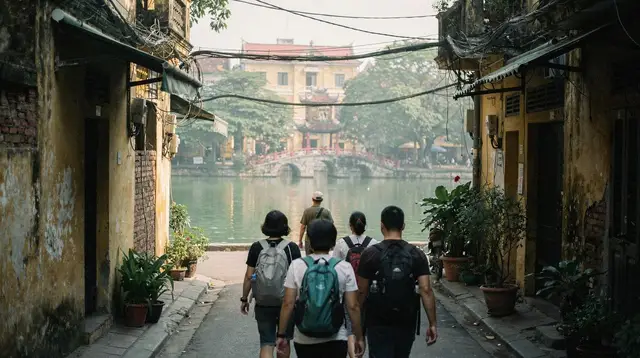
The confusion worth clearing up first: the Old Quarter’s density, which reads as charming and walkable to an adult exploring on foot, is not the same experience pushing a stroller or shepherding a tired five-year-old. Motorbikes are commonly parked directly on the sidewalk, sometimes two or three deep, and what pavement remains is often shared with vendor stalls, plastic stools set out for street food, and shopfront displays spilling outward. The practical result is that pedestrians, including families, end up walking on the edge of the road for long stretches rather than on a clear footpath. This is normal, not a sign that something has gone wrong with your route.
A few adjustments make this manageable rather than exhausting:
- Favour a carrier over a stroller in the Old Quarter and around the lake. A stroller has to be lifted over curbs, angled around parked bikes and occasionally walked in the road; a carrier or a child who can walk holding a hand moves through the same terrain without a wrestling match at every corner.
- If a stroller is unavoidable, plan around wider streets. The boulevards of the French Quarter and the lakeside paths around West Lake in Tay Ho district have noticeably more usable pavement than the 36 streets of the Old Quarter, and make a gentler introduction for a first day.
- Treat any single outing as shorter than it looks on a map. A loop that seems like a pleasant half-hour stroll for an adult can take twice as long with stops, detours around obstacles and a child who wants to look at everything, which is exactly why this page avoids proposing a fixed itinerary — the things-to-do pages and district guides are built to be assembled to your own pace rather than followed as a script.
Crossing the street with children
Vietnam drives on the right, and in Hanoi the street is dominated by motorbikes rather than cars, moving in a dense, continuous flow rather than in the stop-start pattern many visitors are used to. The method that works, and that locals use without thinking about it, is counterintuitive at first: step off the curb once there’s a reasonable opening, then keep walking at a steady, predictable pace. Motorbikes read your trajectory and flow around you. What actually causes near-misses is stopping abruptly mid-crossing, reversing course, or breaking into a run — all of which make you unpredictable to the traffic that’s already adjusting to your steady line.
With children, this changes the calculus in a few ways worth planning around rather than improvising on the spot:
- Hold a hand, always, for the whole crossing. A child who lets go partway across, or who stops to point at something, becomes the unpredictable element the method depends on avoiding.
- Carry a toddler rather than let them walk a crossing alone, even briefly. It removes the risk of a sudden stop or change of direction entirely.
- Cross where locals are already crossing, near a break in parked motorbikes rather than at an empty stretch of road, since a visible pedestrian flow tends to slow traffic more reliably than an isolated family trying to time a gap that may not come.
- Build in extra time for every crossing, especially near Hoan Kiem Lake and the markets, where the volume of both pedestrians and motorbikes is highest.
None of this requires special equipment or a guide, but it is worth rehearsing mentally before the first outing rather than discovering it in the moment. For a broader read on how the flow of traffic works across the city, including buses, the metro and ride-hailing, the getting-around-hanoi guide is the fuller reference; this page only covers the pedestrian side of it.
Pacing a day realistically
The single most common mistake families make in Hanoi is importing an adult sightseeing itinerary and expecting children to keep pace with it. A day that would suit two adults — a temple, a museum, a market, an evening show — is usually too much for a family with young children, not because any one stop is hard, but because the walking and waiting between stops adds up faster than it looks on paper.
A steadier rhythm tends to work better:
- One area, explored loosely, rather than several areas crossed off. Ba Dinh district’s sights — the Ho Chi Minh Mausoleum complex, the grounds around it, and the nearby Temple of Literature — sit close enough together to anchor a single, unhurried morning without a long transfer afterward.
- A long lunch as a built-in reset, not just a meal. Vietnamese family-style dishes suit sharing well, and the low plastic stools at street stalls are usually the right height for smaller children, though a hotel restaurant or an established café is a safer bet for a toddler who needs a proper high chair.
- A rest block in the early afternoon, back at the hotel or somewhere air-conditioned and quiet, rather than pushing straight through to a second sight. This matters more in Hanoi than in a city with wider, shadier sidewalks, simply because the walking itself is more tiring.
- An indoor or semi-indoor option held in reserve for a day that isn’t going well outdoors — the Vietnam Museum of Ethnology and the water puppet theatre both work as a change of pace that doesn’t demand much walking.
For families building out several days rather than a single stop in Hanoi, the northern Vietnam with kids guide and the five-day family itinerary go further into how to sequence a trip that includes the wider region; this page stays focused on the city itself.
Sights that suit families, and one that doesn’t need a special trip
Several of Hanoi’s best-known stops work naturally with children because they don’t demand a long, fixed route to enjoy: the open grounds around the mausoleum complex, the walk around Hoan Kiem Lake itself with its red bridge to Ngoc Son Temple, and a short, unhurried visit to the Temple of Literature, which has courtyards wide enough to let a child move around without threading through crowds.
Train Street deserves a specific note, since it comes up often in family planning. Its trackside cafés and the novelty of a working railway line running between houses are genuinely appealing to children, but access to the section is periodically restricted by the authorities, and the cafés open and close accordingly. It’s worth treating as an opportunistic stop if it happens to be accessible when you’re nearby, not as something to structure a day around or promise a child in advance.
A water puppet performance is one of the more reliably child-friendly evening options in the city: it’s seated, air-conditioned, short, and doesn’t require any walking once you’ve arrived, which makes it a useful anchor for an evening after a physically tiring day.
Practical day-to-day details
A handful of smaller logistics tend to matter more with children than they do travelling as an adult:
| Concern | What to know |
|---|---|
| Drinking water | Tap water isn’t drinkable; bottled or filtered water is standard for the whole family |
| Ice | Industrially made and generally fine in established restaurants and cafés |
| High chairs | More reliable in hotel restaurants and Western-style cafés than at street stalls |
| Toilets | Vary widely in quality outside hotels and larger restaurants; carrying hand sanitiser and tissue is standard practice |
| Language | Vietnamese is the official language; English is common in hotels and tourist-facing restaurants, less so elsewhere |
| Getting around | Ride-hailing apps for cars are usually easier with a child and luggage than negotiating a metered taxi on the street |
None of these are obstacles on their own, but they’re worth building into the day rather than discovering mid-outing.
Activities that give children something to actually do
Beyond sightseeing, a few bookable activities are built around participation rather than walking tours, which tends to suit families better than another temple visit. A supervised art class for children gives kids a hands-on, seated activity in the middle of a trip that’s otherwise full of walking. A family cooking session where you prepare and share a Vietnamese meal together turns a meal into an activity rather than another sit-down stop, and works well for children old enough to help with simple steps.
For a change of scenery outside the city centre, a jeep excursion to a folk painting village with lunch included combines a craft activity kids can take part in with a break from city sidewalks. Families wanting a full day of fresh air and cooler surroundings sometimes prefer a mountain day trip with lunch outside the city, which trades sightseeing density for open space to run around in.
These are worth booking selectively rather than stacking several into one trip; one participatory activity every couple of days tends to balance well against the free-form exploring described above.
Safety notes specific to travelling with children
Violent crime is rare in Hanoi, and the practical risks for families are the same ones that apply to any visitor, just amplified by having a child in tow: traffic, as covered above, and opportunistic scams or overcharging concentrated around Hoan Kiem Lake and the Old Quarter’s busiest tourist streets.
Being visibly distracted by a child — checking a stroller, comforting a tired toddler — is exactly the moment pickpockets and overcharging attempts tend to happen, so it’s worth keeping valuables in a bag worn across the body rather than in an open backpack or stroller basket during those moments. The scams and safety guide covers the general patterns in more depth; nothing about them is specific to families beyond the extra distraction a child creates.
Day trips outside the city that work well with children
Once the family has settled into the city’s pace, a single day trip outside Hanoi can be a welcome change of scenery — open space, fewer motorbikes underfoot, and something hands-on for children to focus on rather than another round of walking between sights. Bat Trang, a ceramics village a short drive from the centre, is one of the easier options: the appeal for children isn’t the pottery history so much as the chance to sit down and shape or paint something themselves, and the Bat Trang ceramic village guide covers what a visit actually involves.
Duong Lam, an older village of laterite houses, moves at a slower, quieter pace than the city and suits a family happy to wander rather than follow a checklist; the Duong Lam ancient village guide has the detail. A jeep-based version of this kind of outing, with a folk painting stop and lunch included, is covered by a rice paper village and ancient citadel day trip, which combines two craft stops without requiring the family to arrange transport themselves.
The Perfume Pagoda is a different kind of day out — it involves a rowing boat up the Yen stream before the walk or cable car to the pagoda itself — and it can work well with children who enjoy a boat ride, though it’s worth reading the Perfume Pagoda guide first, since the site gets busy during its festival period and a crowded pilgrimage crowd is a different experience for a young child than a quiet weekday visit. As with everything else on this page, the rule holds: pick one outing, build in slack for a tired child and an unpredictable nap, and don’t try to stack a craft village and a temple and a boat ride into the same day.
Families planning to go further than a single day trip — into Ninh Binh’s limestone landscapes, Ha Long Bay, or the mountains around Sapa — are better served by the northern Vietnam with kids guide and the dedicated Ha Long Bay with kids page, both of which go into the specific trade-offs of travelling further from the city with young children. This page stops at the edge of Hanoi and its closest day trips deliberately, since the calculus changes once overnight stays and longer transfers enter the picture.
Choosing when to visit with young children
Timing a trip around a child’s tolerance for heat, crowds and disrupted routine matters more than it does for adult travellers, who can push through an uncomfortable afternoon in a way a toddler simply won’t. Hanoi’s weather shifts noticeably across the year, and rather than repeat specifics here, the month-by-month pages — from Hanoi in January through Hanoi in December — and the general best time to visit Hanoi overview are the right place to weigh a particular travel window against a family’s own limits.
What’s worth flagging here is simply that the sidewalk and crossing mechanics described above get harder, not easier, in extreme heat or heavy rain, since a child who’s already uncomfortable has less patience for a slow, careful street crossing or a long wait for a table. Building in more indoor time, and treating the museum and water puppet options above as a fallback rather than a last resort, tends to matter more during the hottest or wettest stretches of the year.
The Tet lunar new year period is worth a separate mention: it’s a genuinely interesting time to be in the city, with visible festival preparation and decoration throughout the Old Quarter, but it also means many family-run restaurants and small shops close for several days around the holiday itself, and transport within the country gets busier and pricier than usual. Families travelling with children during that window benefit from confirming opening hours and transport bookings further ahead than they would at other times of year, simply because the margin for improvising a Plan B shrinks when everything around you is also on holiday.
Getting the trip off on the right foot
The families who find Hanoi easiest with children tend to arrive with a loose plan rather than a fixed itinerary, expect the first day to be an adjustment period rather than a full sightseeing day, and treat sidewalks and crossings as the actual logistics to plan around, not an afterthought to a list of sights. Everything else — which neighbourhood to explore, where to eat, which single activity to book — follows more easily once those two mechanics feel normal rather than stressful.
Family Trip Guide
Verified deep-linked GetYourGuide tours. Book through these links and we earn a small commission at no cost to you.
GetYourGuide does not provide a product photo for this activity — the image shows the meeting point, photographed by us.