The French Quarter: Hanoi's Colonial-Era District
What is the French Quarter in Hanoi?
It is the administrative district just south of Hoan Kiem Lake, built up under French colonial rule with wide tree-lined avenues, villas and institutional buildings, in contrast to the dense, narrow streets of the Old Quarter. It is an ordinary open district, not a gated or ticketed area, and it is reachable on foot from central Hanoi.
A district built on a different scale
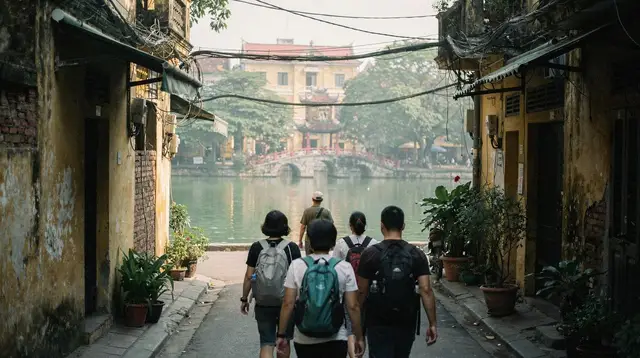
Step south out of the crowds around Hoan Kiem Lake and the city changes register within a few blocks. The tight grid of the Old Quarter, with its narrow shopfronts, tangled overhead wires and motorbikes parked three deep on the pavement, gives way to wide avenues lined with trees, low garden walls and buildings set back from the street. This is Hanoi’s French Quarter, and the shift in atmosphere is the whole point of visiting it.
The district took shape under French colonial administration, when planners laid out a formal grid of boulevards distinct from the older commercial quarter to its north. Where the Old Quarter grew organically around trade guilds and river commerce, the French Quarter was planned as an administrative and residential zone, with government buildings, banks, a post office, schools and villas arranged along broad, regularly spaced streets. That planning logic is still legible today in the width of the roads, the spacing between buildings and the amount of greenery, even though the district now functions as an ordinary, busy part of a modern capital rather than a museum piece.
It is worth being clear about what this district is not. It is not a gated compound, a resort enclave or a ticketed heritage zone. It is an open administrative district of Hanoi, with public streets that anyone can walk, cycle or drive through, mixed in with shops, offices, embassies, hotels and private homes. Visitors sometimes expect a curated colonial theme park; what they find instead is a functioning neighbourhood that happens to have kept its early twentieth-century street layout and a good share of its original architecture.
Where it sits relative to the rest of central Hanoi
The French Quarter occupies the area immediately south and southeast of Hoan Kiem Lake, bordering the Old Quarter to the north. It is close enough to the lake that most visitors reach it on foot as a natural extension of a stroll around the water, rather than as a separate outing requiring transport. Landmarks such as the Opera House and St Joseph’s Cathedral sit at either edge of the district, giving it clear reference points without needing a fixed boundary line to understand where it begins and ends.
Because the French Quarter is so walkable from the centre, it works well folded into a longer day rather than treated as a destination in its own right. Many visitors pass through it on the way between the lake area and other parts of central Hanoi, noticing the change in street width and building style along the way rather than setting out specifically to tour it block by block.
The urban contrast with the Old Quarter
The clearest way to understand the French Quarter is by comparison with the district it borders.
| Feature | Old Quarter | French Quarter |
|---|---|---|
| Street pattern | Narrow, dense grid | Wide, regularly spaced avenues |
| Origin | Organic growth around trade guilds | Planned colonial-era administrative layout |
| Building style | Tube houses, shophouses | Villas, institutional buildings |
| Street life | Constant, at pavement level | Quieter, more set back from the road |
| Typical use today | Retail, food stalls, markets | Offices, embassies, hotels, some retail |
| Greenery | Minimal, mostly potted plants | Mature street trees, garden plots |
Walking from one district into the other, the change is physical before it is historical: the sudden width of the road, the sound dropping as motorbike traffic spreads out, the appearance of tree canopy overhead where before there was only a tangle of cables. It is this contrast, more than any single building, that makes the French Quarter worth a deliberate look rather than an accidental one.
Streetscape and architecture
The buildings of the French Quarter reflect the administrative purpose the district was originally built for. Government offices, a former post office, banks, schools and consular buildings sit alongside private villas that were built as homes for colonial-era officials and, later, for Vietnamese officials and institutions after independence. Many of these buildings remain in active official or institutional use, which means interiors are generally not open for casual visits, even when the exteriors are easy to see and photograph from the street.
This guide does not attempt to catalogue individual landmarks in detail: for the district’s major sights, including specific museums, the cathedral and the Opera House, it is better to consult the dedicated pages for each site rather than rely on a general neighbourhood overview. What matters at the district level is the pattern rather than any single building: deep plots, colonnaded facades, shuttered windows, iron balconies and low perimeter walls that let greenery spill onto the pavement.
The result is a streetscape that rewards slow walking rather than a checklist approach. Looking up at rooflines, noticing where a villa has been converted into a boutique hotel or a cafe, and comparing one block’s building density to the next tells you more about the district’s character than any single stop on a map.
Walking the French Quarter
Because the district is open and walkable, a self-guided route works well for anyone who prefers to set their own pace. Starting from the southern edge of Hoan Kiem Lake and moving outward, the streets naturally widen and quieten, making the direction of travel easy to feel even without constant reference to a map.
For visitors who prefer context along the way, a guided walk can be useful, since much of what makes the French Quarter interesting, such as the reasoning behind the original street layout or the former function of a particular building, is not always obvious from the facade alone.
a guided walk through the French Quarter with a local guide, focused on the district’s colonial-era streets and buildingsA smaller-group version of the same route is also available for travellers who prefer a more intimate pace.
a small-group walking tour covering the same French Quarter streetscapeFor visitors more interested in food than architecture, a route that threads through both the Old Quarter and the French Quarter can be a practical way to see the contrast between the two districts while stopping to eat along the way.
a food-focused walk that crosses from the Old Quarter into the wider streets nearbyGetting there and around
The French Quarter does not require special transport planning: it is reached on foot from the lake and the Old Quarter, and its wide, tree-lined streets are comfortable for walking in a way that the denser Old Quarter sometimes is not. For visitors basing themselves further out, standard options for getting around Hanoi apply equally well here, including ride-hailing apps, metered taxis and the city’s growing metro network.
Because the district borders several other parts of central Hanoi, it is easy to combine with a wider loop. A walk that starts at the lake, crosses through the French Quarter, and continues toward Tay Ho and West Lake or the government and heritage sites of Ba Dinh district covers a good cross-section of the city’s different urban layers in a single day, from the dense trading streets of the old town to the planned avenues of the colonial administrative quarter and on to the newer, greener districts further out.
When to visit
The French Quarter’s wide streets and mature trees make it a comfortable place to walk even when the weather elsewhere in the city feels close and humid, since the greenery and building setbacks provide more shade and airflow than the tighter Old Quarter streets. That said, the general seasonal patterns for visiting Hanoi apply here as everywhere else in the city: the cooler, drier months are the most comfortable for extended walking, while the hot, humid rainy season calls for shorter outings and a slower pace.
Early morning and late afternoon tend to be the quietest times to walk the district, since much of the traffic through it is commuter and institutional rather than tourist-driven, and it thins out well before the evening rush associated with the Old Quarter’s restaurants and bars.
How it fits into a Hanoi itinerary
Because the French Quarter is compact relative to the rest of central Hanoi and requires no separate transport, it slots easily into broader city plans rather than needing its own dedicated day. It pairs naturally with a one-day highlights route through central Hanoi, or with a slower two-day exploration of the Old Quarter that extends south to take in the change in streetscape.
Visitors focused on Hanoi’s heritage sites more broadly may prefer to treat the French Quarter as a connecting walk between stops rather than a destination with its own checklist, using it as the transition between the Temple of Literature or the sites around the Ho Chi Minh Mausoleum and Ba Dinh and the markets and food streets of the Old Quarter.
For anyone weighing up where to base themselves in the city, the French Quarter’s quieter streets are worth knowing about even without going into specific pricing here; the general comparison of Hanoi’s neighbourhoods for accommodation purposes is covered separately.
Practical notes
A few points are worth keeping in mind when planning a walk through the district:
- It is open to everyone. There is no entry requirement or ticket for the district itself; only specific buildings and museums within it may have their own access rules, covered on their individual pages.
- Interiors are often off-limits. Many of the grand buildings are in active institutional use, so admiring them from the street is usually the extent of what is possible without a specific arranged visit.
- It is best explored on foot. The wide pavements and lower traffic density make walking the most natural way to take in the contrast with the Old Quarter.
- It connects easily to other districts. Its position next to the lake and the Old Quarter, and its proximity to Ba Dinh and West Lake, make it a natural link in a longer walking route rather than an isolated stop.
Frequently asked questions about Hanoi’s French Quarter
Is the French Quarter a separate town or gated area?
No. It is an administrative district of central Hanoi with open streets, shops, offices and homes. There is no gate, ticket or entry point, and it borders the Old Quarter and Hoan Kiem Lake directly.
How is the French Quarter different from the Old Quarter?
The Old Quarter is a dense grid of narrow shophouse streets historically organised by trade guilds. The French Quarter, built later under colonial administration, has wider avenues, larger building plots, more greenery and a lower density of street-level commerce.
Can I walk to the French Quarter from Hoan Kiem Lake?
Yes. The district begins right at the southern edge of the lake, and most of it can be covered on foot, which is also the best way to appreciate the change in scale and streetscape.
What kind of buildings are in the French Quarter?
Institutional and administrative buildings from the colonial period, along with villas that were originally built as private residences and offices. Many are still in official use today, so interiors are not generally open to casual visitors.
Is the French Quarter worth visiting if I am short on time?
A short walk through it works well as an add-on to a Hoan Kiem Lake visit, since the contrast with the Old Quarter is easy to notice even on foot without a fixed itinerary.
Are there guided tours of the French Quarter?
Yes, several Hanoi walking tours cover the French Quarter and its streetscape as part of a wider central Hanoi route, usually alongside the Old Quarter or as a food-focused walk that touches both districts.
Does the French Quarter have its own hotels and restaurants?
Yes, the district has hotels, cafes and restaurants of its own, generally quieter and more spread out than the Old Quarter’s dense concentration, though this guide does not cover specific prices or bookings.
Hanoi by Neighborhood
Verified deep-linked GetYourGuide tours. Book through these links and we earn a small commission at no cost to you.
GetYourGuide does not provide a product photo for this activity — the image shows the meeting point, photographed by us.