Ba Dinh District, Hanoi: A Guide to the Political Quarter
What is Ba Dinh district in Hanoi known for?
Ba Dinh is Hanoi's political and administrative district, west of Hoan Kiem Lake. It concentrates the country's leading institutions and commemorative sites, including the Ho Chi Minh Mausoleum complex, the One Pillar Pagoda, the Temple of Literature and the Imperial Citadel of Thang Long, rather than dense visitor accommodation or restaurant streets.
Hanoi’s political heart, west of the lake
Ba Dinh is the district where Vietnam governs itself. It sits immediately west of the Old Quarter and the French Quarter, on the far side of the railway line and the wide avenues that mark the edge of the old commercial core, and it reads as a different city almost as soon as you cross into it.
Where the Old Quarter is dense, mercantile and loud with motorbike horns and street vendors, Ba Dinh is laid out in broad, tree-lined boulevards, walled compounds and open squares. This is where the National Assembly sits, where the Presidential Palace grounds open onto manicured lawns, and where the country’s most visited commemorative site, the Ho Chi Minh Mausoleum, draws a steady procession of visitors each morning.
For travellers, Ba Dinh is less a neighbourhood to wander at random and more a cluster of specific, deliberate visits, each with its own character, its own access rules and its own place in Vietnamese history. This guide is about the district as a whole: how its parts relate to each other, how it differs from the parts of central Hanoi most visitors already know, and how to plan your time here. For the sites themselves, including what to expect inside each one, this guide points you to their dedicated pages rather than repeating that detail.
What actually falls inside Ba Dinh
The district takes its name from Ba Dinh Square, the vast open space in front of the mausoleum where Ho Chi Minh read the Declaration of Independence in 1945, and it radiates outward from there. To the immediate west and north of the square lies the mausoleum and Presidential Palace complex, discussed in full on its own page — see the guide to the Ho Chi Minh Mausoleum and Ba Dinh Square for what the grounds contain and how visits there work.
A short walk from the mausoleum stands the One Pillar Pagoda, a small wooden shrine raised on a single stone column above a lotus pond, and, a little further on, Tran Quoc Pagoda on the shore of West Lake, generally reckoned the oldest Buddhist pagoda in the city. Both are covered together on the One Pillar Pagoda and Tran Quoc Pagoda guide, since visitors typically see them in sequence.
Ba Dinh also holds two sites that predate the modern political district by centuries. The Imperial Citadel of Thang Long, a UNESCO World Heritage property recognised in 2010, preserves the archaeological remains and surviving gates of the royal citadel that served as the seat of Vietnamese power for close to a thousand years; its own page, the Thang Long Imperial Citadel guide, explains what is on view today.
A short distance away sits the Temple of Literature, Vietnam’s first national university, founded in 1070, whose courtyards, stelae and ceremonial gates make it one of the most complete pieces of pre-colonial Hanoi left standing — covered fully on the Temple of Literature guide.
Elsewhere in the district, Hoa Lo Prison, used first by French colonial authorities and later, under a different name, to hold American prisoners of war, sits closer to the boundary with the French Quarter; its history and visiting logistics are set out on the Hoa Lo Prison guide. Several of Hanoi’s national museums also cluster in and around Ba Dinh, and are grouped together on the Hanoi museums guide rather than listed individually here.
A district built for governing, not for guesthouses
It is worth being direct about a common assumption, because it shapes how people plan their trip: Ba Dinh is not a lodging district. Unlike the Old Quarter, where guesthouses, mini-hotels and hostels sit stacked along narrow streets within a few minutes of each other, or the French Quarter, where colonial-era hotels and serviced apartments cluster around the Opera House, Ba Dinh’s blocks are given over to government ministries, embassies, official residences and open institutional grounds. The building stock here is administrative rather than commercial, and the street pattern — wide, straight, sparsely lined with shopfronts — was never designed around footfall or tourism the way the old merchant quarters were.
That has two practical consequences. First, the choice of where to sleep in Hanoi is answered elsewhere, not by this page: the comparative view of neighbourhoods and price bands lives on the where to stay in Hanoi guide, and it is worth reading before booking, because Ba Dinh rarely comes out as the recommended base for a first visit. Second, evenings in Ba Dinh are genuinely quiet. There is little of the bia hoi corner life, night market bustle or late kitchens that define an Old Quarter evening; restaurants that do exist tend to serve office workers and residents rather than visitors, and most travellers plan dinner back in the Old Quarter or the French Quarter after a day spent here.
None of this makes Ba Dinh a place to skip — it simply means the district rewards a focused, planned visit rather than aimless wandering, and that accommodation decisions belong to a different page entirely.
How Ba Dinh fits into a Hanoi itinerary
Most visitors treat Ba Dinh as a single, self-contained block of a day rather than a place to return to repeatedly. A common pattern is to spend a morning moving through the mausoleum grounds, the One Pillar Pagoda and the Temple of Literature, then shift south and east into the French Quarter or the Old Quarter for lunch and the rest of the afternoon. That rhythm is laid out concretely on the two days in the Old Quarter itinerary, which folds a Ba Dinh morning into a wider first look at the city, and it works well because the two districts sit close enough together that no significant transfer time is needed between them.
Travellers with less time sometimes fold Ba Dinh’s highlights into a single guided pass of the city rather than navigating the district’s institutional layout alone; the half-day city tour guide and the full-day city tour guide both typically route through this district precisely because it holds so much of what a first-time visitor wants to see.
For a broader sense of what else the city offers beyond Ba Dinh, the things to do in Hanoi hub groups activities across every district, and the getting around Hanoi guide explains the transport options — metro, ride-hailing, taxi — that make moving between Ba Dinh’s spread-out compounds and the denser quarters straightforward.
Ba Dinh also turns up in itineraries built around very short stops in the city. Travellers passing through on a long layover, rather than staying overnight, often ask whether the mausoleum complex and the Temple of Literature are realistic to fit into a few free hours; the Hanoi layover tour guide and the fuller three-day Hanoi layover itinerary both work through that question directly, weighing Ba Dinh’s sites against airport transfer times and opening hours rather than assuming a layover visitor can simply add the district onto an already tight schedule.
Because several sites in Ba Dinh are active government or commemorative grounds rather than ordinary museums, conduct and dress expectations run stricter here than in most of the city — modest clothing, quiet behaviour and, at some sites, no photography in certain areas. What to book ahead, what to wear, and how tickets work across the district’s main sites are gathered on the Hanoi tickets and entrance guide, which is the right place to check before a Ba Dinh morning rather than assuming the same rules apply as at a temple in the Old Quarter.
Beyond the political core: pagodas within reach
Ba Dinh’s cluster of monuments is not the only reason to come this way. A short distance further out, guided visits reach smaller pagodas and communal houses that sit outside the district’s famous names but share its atmosphere of quiet, older Hanoi. A guided walking tour that takes in Tran Quoc Pagoda on the shore of West Lake is a straightforward way to see the district’s oldest pagoda with context from a local guide rather than working it out alone.
Travellers who want to go a little further into the city’s religious architecture sometimes add a guided visit to Tien Pagoda, one of the lesser-known shrines that rarely makes a rushed itinerary but rewards a slower morning.
For those extending a Ba Dinh day outward rather than back into the Old Quarter, a guided tour of Ba Danh Pagoda is a similarly low-key option, while a guided tour of Dinh Bang Communal House reaches one of the finest surviving examples of traditional Vietnamese communal architecture, a useful counterpoint to the citadel and temple architecture found inside Ba Dinh itself. None of these require abandoning the district’s core sites; they simply extend a Ba Dinh-focused day for travellers with an extra few hours and a specific interest in temple architecture or village heritage.
Where Ba Dinh meets West Lake
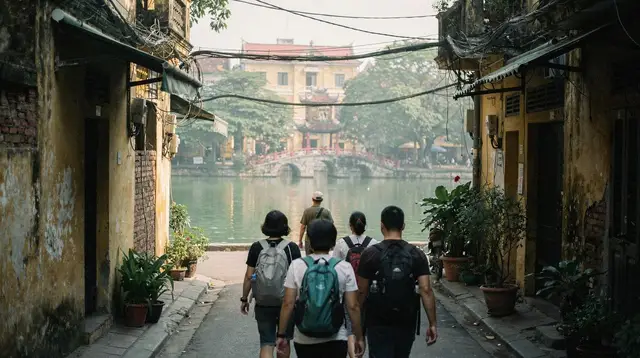
Ba Dinh does not end cleanly at a single boundary; toward its northern edge, around Tran Quoc Pagoda, it shades into Tay Ho district and the shoreline of West Lake, Hanoi’s largest lake. Visitors who walk from the One Pillar Pagoda out to Tran Quoc Pagoda are, in effect, already standing at the point where the two districts meet, with the calm of Ba Dinh’s institutional grounds giving way to the cafes, longer promenades and residential streets that define Tay Ho.
The Tay Ho, West Lake guide picks up from that point and covers the lake itself, worth reading if a Ba Dinh morning leaves you close enough to West Lake to want an hour by the water afterward rather than heading straight back toward the Old Quarter.
Ba Dinh for photographers and slow mornings
Because its grounds are broader and quieter than almost anywhere else in central Hanoi, Ba Dinh is also where visitors interested in traditional dress photography often choose to shoot. The courtyards, stelae and covered gates of the Temple of Literature in particular are a recurring backdrop for ao dai photoshoots, since the architecture reads clearly in a photograph without the crowds and cables of a busier street. The ao dai photoshoot guide covers where to arrange this, what to expect from a photographer and how to time a shoot around a site’s quieter hours, and it is worth reading before a Ba Dinh morning if photography is part of the plan rather than an afterthought.
Ba Dinh in context: how it differs from Hanoi’s other central districts
| District | Character | What it’s known for | Good base for staying? |
|---|---|---|---|
| Ba Dinh | Institutional, spread out, quiet evenings | Mausoleum complex, Temple of Literature, Imperial Citadel | Rarely recommended as a base |
| Old Quarter | Dense, commercial, lively at night | The 36 streets, markets, street food, nightlife | Yes — the most common first-time base |
| French Quarter | Colonial-era, wide avenues, formal | Opera House, cathedral, upscale hotels | Yes — quieter, comfort-focused base |
| Tay Ho (West Lake) | Residential, lakeside, expat-heavy | West Lake views, cafes, longer stays | Sometimes, for longer visits |
This comparison is deliberately brief: it exists to place Ba Dinh in context, not to replace the fuller neighbourhood-by-neighbourhood comparison on the where to stay in Hanoi guide, which weighs these same districts against each other for the purpose of choosing a hotel.
Practical notes for a Ba Dinh day
A few general points are worth keeping in mind rather than site-specific ones, since those belong on each monument’s own page. Dress modestly across the whole district — shoulders and knees covered is the safe baseline, particularly around the mausoleum grounds and the Temple of Literature.
Mornings tend to be calmer than afternoons at the district’s most visited sites, and the mausoleum in particular runs on a schedule that is worth checking directly on its own guide rather than assuming it mirrors a typical museum’s hours. Between compounds, distances are longer than they feel on a city map that also shows the compact Old Quarter, so budgeting time for walking or a short ride between, say, the mausoleum grounds and the Temple of Literature is sensible rather than optimistic.
If Vietnamese history and twentieth-century politics interest you beyond what a walk through the grounds can convey, the Hanoi museums guide points to the national museums clustered nearby that go deeper into the material than any single monument can on its own. And for a sense of the etiquette expected at commemorative and religious sites more broadly across Vietnam, not just in Ba Dinh, the etiquette and customs guide is a useful general reference before your first temple or mausoleum visit of the trip.
Ba Dinh rewards travellers who come with a plan rather than an urge to wander, because its real character — the seat of a nation’s government layered over nearly a thousand years of continuous political history on the same ground — is best understood one deliberate site at a time, each with its own story to follow through its own dedicated guide.
Hanoi by Neighborhood
Verified deep-linked GetYourGuide tours. Book through these links and we earn a small commission at no cost to you.
GetYourGuide does not provide a product photo for this activity — the image shows the meeting point, photographed by us.