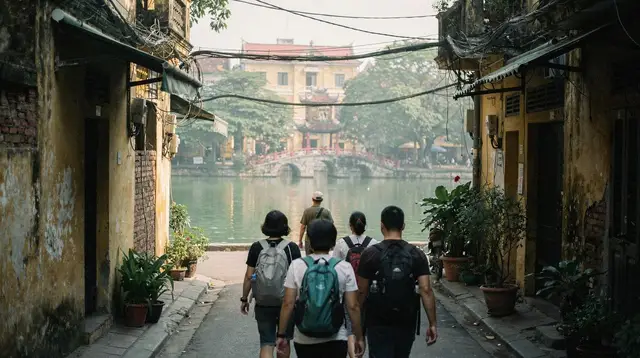
One Pillar Pagoda and Tran Quoc Pagoda: A Guide to Hanoi's Two Landmark Pagodas
Are the One Pillar Pagoda and Tran Quoc Pagoda the same visit?
No. The One Pillar Pagoda is a small wooden structure on a single stone pillar inside the Ba Dinh complex, near the Ho Chi Minh Mausoleum. Tran Quoc Pagoda is a multi-tiered brick tower on a small island in West Lake, several kilometres away. Seeing both in one outing means a deliberate transfer between two different parts of the city, not a single stroll.
Two Pagodas, Two Parts of Hanoi
Visitors researching Hanoi’s temples often lump the One Pillar Pagoda and Tran Quoc Pagoda together, and it is easy to see why: both are small, photogenic, frequently listed side by side in “top sights” round-ups, and both are, genuinely, pagodas rather than temples in the stricter sense. But they are not next to each other, they are not the same style of building, and they do not share a history beyond both belonging to Hanoi’s long Buddhist tradition. This guide treats them as the pair they are usually searched as, while being clear about what separates them, so a plan built around “seeing the pagodas” does not collapse into an unrealistic single stop.
The One Pillar Pagoda (Chua Mot Cot) sits inside the wider Ba Dinh district complex, close to the Ho Chi Minh Mausoleum and the Presidential Palace grounds. It is tiny — a single wooden pavilion raised on one stone column, built to resemble a lotus blossom rising from a pond — and most visits to it last a matter of minutes rather than an hour. Tran Quoc Pagoda, by contrast, stands on a small islet connected by a short causeway to the shore of West Lake, in Tay Ho district, several kilometres north of Ba Dinh.
It is a working monastery with a tall, multi-tiered brick tower, courtyards, and a lakeside setting that invites a slower visit. This guide does not cover the Ho Chi Minh Mausoleum itself, which has its own dedicated page, and for the broader sweep of Hanoi’s Buddhist and temple heritage, the museums guide is a better starting point than this one.
The One Pillar Pagoda: A Small Building With an Outsized Reputation
The One Pillar Pagoda is one of the most photographed structures in Hanoi despite its size, largely because the design itself is unusual. The wooden pavilion sits atop a single stone pillar rising from a square pond, meant to evoke a lotus flower — a recurring image in Buddhist symbolism — opening above the water. The structure visitors see today is a later reconstruction rather than an unbroken original; like many wooden buildings in a tropical climate with a long and turbulent history, it has been rebuilt more than once, most recently in the mid-20th century. This guide does not state an exact founding date, since the pagoda’s documented history spans multiple building phases and the precise years attached to each are easy to misquote.
Because of its location within the Ba Dinh complex, the One Pillar Pagoda is almost always visited alongside the Ho Chi Minh Mausoleum and the surrounding grounds — the Presidential Palace gardens, Ho Chi Minh’s stilt house, and the nearby Temple of Literature a little further south. It is not, however, a room or wing inside the mausoleum building; it is a separate, freestanding structure a short walk away within the same grounds, with its own small approach and pond. Most visitors spend only a few minutes here, which is appropriate — there is not a great deal of interior space to explore, and its value is largely in the view of the structure itself rather than an extended browse.
Etiquette at the One Pillar Pagoda follows the norms expected at any active place of worship in Vietnam: modest dress covering shoulders and knees, quiet behaviour, and following any signage or staff instructions about where photography is and is not appropriate. Because it sits within a tightly managed government complex that also includes the mausoleum, visitors should expect security presence and, at times, queueing procedures that have nothing to do with the pagoda itself but come with visiting Ba Dinh generally.
Tran Quoc Pagoda: Hanoi’s Oldest, on West Lake
Tran Quoc Pagoda is widely described as the oldest Buddhist pagoda in Hanoi, standing on a small islet just off the eastern shore of West Lake — the largest lake in the city and the heart of Tay Ho district. A short causeway connects the islet to the shore, and the pagoda’s red multi-tiered brick tower, visible from a good stretch of the lakeside promenade, has become one of the more recognisable skyline elements in this part of Hanoi. Its long history on or near this site has made it a place of continuous religious practice, and it remains an active monastery rather than a museum piece — monks live and work on the grounds, and the courtyards are used for regular worship, not staged for visitors.
Because Tran Quoc Pagoda sits directly on the water, a visit here naturally extends into a longer look at West Lake itself. The lakeside path in both directions passes cafés, small parks, and residential streets that make up much of Tay Ho’s character, distinct from the dense, commercial feel of the Old Quarter closer to Hoan Kiem Lake. Visitors who enjoy quiet walking often build in extra time here rather than treating the pagoda as a quick photo stop, since the setting rewards a slower pace — watching the light change over the water, or simply sitting near the causeway, is part of what makes this site worth the trip out from central Hanoi.
As with the One Pillar Pagoda, modest dress and quiet behaviour are expected, and shoes generally come off before entering interior shrine spaces. Because Tran Quoc Pagoda is an active monastery, visitors may encounter monks going about daily routines, and it is worth extending the same courtesy here that any working religious site deserves — this is not a recreated or purely ceremonial space kept for tourism.
Why These Two Get Confused — and How to Plan Around It
The confusion between the two pagodas usually comes down to three things: both names include “pagoda,” both appear on nearly every general “things to do in Hanoi” list, and both are frequently mentioned in the same breath as other Ba Dinh-area sights, which can make it sound as though they are within walking distance of each other. They are not. The One Pillar Pagoda sits within the fenced, security-controlled Ba Dinh complex; Tran Quoc Pagoda sits on West Lake, a meaningful transfer away by taxi, ride-hailing app, or motorbike — not a walk, and not a quick detour on foot between the two.
For visitors who want to see both in a single day, the practical approach is to treat them as two separate stops joined by a short ride, rather than as one combined sight. A common sequence is to visit the Ho Chi Minh Mausoleum grounds and the One Pillar Pagoda in the morning, when the mausoleum area tends to be busiest and most controlled, then take a taxi or ride-hailing car north to West Lake for Tran Quoc Pagoda and a slower lakeside walk in the early afternoon. This order also avoids doubling back across the city, since Ba Dinh and Tay Ho are roughly adjacent districts on Hanoi’s western side.
| Site | District | Setting | Typical time on site |
|---|---|---|---|
| One Pillar Pagoda | Ba Dinh | Small pavilion on a pillar, within the mausoleum complex | A few minutes |
| Tran Quoc Pagoda | Tay Ho | Multi-tiered tower on an islet in West Lake | 30–60 minutes, longer with a lakeside walk |
Getting Between Them
There is no direct public transport link built specifically for this route, and walking between the two is not realistic for most visitors given the distance and the layout of the intervening streets. A metered taxi or a ride-hailing app such as Grab or Be is the simplest way to move between Ba Dinh and West Lake, and traffic conditions mean the ride is best treated as a flexible 15–25 minutes rather than a fixed figure.
Visitors staying in the Old Quarter or French Quarter will find both pagodas are a further ride out from their hotel than central sights like Hoan Kiem Lake or the Temple of Literature, so building in transfer time on both ends of the day is worth doing rather than assuming everything in Hanoi is walkable from a central base. For a wider sense of how the city’s transport options fit together, the getting around Hanoi guide covers buses, the metro lines, and ride-hailing in more depth.
Those staying closer to West Lake itself, in the Tay Ho area, may find it easier to flip the order and start at Tran Quoc Pagoda before heading south into central Hanoi for the Ba Dinh sights and the rest of a city day. Either sequence works; the point is simply to plan the transfer deliberately rather than assume both pagodas belong on the same short walking loop as central landmarks.
Guided Options for Tran Quoc Pagoda and West Lake
Because Tran Quoc Pagoda sits within a larger, worthwhile area to explore, a guided walk that covers the pagoda alongside the rest of West Lake tends to add more value than a solo drop-in visit, particularly for travellers who want context on the site’s Buddhist history and its place in the city. A guided walking tour focused specifically on Tran Quoc Pagoda is a straightforward way to get that context without having to arrange transport and research independently, and it pairs well with an early or late-afternoon slot when the light on the lake is at its best.
For visitors who want the pagoda folded into a broader look at the lake district, a combined Tran Quoc Pagoda and West Lake walking tour extends the same visit into the surrounding streets and shoreline, useful for anyone treating Tay Ho as a half-day rather than a single stop. Neither of these covers the One Pillar Pagoda or the Ba Dinh complex, which sit far enough away that they are best treated as a separate booking or a self-guided add-on earlier in the day.
Travellers looking to extend a day beyond the two pagodas sometimes pair a West Lake morning with a craft-village afternoon outside the city; a guided visit to the Dinh Bang communal house is one option for a heritage-focused half-day that complements, rather than duplicates, a pagoda-focused itinerary.
Nearby Heritage to Round Out the Day
Because both pagodas sit within larger heritage clusters, most visitors combine them with other sights rather than treating either as a standalone outing. Near Ba Dinh, the Temple of Literature, Vietnam’s first university, and the wider Ho Chi Minh Mausoleum grounds are natural additions to a One Pillar Pagoda visit, and Hanoi’s cluster of museums sits within reasonable reach for travellers who want more historical depth than a single small pagoda can offer.
Near Tran Quoc Pagoda, the rest of West Lake rewards unhurried exploring, and travellers based centrally sometimes fold a West Lake afternoon into a longer loop that also takes in the Old Quarter markets and streets on the way back. For a first-time visitor trying to fit everything into a short stay, the one-day Hanoi highlights itinerary and the two-day Old Quarter itinerary both show how a pagoda visit slots into a wider city plan without overloading a single day.
Travellers with a car and driver for the day, or those short on time, often prefer a private full-day tour that pairs a craft village like Tho Ha with the Co Loa Ancient Citadel, which covers heritage sites outside the immediate city centre and can be adjusted to include a stop at West Lake on the return. For a broader look at how private tours with a driver work in Hanoi, and how they compare to piecing together taxis and ride-hailing rides between stops, the linked guide breaks down the trade-offs.
Practical Notes for Both Sites
Neither pagoda publishes fixed, reliable opening hours or entrance fees that are worth stating here as a fixed figure — these details shift over time, and the safest approach is to confirm them locally on the day, through a hotel concierge, a guide, or signage on site, rather than relying on a number fixed months or years earlier.
What does stay constant is the dress expectation: shoulders and knees covered, and shoes off before entering any interior shrine space, at both sites. Photography is generally welcome in the outdoor courtyard areas of both pagodas, though visitors should be attentive to any signage restricting photography near active shrines or during ceremonies, particularly at Tran Quoc Pagoda given its status as a working monastery.
Weather is worth factoring in for Tran Quoc Pagoda specifically, since much of its appeal comes from the lakeside setting rather than an interior visit — a grey, humid summer afternoon or a damp winter drizzle changes the experience of the walk considerably compared with a clear autumn morning. The One Pillar Pagoda, being smaller and largely an outdoor viewing experience within a controlled complex, is less weather-dependent, though the surrounding mausoleum grounds involve a fair amount of walking and standing in queues, which is worth planning for regardless of season.
Museums and Culture in Hanoi
Verified deep-linked GetYourGuide tours. Book through these links and we earn a small commission at no cost to you.
GetYourGuide does not provide a product photo for this activity — the image shows the meeting point, photographed by us.