Perfume Pagoda Day Trip from Hanoi
What does a Perfume Pagoda day trip from Hanoi actually involve?
It combines a road transfer south-west of Hanoi with a rowing-boat crossing along the Yen Stream to the foot of the karst hill, followed by a walk or cable car up to Huong Tich Cave. It is a single destination south-west of the city, distinct from the Duong Lam, Thay and Tay Phuong pagodas that some listings bundle together with it.
A day trip built around a river crossing, not just a road
Most day trips out of Hanoi are entirely road-based: a van south to Ninh Binh, a van west to Duong Lam or Bat Trang, a van back. The Perfume Pagoda is different. The road transfer from Hanoi only gets you as far as the boat pier on the Yen Stream, at the edge of the Huong Son commune south-west of the city. From there, the way in is by water: a flat-bottomed rowing boat, usually paddled by a local boatwoman, carries small groups along the stream between limestone hills to the base of the mountain that holds the pagoda complex.
That river approach is the whole character of the trip, and it is worth understanding before you book, because it shapes the pace of the day in a way a purely road-based excursion doesn’t. You sit low in a narrow boat for a stretch of the journey, watching karst hills close in on both banks, before switching to your own feet (or a cable car) for the climb to the cave itself. It is a slower, more layered outing than a straight temple visit, and it rewards treating it as its own kind of day rather than as a quick stop bolted onto something else.
This page covers that route and what to expect from it — the road transfer, the boat crossing, the climb, and the pagoda complex itself. It does not go into the difference between booking the trip as a group tour or a private one; that comparison, including how it affects pickup times and pace, is covered separately in the group versus private day trip guide.
Where the Perfume Pagoda actually is
The Perfume Pagoda, known locally as Chua Huong, sits in a limestone range south-west of Hanoi, reached via the Yen Stream. It is a single, self-contained excursion, not a stop on the way to somewhere else, and it should not be confused with other pagodas that lie in a completely different direction from the city.
The most common mix-up in commercial listings is with Thay Pagoda and Tay Phuong Pagoda, both of which sit near Duong Lam, west of Hanoi in the opposite direction from the Yen Stream. Because Duong Lam’s ancient village, Thay Pagoda and Tay Phuong Pagoda are often sold as a single bundled day trip, some tour descriptions blur the line between that cluster and the Perfume Pagoda, especially when photos of laterite-walled villages and forested hillside temples get used somewhat interchangeably in marketing copy. They are separate excursions in separate directions, and a booking confusion between them means an entirely different day.
If your interest is specifically the boat-and-cave route described here, look for the Yen Stream and Huong Tich Cave by name in a tour’s itinerary, not just “pagoda day trip” as a category. If what actually interests you is the ancient village and its pair of hillside pagodas, the Duong Lam ancient village day trip guide and the craft village and workshop day trip guide cover that separate route.
The road transfer
The day starts with a road transfer from Hanoi to the boat pier at Duc Khe, the gateway village for the Yen Stream. Most operators pick up from central hotels in the Old Quarter or nearby, and the route runs south-west out of the city through the flat rice country of the Red River Delta before reaching the foothills where the Huong Son range begins.
Exact transfer times depend heavily on Hanoi’s traffic, the time of departure and which operator you’re travelling with, so this page won’t put a fixed number on it — check the specific figure quoted by your tour or transfer booking, since it can vary noticeably between an early departure and a mid-morning one.
The boat crossing on the Yen Stream
At the pier, the road transfer ends and the boat leg begins. Boats on the Yen Stream are shallow, narrow craft, typically rowed rather than motorised, carrying a handful of passengers each. The crossing follows the stream through a landscape of karst hills rising directly from the water, past smaller shrines and rock formations that locals have named for their shapes over centuries of pilgrimage traffic.
It’s a markedly slower, quieter stretch of the day than the road transfer, and for many visitors it’s the most memorable part of the trip — closer in feel to the boat rides through Tam Coc or Trang An than to a typical tour bus stop. Boats operate individually or in small convoys depending on how busy the pier is on a given day, which links back to the seasonal swings in visitor numbers covered further down this page.
As for what the crossing costs: boat fares are generally included in package pricing or handled separately at the pier depending on how a trip is booked, and rates shift by season, boat size and group size. This page won’t quote a fixed price for it — confirm current fares with your tour operator or, if travelling independently, at the pier itself on the day.
| Stage | Mode | What it covers |
|---|---|---|
| Hanoi to Duc Khe pier | Road | Transfer through the Red River Delta to the boat pier |
| Duc Khe pier to the mountain base | Boat (Yen Stream) | Rowed crossing past karst hills and smaller shrines |
| Mountain base to Huong Tich Cave | Foot path or cable car | Climb through forest to the main cave and pagoda complex |
The climb to Huong Tich Cave
From the boat landing, the route to the main pagoda splits into two options: a stepped path on foot through forested hillside, passing several smaller pagodas and shrines along the way, or a cable car that covers most of the ascent in a few minutes. Many day-trip itineraries let visitors take one route up and the other down, which spreads out the walking without skipping the views from the cable car.
Huong Tich Cave itself, described in temple inscriptions as the “most beautiful cave under the southern sky,” is a large natural cavern that houses the main altars of the complex, with stalactites and stalagmites that pilgrims have long associated with prosperity and fertility. It’s an active place of worship rather than a sightseeing attraction dressed up as one, and it draws a steady stream of Vietnamese pilgrims as well as visiting travellers, which shapes the atmosphere more than any single set of opening hours does.
Along the path and around the cave mouth, small stalls sell incense, offerings and snacks, and the wider Huong Son complex includes a scatter of subsidiary pagodas and shrines beyond the main cave, should you have the time and energy to explore further after the primary stop.
Why crowd levels vary so much
One thing worth setting expectations on clearly: how busy the Perfume Pagoda feels on any given day can vary enormously, and it isn’t simply a matter of weekday versus weekend. The site hosts a spring festival period that draws large numbers of pilgrims from across northern Vietnam, filling boats, paths and the cave itself well beyond what an ordinary day looks like. Outside that period, the same route can feel considerably calmer, with shorter queues for boats and more breathing room on the path up to the cave.
Because the festival follows the lunar calendar rather than a fixed date on the standard calendar, this page deliberately doesn’t state a specific date range for it — the timing shifts from year to year. If avoiding crowds (or, conversely, experiencing the pilgrimage atmosphere at its fullest) matters to your plans, check current dates closer to your travel window rather than relying on a general season name, and factor in that boat waiting times and pier congestion will differ accordingly.
What to bring
- Footwear: the path up to Huong Tich Cave involves stone steps and uneven forest ground, so trainers or hiking shoes work better than sandals.
- Rain layer: neither the open boats on the Yen Stream nor the cave itself offer much shelter, so a light rain jacket is worth carrying regardless of forecast.
- Cash: for boat fares where not prepaid, offerings, snacks along the path, and any souvenirs from the stalls near the cave.
- Modest clothing: shoulders and knees covered, in keeping with the site’s role as an active pagoda rather than a general tourist attraction.
- A bit of flexibility: boat departures and pier congestion depend on how busy the day is, so a day trip here rewards patience more than a purely road-based excursion does.
Pairing it with the rest of the day
A Perfume Pagoda excursion typically fills a full day on its own once road transfer, boat crossing, the climb and time at the cave are all accounted for, which is part of why it’s rarely combined with a second major site in the same itinerary the way some closer, purely road-based day trips are.
If you’re weighing it against other options south-west and south of Hanoi, the day trips from Hanoi overview lays out how it compares in scope to routes like the Bat Trang pottery village day trip or the Hoa Lu and Tam Coc day trip, and the Ninh Binh day trip from Hanoi guide covers the other major boat-based excursion out of the city, on the Trang An and Tam Coc waterways rather than the Yen Stream.
For booking the trip itself, two options run this specific route:
a standard full-day trip covering the road transfer, boat crossing and cave visit is the most direct way to book the route described above. A closely related option, a full-day itinerary that pairs the boat trip with additional cave exploration, adds more time inside the Huong Tich complex for those who want to linger rather than move straight back down to the boat.
If you’d rather combine a broader look at rural sites west of Hanoi into your week instead of a single dedicated day, a two-day trip covering Ba Vi and Son Tay villages and a tour taking in incense and conical hat villages alongside Ninh Binh’s Trang An waterway cover different countryside routes around the city, useful for comparison if you’re still deciding which side of Hanoi to prioritise.
Perfume Pagoda day trip: frequently asked questions
Is the Perfume Pagoda the same as Thay Pagoda or Tay Phuong Pagoda?
No. Thay Pagoda and Tay Phuong Pagoda sit near Duong Lam, west of Hanoi, and are often paired together in commercial listings with Duong Lam’s ancient village. The Perfume Pagoda (Chua Huong) is a separate complex south-west of the city, reached by boat up the Yen Stream, and it is not part of that Duong Lam cluster.
Does the trip involve a boat as well as a road transfer?
Yes. The road transfer only gets you to the boat pier on the Yen Stream. From there a rowing boat carries visitors along the stream to the base of the karst hill, where the walk or cable car ride up to Huong Tich Cave begins.
How busy is the Perfume Pagoda on a given day?
Crowd levels swing sharply depending on the time of year, and the site is at its busiest during its spring festival period, when pilgrim numbers rise well above an ordinary day. Outside that window it can be considerably quieter, but the exact dates shift each year with the lunar calendar, so check closer to your visit rather than assuming a fixed period.
How long does the day trip take from Hanoi?
It runs as a full-day excursion combining road and boat travel plus time at the site itself. Exact transfer times vary by operator, traffic and departure point, so check this directly with whichever tour or transfer you book rather than relying on a fixed figure.
How much does the boat crossing cost?
Boat fares on the Yen Stream are typically bundled into tour packages or paid locally, and they vary by boat size, group arrangement and season. Confirm current pricing with your tour operator or at the pier itself rather than relying on a fixed number.
Do I need to walk up to the cave, or is there another option?
Both are available. Huong Tich Cave sits above the boat landing and can be reached on foot up a stepped path through the forest, or by a cable car that covers most of the climb. Many day-trip itineraries let visitors choose one way and take the other back down.
Is this trip run as a group tour or can it be private?
Both formats exist, and the choice between them affects pace, pickup flexibility and price rather than the route itself. That comparison is covered on a separate page rather than here, since the itinerary and stops are the same either way.
What should I bring for a Perfume Pagoda day trip?
Comfortable shoes for the stepped path up to the cave, a light rain layer since the boat and cave sections offer little shelter, cash for the boat and any offerings, and modest clothing that covers shoulders and knees, since the site is an active place of worship, not a museum.
Museums and Culture in Hanoi
Verified deep-linked GetYourGuide tours. Book through these links and we earn a small commission at no cost to you.
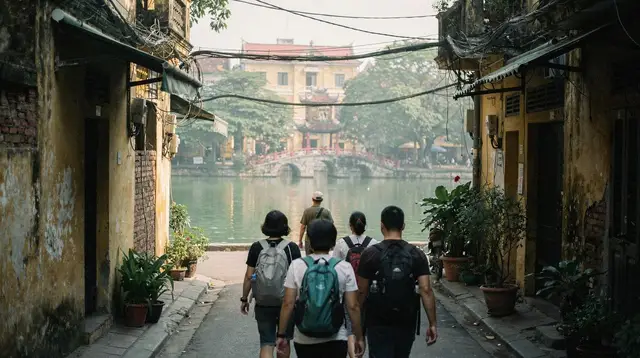
GetYourGuide does not provide a product photo for this activity — the image shows the meeting point, photographed by us.