Vietnam's Other Festivals and Public Holidays, Beyond Tet
Which Vietnamese festivals and holidays should I know about besides Tet?
Vietnam has a handful of national public holidays and several lunar festivals spread through the year, none of which close the country down the way Tet does. A national holiday usually means banks and offices pause and transport gets busier, while a lunar festival tends to affect one specific place, like a pagoda or a temple, rather than the whole city.
The calendar has more going on than just Tet
I used to think Tet was the only date on the Vietnamese calendar a traveller needed to worry about. It isn’t. Between the national public holidays and a string of lunar festivals, there’s a quiet rhythm to the year that I only picked up on after spending enough time moving between Hanoi and the villages and pagodas around it. None of it comes close to the scale of Tet, which I cover separately because it genuinely reshapes a trip — this page is the smaller, gentler stuff sitting around it.
The first distinction that took me a while to internalise is that a national public holiday and a lunar festival are not the same kind of event, and they don’t behave the same way.
National public holidays: quieter than you’d expect
Vietnam has a short list of national public holidays through the year — a new year’s day at the start of the Gregorian calendar, a spring day honouring the legendary Hung Kings that actually follows the lunar calendar rather than a fixed date, and a pair of holidays later in the year tied to liberation and to national independence. I’m deliberately not pinning these to specific days here, partly because a couple of them move with the lunar calendar and partly because I’d rather send you to an official Vietnamese calendar for the exact date in your travel year than risk printing one that’s already wrong.
What surprised me the first time I was in Hanoi for one of these holidays is how little actually changes on the ground. Banks close. Government offices close. Some larger companies give staff the day off. But the plastic stools are still out, the pho stalls are still steaming, and most family-run restaurants and shops carry on exactly as normal — busier, if anything, because it’s a day off for Vietnamese families too, and they’re eating out and visiting relatives just like anywhere else. That’s the confusion worth correcting: a national holiday is not a shutdown. Tet is the one holiday that behaves like that, and it isn’t close.
Where these holidays do matter for a visitor is transport. On the days around a national holiday, domestic flights, sleeper trains out of Hanoi station and the limousine minibuses that run toward Sapa, Ninh Binh and the coast fill up with Vietnamese travellers heading to see family or take a short break. If my own dates happen to land near one, I book those seats a little earlier than I otherwise would, and I expect the roads out of the city to be slower than usual for an hour or two.
Lunar festivals: local, cultural, and worth a detour rather than a plan
The festivals that follow the lunar calendar feel completely different in character. They’re not administrative holidays with an office closure attached — they’re cultural or religious moments, usually tied to a specific place, and they show up as a shift in atmosphere rather than a shutdown.
The Perfume Pagoda is the clearest example I’ve seen. Its festival season, rowed up the Yen stream in the first lunar months of the year, turns a normally peaceful boat ride into a genuinely packed pilgrimage, with boats queuing on the water and the trail up to the cave shrine full of families making the trip together. I still think it’s worth seeing, lunar festival or not, but I go in expecting a very different mood than a quiet weekday visit — more devotional crowd than tourist outing, and better suited to travellers curious about that side of Vietnamese life than to anyone chasing a calm morning out.
Later in the lunar year comes Mid-Autumn Festival, which is the one I’d actively try to catch if the timing works out. In the weeks before it, the streets around the Old Quarter, especially the lane known for lanterns and toys, fill up with mooncakes, paper lanterns and drums for the children’s processions that follow. It doesn’t close anything or complicate transport the way a national holiday can; it just makes the evenings in the old streets noticeably livelier, and I’d rank it among the nicer accidental things to stumble into on a Hanoi trip.
There’s also a mid-year festival tied to the summer solstice period, more of a household and market custom than a public spectacle, and a festival in the seventh lunar month connected to ancestor worship and Buddhist tradition, when you’ll notice more incense and offerings at temples like Tran Quoc Pagoda around West Lake. Neither is something to build an itinerary around, but both are part of why the city feels different depending on when you land.
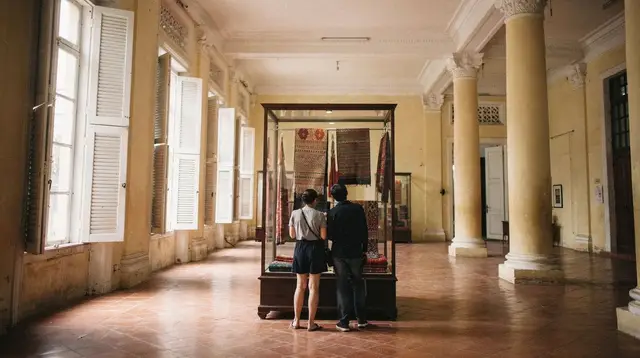
If the ancestor-worship side of these festivals interests you beyond what a temple visit alone explains, the Vietnam Museum of Ethnology is worth pairing with the trip — it’s the place I’d point anyone who wants the context behind what they’re seeing at a pagoda during the seventh lunar month, rather than just the atmosphere of it.
Festivals outside Hanoi: the same rhythm, smaller crowds
The same pattern — a quiet shift in atmosphere rather than a shutdown — plays out beyond the city too. Villages and pagodas around Ninh Binh, including the temples around the ancient capital of Hoa Lu, keep their own smaller local festival calendars, usually tied to a specific pagoda or communal house rather than announced anywhere a visitor would easily find. I’ve never planned a Ninh Binh day trip around one, and I wouldn’t suggest it — but if you happen to land on a festival day out there, treat it the same way as the Perfume Pagoda: a livelier, more local version of a place you’d otherwise see on a quiet weekday.
How I actually plan around all of this
Honestly, my approach has settled into something simple: I don’t try to time a Hanoi trip to hit or avoid any of these, the way I would with Tet. Instead, once I have rough dates, I check whether a national holiday falls inside them, and if it does, I book my transport out of the city a bit earlier than usual, whether that’s a night train toward Sapa or a limousine bus toward Ninh Binh or the coast. Everything else — restaurants, markets, day trips — I’ve never found meaningfully disrupted by these dates the way it can be during Tet.
If a lunar festival happens to land during my trip, I treat it as a bonus rather than a problem: a livelier evening in the Old Quarter for Mid-Autumn, or a busier but more atmospheric boat queue at the Perfume Pagoda. I also try to book ahead for anything popular rather than assume I can walk up, since Vietnamese travellers are often moving around the same country at the same time. For sights and museums inside the city, it’s still worth checking entrance details before you go, since a handful of state-run sites do close on the fixed national holidays even when everything else stays open.
An evening that lines up with a lunar festival is also a good excuse to catch the water puppet show in the Old Quarter, or to walk through Dong Xuan Market while it’s dressed up for the season rather than on an ordinary weekday — both are things I’d do anyway, but they feel better timed around a festival evening than a random Tuesday.
One thing this calendar rhythm has done for me is deepen a trip rather than complicate it. Watching a communal house festival unfold in a village like Dinh Bang, or catching lanterns going up before Mid-Autumn in the Old Quarter, has taught me more about how Vietnamese people actually mark time than any museum has. If that kind of thing interests you, a guided visit to a working communal house is a good way in.
a guided visit to Dinh Bang’s communal house and its local festival traditionsAnd if your trip is built around a longer loop through the north rather than a single city stay, keeping an eye on the lunar calendar mostly just means booking transport a touch earlier, not rearranging your route.
a multi-day loop through Hanoi, Sapa and Ha Long Bay, or a simpler public bus connection toward Ninh Binh, Sapa, Cat Ba and Ha Giang if you’re travelling on a tighter budget and want the flexibility to dodge a busy day.
What I’d skip worrying about
I’ve seen travellers get anxious about hitting Vietnam during “festival season” as if it were one continuous event like Tet. It really isn’t. Outside of Tet, nothing on this list has ever cost me a closed restaurant, a cancelled tour or a wasted day. The worst it’s done is add a queue at a boat dock or nudge me to book a train seat a day earlier than I would have otherwise.
If you want the one date that genuinely deserves careful planning, that’s Tet, the lunar new year — everything on this page is the calmer, more interesting texture sitting around it, including tea culture excursions that pair well with a quieter, festival-free stretch of the calendar.
a three-day tea culture trip to Thai Nguyen is one of the outings I’d genuinely plan for any time of year, festival or not — it doesn’t depend on any date on this page.
Questions travellers ask me about Vietnam’s other festivals and holidays
Do national public holidays close shops and restaurants in Hanoi?
Not systematically. Banks, government offices and some larger businesses close, but most street food stalls, family restaurants and shops stay open, sometimes even busier than usual, because Vietnamese families are out and about too.
Are these holidays fixed on the same date every year?
Some are fixed on the Gregorian calendar and some follow the lunar calendar, which shifts each year against our calendar. I’d rather point you to how each one behaves than pin a date I can’t guarantee will still be right by the time you read this.
Will a public holiday affect my train or bus booking?
It can. Domestic trains, sleeper buses and limousine minibuses toward Sapa, Ninh Binh, Ha Long and Cat Ba tend to fill up faster around national holidays, since it’s when Vietnamese families travel too, so I book a few days ahead if my trip falls near one.
Is the Hung Kings’ Temple Festival worth planning around?
It’s a genuinely interesting moment if you’re already curious about Vietnamese ancestor worship and national identity, but it’s mainly significant near the Hung Kings’ temples themselves rather than in Hanoi, and it isn’t essential to build a first trip around.
What about Mid-Autumn Festival — does it affect the Old Quarter?
Yes, in a nice way. In the weeks around it the streets selling mooncakes, lanterns and toys around the Old Quarter get noticeably more colourful and crowded in the evenings, which I’d actually recommend catching if your dates line up.
Should I avoid Vietnam during these festivals?
No — unlike Tet, none of these holidays or festivals should make you reconsider your dates. At most they add a bit of extra bustle to transport booking and to a handful of specific sites, and several of them are genuinely worth experiencing.
Where can I read about Tet itself?
Tet is different enough, and disruptive enough, that it gets its own page rather than a mention here — that’s where I cover what it actually means for a trip.
tours.Planning
Verified deep-linked GetYourGuide tours. Book through these links and we earn a small commission at no cost to you.
GetYourGuide does not provide a product photo for this activity — the image shows the meeting point, photographed by us.