Hanoi in November: What I Actually Pack and Where I Go
What is Hanoi like in November?
November sits at the tail end of the autumn stretch across northern Vietnam, generally clear and dry with good visibility. Mountain nights in places like Sapa and Ha Giang start to feel genuinely cool, so pack for evenings that are no longer warm, even if the days in Hanoi still feel pleasant.
Why November Still Feels Like Autumn to Me
Every year around this time I get the same message from a friend flying in: “It’s still hot there, right? It’s Vietnam.” And every year I have to explain, again, that Hanoi is not the postcard version of Vietnam most people carry in their heads. This is the north, on the same latitude as places that get real winters elsewhere in Asia, and November is when the city’s long autumn run is quietly wrapping up.
I don’t want to turn this into a month-by-month comparison — that’s what the best time to visit Hanoi page is for, and I’d rather send you there than re-litigate it here. What I want to talk about is what November actually feels like when you’re standing in it, because the gap between expectation and reality is where most packing mistakes happen.
In the city itself, the light is the thing I notice first. The sky tends to be clearer than what settles in over December and January, when a grey lid can sit over Hanoi for days. Walking around Hoan Kiem Lake or through the Old Quarter, the air generally feels less hazy, and photos from the top of the Temple of Literature or along West Lake tend to come out sharper. That clarity is the main gift of this stretch of the calendar.
The Mistake I See Every November
Here’s the part I actually want to correct, because I watch it happen constantly at drop-off points in Sapa and along the Ha Giang loop: people arrive dressed for a beach country. They’ve read “Vietnam,” packed accordingly, and then find themselves standing at an overlook near Fansipan as the sun drops, suddenly cold in a t-shirt and sandals.
I want to be careful here, because I’m not going to hand you a number. I’m not going to tell you it’s a specific temperature at night in the mountains, because that varies by elevation, by cloud cover, by the particular evening you happen to be there, and giving a false sense of precision is worse than giving none. What I can tell you honestly is this: it is not yet winter up there, but it is no longer warm once the sun goes down.
A fleece and a wind layer earn their space in your bag. If you’re doing a homestay near Mu Cang Chai or bunking down after a day on the Dong Van plateau, that evening chill is real enough that I’ve seen people buy extra blankets on the spot from a homestay owner who’s clearly used to this exact scene playing out.
Down in Hanoi and along the coast toward Ha Long Bay, the shift is much gentler — evenings there cool off the way any autumn evening does, nothing dramatic. It’s really the elevation gain in the north and northwest that changes the equation, not the calendar date on its own.
What I’d Actually Do With a November Trip
This is where November earns its reputation among people I know who plan trips here for a living: it’s generally a favorable stretch for both trekking and riding.
For trekking, the trails around Sapa and through the Muong Hoa valley tend to be in good shape this time of year — drier underfoot than the wetter months, and with those clearer skies giving you actual views instead of a wall of mist. I’ve done the walk down into the valley on a November morning and had the kind of unbroken sightline over the terraces that just doesn’t happen reliably in July. If a guided route sounds better than working it out solo, the two-day Sapa, Fansipan and Muong Hoa valley trip is the one I point people toward, mostly because it handles the transport logistics that otherwise eat a full day.
For riding, whether that’s a self-guided loop or sitting behind an easy rider, this is one of the more comfortable windows on the Ha Giang loop — cooler air makes the long riding days easier on the body, and the drier surface conditions matter more than people expect on some of those mountain roads. I’d still layer up before setting out in the morning.
Out toward the coast, Ha Long Bay cruises are generally running normally by November — the typhoon risk that shadows the summer months has mostly passed by this point, though I’d still keep an eye on the forecast in the days before departure rather than assume it’s a settled matter. If you want the classic overnight version, the two-day Ha Long Bay cruise from Hanoi is the one I book most often for first-time visitors, and if your schedule is tighter, the full-day Ha Long Bay trip from Hanoi still gets you out on the water and back the same night.
Closer to the city, this is also a pleasant month for something slower. I took a friend out to the tea hills on the three-day Thai Nguyen tea culture trip last November and the cool, clear mornings there were honestly one of the better parts of that whole visit — nothing dramatic, just easy walking weather among the tea rows.
How I’d Pack for It
If there’s one practical habit I’d pass on, it’s this: pack for two different climates in one bag if you’re leaving Hanoi. Light layers for the city and the lowlands, something warmer and windproof for any night spent at elevation in Sapa, Ha Giang, or Moc Chau. A lot of trip regret I hear about isn’t from bad weather — it’s from being under-prepared for weather that was never going to be extreme, just cooler than assumed.
Beyond that, I don’t think November needs much special engineering. It rewards people who move around rather than plant themselves in one place, which is more or less how I’d describe the whole northern circuit anyway — a loop through Ninh Binh, the bay, and the mountains, with Hanoi as the hinge in the middle.
FAQ: Hanoi and Northern Vietnam in November
Is November a good time to visit Hanoi?
Yes, generally — it falls within the clearer, drier stretch of the year across the north, and the visibility tends to be better than in the following winter months. For how it compares to other months, see the best time to visit Hanoi page.
Do I need warm clothes in Hanoi in November?
You’ll likely be fine with light layers in the city itself during the day, but bring something warmer for the evenings, especially if you’re heading up to elevation.
Is it cold in Sapa or Ha Giang in November?
Evenings get noticeably cooler than in Hanoi, and it can catch travelers off guard if they’ve packed only for a tropical climate. It isn’t winter cold yet, but it’s no longer warm after dark, so pack a proper layer.
Are the rice terraces still green or golden in November?
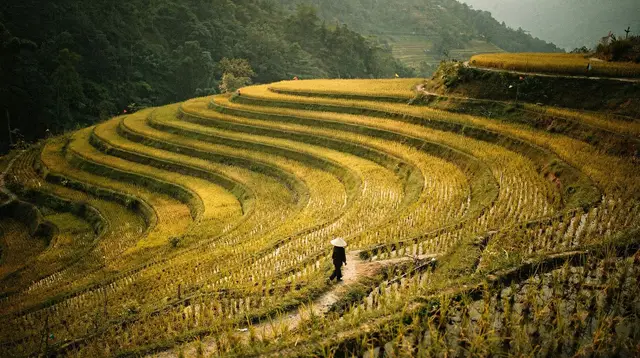
By November the main harvest colors have generally passed their peak; for the season-by-season picture, see rice terrace seasons in northern Vietnam.
Can I still go on a Ha Long Bay cruise in November?
Yes, cruises generally run as normal in November, once the summer typhoon risk has passed. It’s still worth checking the forecast close to your departure date; more on this in the Ha Long Bay cruise season guide.
Is November good for trekking around Sapa?
Yes, trail conditions and visibility both tend to work in your favor this month, which is part of why it’s a popular window for trekking; see the Sapa trekking guide for route options.
Is the Ha Giang loop rideable in November?
Yes, cooler and generally drier conditions make it one of the more comfortable months for the loop; the Ha Giang loop guide covers route planning and timing.
What should I pack for a November trip covering both Hanoi and the mountains?
Pack in layers: lighter clothing for Hanoi and the lowlands, plus a fleece or windproof layer for mountain evenings in Sapa, Ha Giang, or Moc Chau, where the temperature drop after dark is more noticeable than in the city.
Seasonal Guide
Verified deep-linked GetYourGuide tours. Book through these links and we earn a small commission at no cost to you.
GetYourGuide does not provide a product photo for this activity — the image shows the meeting point, photographed by us.