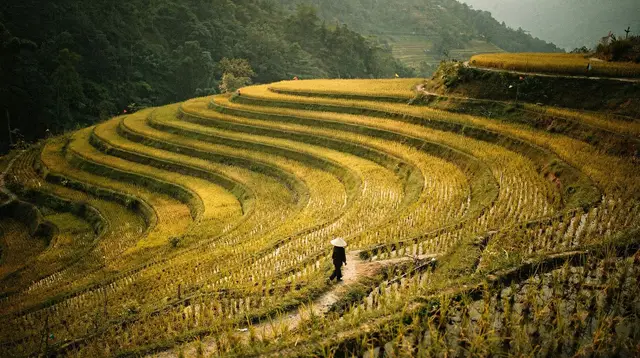
Rice Terrace Seasons in Northern Vietnam: Planting or Harvest?
Is there one rice terrace season in northern Vietnam, or two?
There are two, and they look almost nothing alike. In spring the terraces around Sapa, Mu Cang Chai and Ha Giang are flooded and mirror-like as they get planted, and later in the year they turn gold as the rice ripens for harvest. Exact dates shift from year to year and valley to valley, so check the monthly pages for the nuance.
The first time someone told me the rice terraces near Sapa were “in season,” I assumed that meant one thing — that there was a window, and either you caught it or you didn’t. It took me two trips to realize that’s wrong. Northern Vietnam’s terraces, whether you’re looking at them above the Muong Hoa valley, across the slopes of Mu Cang Chai, or along the switchbacks of the Ha Giang loop, actually go through two completely different photogenic moments in a single year, and travelers routinely turn up expecting one and find the other.
Two seasons, not one
The confusion is understandable. “Rice terrace season” gets used online as though it describes a single fixed period, the way people talk about cherry blossom season or foliage season elsewhere. In the north of Vietnam it’s really two separate events, months apart, with a long stretch of ordinary green growing in between.
The first is planting, in spring. Farmers flood the terraces to prepare them, and for a few weeks the water sits in each stepped field, catching the sky. On a clear morning the whole hillside becomes a staircase of mirrors — grey when it’s overcast, blue when it isn’t, sometimes streaked pink at sunrise. This is the version of the terraces you see in a lot of drone photography, and it photographs completely differently from what most people picture when they hear “rice terraces.”
The second is harvest, later in the year, when the rice has ripened and the whole landscape shifts to gold, amber and rust. This is the classic postcard image — the one most people actually mean when they say they want to see the terraces “in season.” The fields are dry by then, the grain heavy on the stalk, and entire valleys change color within what feels like a short stretch of time.
Between those two windows, the terraces are simply green. Growing rice looks like growing rice; it’s a working agricultural landscape rather than a spectacle. I don’t think that’s a disappointment exactly, it’s just not what most visitors are picturing when they plan a trip around “seeing the terraces.”
Why I won’t give you a fixed calendar here
I’m deliberately not naming exact months or weeks for either window on this page. Planting and harvest timing depends on altitude, on each valley’s own irrigation schedule, and on the particular year’s weather, and it shifts noticeably between Sapa, Mu Cang Chai and the Dong Van plateau around Ha Giang. A date that’s accurate for one valley in one year can be off by weeks somewhere else.
Rather than print a calendar that goes stale, I’d rather send you to the pages built to track that nuance: the best time to visit Hanoi hub, and the monthly breakdowns for whichever month you’re actually considering, from Hanoi in March and Hanoi in April through to Hanoi in September and Hanoi in October. Those pages are where I’ll be specific about a given month; this one is about not confusing the two seasons in the first place.
What each season actually feels like on the ground
Planting season in the mountains overlaps with the region’s damper spring weather — misty mornings, a persistent light drizzle some days, and terraces that hold water and reflect whatever light gets through the cloud. It’s quieter than harvest season for tourism, and the light can be moody rather than crisp. If you’re trekking through the Muong Hoa valley below Fansipan during this window, expect soft, sometimes grey scenery rather than saturated colour, and be ready for muddier trails.
Harvest season tends to fall in a clearer, drier stretch of the year in the mountains, which is part of why it’s the more popular window. The terraces turn gold in sequence rather than all at once — lower fields first, higher ones later, so a single valley can show you green, gold and already-cut terraces within the same walk. It’s also, unsurprisingly, the busier time to be trekking, staying in a homestay in Mu Cang Chai, or driving the Ha Giang loop past the Ma Pi Leng Pass.
Planning around which one you actually want
If reflections and mist are what you’re after, plan for the planting window and read up on the specific month before you commit — I’d start with the rice terrace and season guide and the trekking in the rainy season notes, since that window overlaps with wetter trail conditions. If it’s the gold, ripe-field look you’re chasing, aim for the harvest window and expect more company on the trail, especially around well-known viewpoints.
Either way, I’d build the terraces into a wider loop rather than a single stop. A short Sapa multi-day tour or the longer Ha Giang loop multi-day tour both give you more than one valley and more than one elevation, which matters because timing varies between them.
For something with a driver handling the mountain roads, a two-day Sapa and Fansipan trip through the Muong Hoa valley is a manageable way to see the terraces without organizing transport yourself, and if you’re combining the mountains with the rest of the north, a five-day highlights route through Hanoi, Sapa and Ninh Binh covers a lot of the terrain this page talks about in one trip.
For a longer version that also folds in Ha Long Bay, a six-day Vietnam highlights itinerary linking Hanoi, Sapa and a Ha Long cruise is worth a look, and if tea terraces rather than rice terraces are part of the appeal, a three-day Thai Nguyen tea culture trip shows a related but distinct kind of terraced landscape closer to Hanoi.
I’d also flag one thing that trips people up: some itineraries advertised around “terrace season” actually describe the trekking season more broadly, which is a slightly different question from when the fields themselves look their best. If terrace colour is your priority, ask specifically about that, not just about trekking conditions, when you’re booking anything timed around it.
For the wider picture of how the north’s climate shapes a trip beyond the terraces, the mountain climate in Sapa and Ha Giang page and the rainy season in northern Vietnam page are both useful companions to this one, and if you’re weighing which mountain region to prioritize at all, Sapa vs Ha Giang covers that comparison directly.
Seasonal Guide
Verified deep-linked GetYourGuide tours. Book through these links and we earn a small commission at no cost to you.
GetYourGuide does not provide a product photo for this activity — the image shows the meeting point, photographed by us.