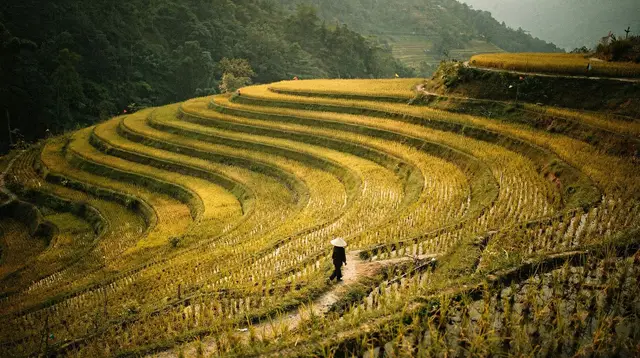
Trekking in the Rain: How Mud Changes Northern Vietnam's Trails
Does rain make trekking in northern Vietnam more difficult?
Yes. From roughly May to September, heavy downpours turn clay and rice-terrace paths into slippery mud, which changes how hard a trek feels far more than its distance does. Autumn (roughly October–November) is generally considered the best trekking season, not summer, despite summer falling in the school-holiday period.
Why the calendar matters more than the map on a northern Vietnam trek
Most people planning a trek in northern Vietnam start with a map: how far is it from Hanoi, how many kilometres, how much altitude gain. Those numbers matter, but there’s a second variable that changes the experience of a trail more than distance ever does, and it barely shows up in itinerary descriptions: what the ground is made of that week.
Across Sapa, Pu Luong, Mai Chau and Mu Cang Chai, the classic trekking routes run along the raised earth bunds between rice terraces, down clay footpaths through forest, and across streams that rise and fall with the rain. In dry conditions these are firm, grippy and forgiving of a slip. After a heavy downpour, the same clay becomes a slick, sucking surface that can turn a gentle stroll into a genuinely tiring, concentration-heavy walk — not because the route got longer, but because every step now needs to be placed with care.
This guide is about that seasonal shift: when it happens, why it happens, which areas it affects most, and how to plan around it whether you’re booking a guided day trek or putting together a longer independent route. For the treks themselves — the specific valleys, villages and viewpoints — see the destination and guide pages linked throughout; this page focuses on the one factor that changes how those routes actually feel underfoot.
The rainy season, in plain terms
Northern Vietnam has four real seasons, and that surprises a lot of visitors who associate the country with the tropical south. Broadly: spring (roughly March–April) is mild and damp, with the fine, persistent drizzle known locally as mua phun; summer (roughly May–September) is hot, very humid and wet, with a typhoon risk from around July to September that can also affect the coast and bay cruises; autumn (roughly October–November) is dry, clear and warm, and is widely considered the best season for outdoor activity in the north; winter (roughly December–February) is cool and grey in Hanoi, and noticeably colder in the mountains around Sapa, Ha Giang and Cao Bang.
The trekking-relevant part of that calendar is the summer stretch. Roughly May to September brings the heaviest and most frequent rain to the trekking areas of the north, and that’s precisely the period when clay paths, terrace bunds and forest trails hold the most water. It’s worth being specific about what this guide will and won’t claim: exact rainfall totals, number of rainy days per month and temperature figures drift between sources and years, so none are given here — the point that matters for planning a trek is the pattern (wet season roughly May–September, dry season roughly October–April, with the shoulder months of spring and early autumn in between), not a precise number.
The idea to unlearn: summer is not the best trekking season
There’s a common assumption, especially among visitors booking around school holidays, that summer is the natural time to plan an active outdoor trip to northern Vietnam. It’s an understandable assumption — summer is when families travel — but for trekking specifically it runs backwards. Summer is the rainy season in the north. The trails are at their muddiest, the humidity makes uphill sections harder work, visibility on ridgelines can be poor, and the typhoon season adds a layer of unpredictability that can also disrupt transport and cruise schedules elsewhere on a trip.
Autumn, roughly October to November, is the season most local guides and repeat visitors point to as the best trekking window: the rains have mostly cleared, the air is dry, and in areas like Mu Cang Chai the rice terraces are also at their most photogenic, turning gold around harvest time. Spring, particularly later spring, can also work well once the persistent early drizzle has eased, though it tends to be more humid underfoot than autumn. If a trip has to happen in summer for other reasons — work schedules, school holidays, a fixed window — that’s a reasonable trade-off to make deliberately, but it’s worth making it knowingly rather than assuming summer is simply the “normal” time to trek.
How mud actually changes a trek
Distance and elevation gain describe a route on paper. Trail surface describes what it’s like to actually walk it, and that’s where rainy-season conditions have the biggest effect:
- Pace slows down. Careful foot placement on slick clay takes longer than a confident stride on a dry path, even on flat ground.
- Descents get harder than ascents. Going uphill on wet clay is often more about traction; coming back down the same slope is where most slips happen, because gravity is now working against control rather than effort.
- Terrace bunds narrow and soften. The raised earth paths between rice paddies, a defining feature of treks around Sapa and Mu Cang Chai, are only 20–30cm wide in places; wet and slippery, they demand full attention rather than the easy stroll they can be in dry weather.
- River crossings change day to day. Streams that are a simple step-across in the dry season can rise after heavy rain, particularly in Pu Luong and around Mai Chau, and a route that was fine the week before may need a different crossing point or a guide’s local knowledge of the day’s water level.
- Forest sections get slicker and darker. Shaded, root-covered trail through forest holds moisture longer than open terrace paths and dries out more slowly after rain stops.
None of this means rainy-season trekking is unsafe by default — guided treks around Sapa and Cat Ba National Park run through the wet months, and local guides are used to reading trail conditions and adjusting accordingly. It does mean that a route graded “easy” in a dry-season brochure can feel considerably more demanding after a week of rain, and that grading systems based purely on distance and elevation can be misleading. For a broader look at how trek difficulty is actually assessed, see the difficulty-levels guide.
Where it matters most
Not every part of the north is affected equally. The terraced, clay-heavy landscapes are the most rain-sensitive:
| Area | Terrain type | Rainy-season effect |
|---|---|---|
| Sapa / Muong Hoa valley | Rice terrace bunds, forest trail, some altitude | Terrace paths become slick and narrow; higher trails near Fansipan can be cold and misty on top of the mud |
| Pu Luong | Limestone hills, terraces, stream crossings | Stream levels rise; forest sections hold moisture longer |
| Mai Chau | Valley floor, gentler terrain, village paths | Generally more forgiving, but low-lying paths can turn to mud puddles |
| Mu Cang Chai | Steep terrace systems, higher altitude | Steep terrace edges become the most slip-prone terrain in the north |
| Ha Giang loop | Mostly paved or graded mountain roads | Different hazard: fog, reduced visibility and landslide risk on roads, rather than mud underfoot |
Note that the Ha Giang loop, usually ridden by motorbike rather than walked, is affected differently — see the motorbike season and fog guide for that side of the picture rather than assuming the same mud logic applies there.
Practical adjustments, not cancellation
Rainy-season conditions are a reason to plan differently, not necessarily a reason to skip trekking altogether if that’s the only window available.
Footwear: closed, grippy trekking shoes with real tread outperform trail runners or sandals on wet clay. Many local guides in Sapa and Pu Luong switch to simple rubber boots for the muddiest sections, and some operators can rent or supply them — worth asking when booking.
Poles: a pair of trekking poles makes a noticeable difference on slick descents and unstable terrace bunds, and they’re light enough to carry even on a shorter day trek.
Pace and route flexibility: build slack into a multi-day itinerary rather than a tight schedule. A guide with current, local knowledge of which sections have turned muddy that week is worth more than a rain forecast checked from Hanoi. This is one of the practical advantages of a guided trek over a fully independent one in the wet months — see the group versus private tour comparison for how that trade-off plays out more broadly.
Layering for humidity: rain in the north comes with high humidity, so breathable layers matter as much as waterproofing; a heavy waterproof shell that doesn’t breathe can leave you just as wet from sweat.
Timing within the day: many local guides start earlier in the rainy season to get the most exposed or steepest sections done before afternoon downpours build, which are more common later in the day during summer.
Booking a guided trek around rainy-season conditions
A local guide’s value goes up, not down, in wet conditions — they know which terrace paths are currently passable, where a stream crossing has become unsafe, and how to re-route a day trek on the spot. For a first outing in wet-season conditions, or for anyone unsure how their own fitness and balance handle slick clay, a guided option is the more forgiving choice.
Around Sapa, guided day treks continue year-round and are a practical way to test conditions before committing to anything longer: a locally guided trek through the valleys around Sapa or a one-day guided trekking tour that adjusts pace and route to the day’s conditions.
For those based in Hanoi without time for the journey north, a shorter guided walk closer to the city offers similar terrain logic on a smaller scale: a Lung Cung trekking day out from Hanoi with a local guide.
On the coast, Cat Ba Island’s national park has its own limestone-forest trails, less clay-heavy than the terrace routes but still worth guiding in wet weather: a guided trek through Cat Ba National Park, or a shorter version with a half-day trekking route through the park for a lighter introduction.
Multi-day treks in the rainy season
The trade-offs above matter more on a multi-day trek than on a single guided day out, because there’s less room to simply reschedule around one bad afternoon. A two-day route gives a guide the chance to read conditions on day one and adjust the second day’s pace or path accordingly, which is one reason multi-day treks with an overnight homestay tend to handle rainy-season mud better than a fixed point-to-point itinerary booked well in advance. Around Sapa, that might mean a two-day trek through the valleys and villages around Sapa, with a homestay night splitting the walking into two shorter, more manageable days rather than one long push.
West of Hanoi, the same logic applies to a two-day trip from Hanoi to Pu Luong through its ethnic villages, where the valley-floor sections stay walkable even when the higher limestone trails get greasy after rain. On the coast, a mixed day that swaps some walking for paddling is also a sensible rainy-season adjustment: a one-day trek-and-kayak combination in Cat Ba National Park spends less time on the muddiest forest sections without cutting the day short.
For those with more time and a genuine interest in the terrain rather than just a single highlight, the Sapa trekking guide and the Pu Luong trekking guide go into route-level detail that this page doesn’t try to duplicate — worth reading once a season and a general area are chosen, since the right multi-day route depends as much on fitness and time available as on the weather.
A Sapa homestay night also does double duty in wet weather: it’s a dry, warm break partway through a route, and a chance for a local host to give a same-day read on which sections further along have turned muddy, which is often more current than anything a guide arranged in Hanoi can offer in advance.
Planning the rest of the trip around the same logic
Rainy-season mud isn’t the only weather-driven planning factor in the north — it connects to broader seasonal decisions worth making together rather than in isolation. The rice terrace season guide explains when the terraces are green versus golden, which matters for photography as much as for trail conditions.
The rainy season overview covers what wet weather means for the rest of a trip beyond trekking, including cruise cancellations on the bays. And because Sapa, Ha Giang and Cao Bang run noticeably colder and wetter than Hanoi at various points in the year, the mountain climate guide is worth reading alongside this one before packing.
For a wider view of when to visit the north at all — not just for trekking — see the best time to visit Hanoi, which lays out how the same seasonal pattern affects the city, the bays and the mountains differently.
Choosing a trek that fits the season, not just the calendar
If the trip dates are fixed in the rainy season, the more useful adjustment is choosing a gentler route rather than cancelling outright. Mai Chau’s valley-floor paths are generally more forgiving in wet weather than the steep terrace edges of Mu Cang Chai, and a shorter, well-guided day trek reduces exposure to the sections most likely to be genuinely difficult. If the dates are flexible, shifting toward autumn changes the experience more than almost any other single decision — drier trails, clearer views and, in many areas, the terraces at their most spectacular.
Either way, the trail itself deserves more attention in trip planning than it usually gets. A route’s length on a map is only half the story in northern Vietnam; what the season has done to the ground underfoot is the other half.
Seasonal Guide
Verified deep-linked GetYourGuide tours. Book through these links and we earn a small commission at no cost to you.
GetYourGuide does not provide a product photo for this activity — the image shows the meeting point, photographed by us.