Hanoi in September: A Month of Transition
Is September a good time to visit Hanoi and northern Vietnam?
September is a transition month: the summer monsoon gradually loosens its grip on the north, but typhoon risk is still real in the first half of the month, especially for the bays. Conditions tend to settle down by the closing weeks, which is why many travellers treat late September as the real start of the best season rather than the whole month at once.
Why I never fully trust the first half of September
I’ve stopped thinking of September as a single season. It behaves more like a hinge between two very different moods: the humid, unpredictable summer that has dominated the north since around May, and the calmer, clearer stretch that everyone actually plans their trip around, covered on its own in my best time to visit Hanoi piece. September sits right on that hinge, and which side of it you land on can shape your whole trip.
The honest way I describe it to friends: the summer rainy season is running out of energy, but it hasn’t left the building yet. Early in the month, the same weather systems that build up over the South China Sea through the summer can still spin into typhoons that brush or cross northern Vietnam. I don’t put a number on how often this happens in a given September, because it varies wildly year to year, but I always keep an eye on it if I’m booking anything involving a boat.
The part that actually affects your itinerary: the bays
If there’s one place September’s instability shows up most, it’s on the water. A tropical system tracking anywhere near the Gulf of Tonkin can mean cruise operators on Ha Long Bay suspend departures for safety, sometimes with only a day or two of warning. I’ve written more on how that works, and what operators typically offer instead of a refund, in the typhoon cancellation policy guide — it’s worth reading before you commit to non-refundable dates. The broader rhythm of the cruising calendar, including why some captains treat September as still slightly risky, is in my Ha Long Bay cruise season overview.
None of this means cancel your plans. It means build in slack. If a Ha Long departure gets pushed, having a spare day in Hanoi or a flexible booking window saves the trip. When conditions do cooperate, and they very often do, a cruise through the bay in September has the same scenery as any other month, just with fewer crowds than the October and November peak. I usually point people toward an overnight option, and this is one of the itineraries I book most for early autumn clients:
a two-day Ha Long Bay cruise from HanoiIf someone only has a single free day and wants to hedge against a possible weather delay, a day trip is the lower-commitment option:
a full-day Ha Long Bay trip from HanoiWhat’s happening in the highlands (and what I’m not going to tell you here)
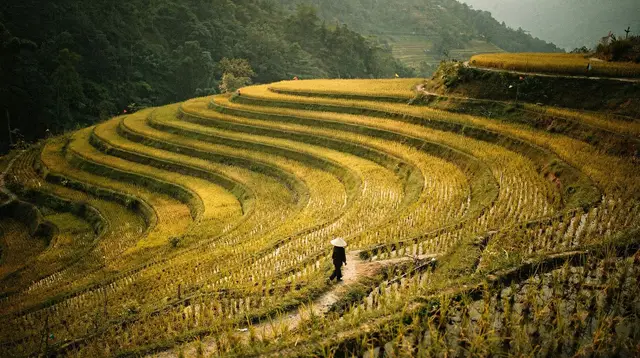
If you follow northern Vietnam travel content at all, September is also the month people start talking about rice terraces. I want to be careful here, because it’s easy to blur two completely different pictures together. The terraces you see photographed with young, waterlogged, mirror-green paddies belong to spring planting season — a different look, a different set of months, a different mood entirely. What starts happening in the high country around September is the harvest, when the same terraces turn gold rather than green.
I go into exactly when that shift happens, how it varies by elevation and region, and why a terrace in Sapa doesn’t turn at the same pace as one in Mu Cang Chai, in a dedicated piece on rice terrace seasons in northern Vietnam — that’s the page to read before you plan a trip around the terraces themselves, not this one.
What I will say here is that September is a reasonable month to be up in that part of the country if the terraces are your draw, because the transition in the highlands roughly tracks the transition down in Hanoi: less monsoon instability as the month goes on, cooler and clearer air moving in from the north. If you’re weighing a highlands trip against time in Hanoi and the bays, my multi-day tours from Hanoi guide lays out how people usually split the time.
Hanoi itself, day to day
In the city, September doesn’t feel dramatic. The heaviest, stickiest stretch of summer is easing, and there’s a sense — subtle, not sudden — that the year is turning a corner. I still keep a light rain layer in my bag the whole month, because a downpour can arrive with little warning even on an otherwise calm day, a habit left over from the deeper monsoon months. Walking the Old Quarter, sitting at a bia hoi corner, or wandering around Hoan Kiem Lake in the early evening all feel exactly like they do the rest of the year — this is a month that changes the sky and the water more than it changes the streets.
It’s also a fine month for day trips that don’t depend on calm seas. Ninh Binh, with its river caves and karst scenery, isn’t exposed to the same cancellation risk as a bay cruise, which makes it one of my go-to recommendations for early September when I’m not sure how a client’s dates will line up with the weather. My day trips from Hanoi guide covers the full spread of options if the coast doesn’t cooperate.
Two very different Septembers, packed into one month
If I had to summarise it, I’d say September gives you two different trips depending on which week you land in. The first half asks for flexibility: watch the forecast, don’t lock in a single non-refundable cruise date, and have a backup plan that doesn’t involve open water. The second half tends to reward patience — this is usually when the sky clears, the humidity drops off, and the month starts to resemble the calmer stretch that runs into October. I don’t attach fixed dates to that shift because it moves year to year, but travellers I’ve worked with consistently describe the last week or two of September as noticeably more settled than the first.
For a longer trip that spans both moods, I often suggest pairing lowland time with a highland stretch, since a spell of coastal instability rarely affects the mountains the same week. A structured week like my seven days north Vietnam classic itinerary naturally absorbs a weather hiccup on one leg without derailing the rest.
If tea country appeals more than a cruise or a trek, September is also a pleasant month to slip away from the crowds entirely:
a three-day Thai Nguyen tea culture trip from HanoiAnd for travellers based in Hanoi who want a shorter cultural detour that isn’t weather-dependent at all, I regularly recommend:
a guided visit to the Dinh Bang communal house near HanoiFrequently asked questions about visiting Hanoi in September
Is Ha Long Bay safe to visit in September?
Most of the month is fine, but early September carries genuine typhoon risk in the Gulf of Tonkin, and cruise operators will cancel or reroute departures for safety when a system is tracking nearby. Book with an operator that has a clear rescheduling policy and avoid non-refundable single-date bookings if you can.
Are the rice terraces ready to see in September?
The terraces move into their harvest period around this time of year, turning from green to gold, but the exact timing varies by region and elevation and isn’t something I’ll pin to a date here. See the dedicated rice terrace seasons guide for the specifics.
Is September the rainy season in Hanoi?
September is the tail end of the rainy season rather than its peak. Rain becomes less frequent and less intense as the month goes on, but I never treat any single September date as guaranteed dry, especially in the first half.
Should I book a Ha Long Bay cruise or a day trip in September?
If your dates are flexible, a cruise gives you more time on the water and better odds of good conditions on at least one of the days. If your schedule is fixed and inflexible, a day trip limits your exposure to a single-day cancellation rather than losing an overnight booking.
Is late September better than early September?
In my experience, yes. The back half of the month tends to be calmer and clearer than the first, though this shifts from year to year and I wouldn’t build a trip around a specific week without checking the forecast closer to your dates.
Can a typhoon affect Hanoi city itself, not just the coast?
Systems that stay offshore mainly bring wind and rain to Hanoi rather than the direct impact felt on the coast. It’s rarely severe in the city, but it can still mean a wet, blustery day or two.
Is September a good month for trekking in the mountains?
It can be, especially as the month progresses and the weather stabilises, but trail conditions after a wet summer are worth checking locally before a serious trek — see my trekking rainy season and mud guide for what to expect underfoot.
How does September compare to October in Hanoi?
October is generally the more settled of the two, which is why I treat it as the start of the region’s best season. September is the run-up to that — worthwhile, but with more day-to-day variability, particularly early on. My Hanoi in October piece picks up where this one leaves off.
Seasonal Guide
Verified deep-linked GetYourGuide tours. Book through these links and we earn a small commission at no cost to you.
GetYourGuide does not provide a product photo for this activity — the image shows the meeting point, photographed by us.