Hanoi in April: What It's Actually Like
What is Hanoi like in April?
April sits at the tail end of the mild, damp spring window across the whole north, from Ninh Binh's karst up to the mountains around Ha Giang, with warmth building steadily as the summer monsoon approaches. It's a generally easy month to travel in, though haze can dull mountain views on any given day.
I keep coming back to Hanoi in April, and I still can’t give it a single clean label. It isn’t the crisp, golden stretch that autumn gets credit for, and it isn’t the soaked, sticky middle of summer either. It sits in between — the tail of a mild, humid spring that covers the whole north, from the flat karst fields around Ninh Binh up to the switchbacks near Ha Giang — with the heat building day by day toward the monsoon that’s still a little way off. If you want the full seasonal picture rather than one month’s slice of it, I’d point you to the best time to visit Hanoi guide first; this is really just my notes on what April specifically feels like on the ground.
Mornings that don’t rush you
What I notice most in April is the pace of the mornings. The air is soft rather than sharp, often carrying that fine, almost invisible drizzle the locals call mua phun — not the kind of rain that ruins a day, more the kind that puts a light sheen on the Old Quarter’s pavement before nine a.m. and then quietly disappears. Walking around Hoan Kiem Lake at that hour, before the motorbikes really pick up, is one of the small rituals I look forward to every time I’m back in this city this time of year.
By midday things warm up noticeably, and the humidity climbs with the temperature. I don’t try to put a number on either — it changes year to year, and honestly the number matters less than how you dress for it. Layers are the whole strategy: something light for the city, something with sleeves for the evening, and a compact rain shell that lives in my bag the entire month whether or not I use it.
South to the karst
Ninh Binh is where I usually send the first free day. It’s close enough — a couple of hours south of Hanoi — that the same soft spring air follows you there. Rowing through Trang An or Tam Coc in April, the limestone towers sometimes stand out crisp against the sky and sometimes soften into pale grey shapes further back, depending entirely on the day’s haze.
I’ve had both kinds of afternoons here in the same week, so I’ve stopped expecting one or the other. If you want a fuller sense of how the whole karst region behaves through the seasons, the karst landscapes guide covers more than I will here. For the boats specifically, the Trang An boat guide is worth a look before you go, since queueing and timing shift a little with the season.
Ha Long Bay, further east, follows a similar pattern in April. It’s well ahead of the typhoon-risk months of summer, so cancellations are unlikely, and cruises run on their normal schedules. I’ve cruised out of Hanoi on an overnight boat in April and watched the karst islands sharpen and blur again within the same afternoon as low cloud drifted through. It didn’t ruin anything — if anything it made the bay feel a bit more atmospheric than the postcard-blue version everyone expects.
North to the mountains, with patience
Ha Giang and Sapa are where April asks a little more of you. The switchback roads through Dong Van and the wider Dong Van plateau can sit under cloud for a stretch of the morning before clearing, or not clear at all that day. I’ve learned not to build a Ha Giang loop itinerary around one specific viewpoint on one specific day — I give myself an extra day where possible, or at least keep expectations loose about which pass will actually be visible when I get there.
Sapa behaves the same way. Mornings in the Muong Hoa valley can start grey and mist-bound, then open up by mid-afternoon, or they can stay closed in the whole day. It doesn’t feel like wasted time to me — walking through terraced hillsides half-hidden in cloud has its own quiet appeal — but if a specific photo is the whole point of the trip, April’s mountain haze is a real variable to plan around. For the mechanics of trekking there, the Sapa trekking guide is more useful than anything I could summarize in a paragraph.
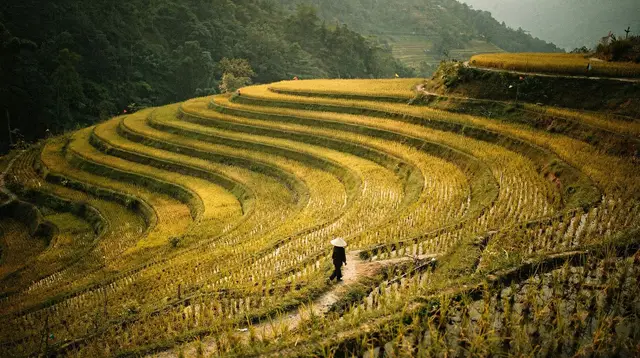
As for the terraces themselves, I don’t try to guess from April alone whether they’re green, flooded, or bare — planting timing shifts year to year and area to area. The rice terrace season guide tracks that calendar properly; I check it every time before I build a trip around Mu Cang Chai or the valleys near Sapa. The terraces guide fills in the rest of the practical detail.
What I’d actually book
If I only had a handful of days in April, I’d split them between the bay and the mountains rather than trying to do everything. A two-day cruise out to Ha Long Bay gives the karst scenery room to reveal itself over two mornings instead of one rushed afternoon, which matters more in a hazier month like April. For a shorter window, a full-day trip out to Ha Long Bay still works, just with less flexibility if the weather doesn’t cooperate.
For the mountains, I lean toward a two-day trip into Sapa, Fansipan and the Muong Hoa valley — two days give the mist a chance to lift at least once. And if you’d rather stay closer to Hanoi and skip the long transfers entirely, a three-day trip into the Thai Nguyen tea hills is a gentler, lower-altitude way to spend a few spring days without betting everything on clear mountain weather.
The short version
April doesn’t hand you guarantees, and I wouldn’t tell you it’s objectively the best month to come — no single month is, and I’m wary of anyone who claims otherwise. What it does offer is a workable, mild stretch across the whole north: warm enough to enjoy, not yet deep into the summer humidity, with the karst and the mountains both open and running normally. Plan for a little haze, pack a light rain layer, and build in one spare day if the mountains are part of the plan. For the fuller comparison across the whole year, the seasons overview is still the page I’d start from — this one is just what April, specifically, has looked like to me.
Beyond the bay and the mountains, April is also a fine month for slower days back in the city — wandering Hoan Kiem Lake, or planning a four-day loop through Ninh Binh and Ha Long Bay if you want both landscapes without rushing either. And if the karst pulls you in the way it pulls me in every time, the Ninh Binh activities page is a good place to see what else fits around the boat rides.
For something quieter and more hands-on than a cruise or a trek, a three-day trip out to the Na Hang waterfalls is one I’d genuinely consider in April, when the softer light suits that kind of scenery better than the flat glare of summer.
Seasonal Guide
Verified deep-linked GetYourGuide tours. Book through these links and we earn a small commission at no cost to you.
GetYourGuide does not provide a product photo for this activity — the image shows the meeting point, photographed by us.