Cao Bang & Ban Gioc Loop: The Northeast Motorbike Route
Is the Cao Bang loop the same trip as Ha Giang?
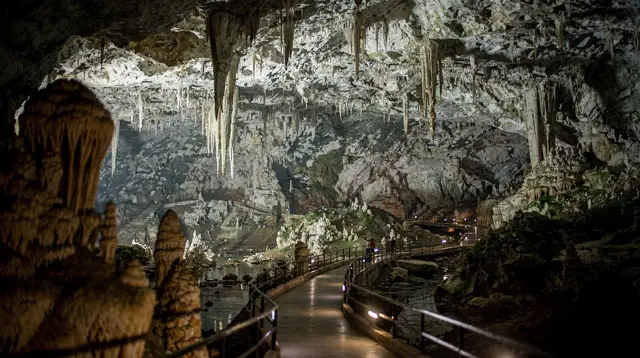
No. Cao Bang and Ha Giang are separate provinces in Vietnam's far north, each with its own loop route, and they are not combined into a single trip. The Cao Bang loop centres on Ban Gioc waterfall and Nguom Ngao cave, while Ha Giang centres on the Dong Van plateau.
A quieter route to the northeast border
The Cao Bang loop belongs to the same family of trips as the far better known Ha Giang loop guide: a multi-day motorbike or car route through the mountains of northern Vietnam, built around a handful of natural landmarks and the roads that connect them. What sets it apart is that far fewer riders make the trip.
Where Ha Giang’s Dong Van plateau now sees a steady stream of rental bikes and tour groups, Cao Bang’s roads, terraced valleys and karst outcrops still feel largely local. The anchor of the route is Ban Gioc waterfall, a wide, multi-tiered cascade on the Quay Son river that marks part of the border with China, paired on most itineraries with the nearby limestone chambers of Nguom Ngao cave.
This page sets out the shape of the loop, how it compares with Ha Giang, and what to check before you book a self-drive trip or a guided tour. We deliberately avoid stating ticket prices, opening hours, water flow or exact kilometre distances here, because these details shift with season, river conditions and local management, and a wrong number is worse than no number. Check them with your tour operator or accommodation close to your travel dates.
Where Cao Bang sits relative to Ha Giang
Cao Bang and Ha Giang are both provinces in Vietnam’s mountainous far north, both popular with motorbike travellers, and both reachable as multi-day loops out of Hanoi. Beyond that, they are separate destinations with separate road networks, separate start and end points, and separate signature landmarks: Ha Giang for the Dong Van Karst Plateau and the Ma Pi Leng Pass, Cao Bang for Ban Gioc waterfall and the caves and villages around it.
A frequent point of confusion among first-time visitors is assuming these two loops can be strung together into a single continuous trip, riding from Ha Giang’s plateau roads straight into Cao Bang or vice versa within the same multi-day itinerary. In practice, tour operators and most independent riders treat them as two distinct trips, each typically started and finished from a common base such as Hanoi or a provincial hub, rather than linked directly to one another.
If you want to see both regions, the more common approach is to complete one loop, return to a base, and then set out on the second, or to plan two separate visits to northern Vietnam altogether. Riders short on time often have to choose one province over the other rather than attempting both in a single week.
What the loop covers
A typical Cao Bang loop moves through a sequence of stops built around the provincial town of Cao Bang as a base, with riders fanning out to the region’s landmarks over two to three days rather than following one straight line. The core elements that most itineraries share:
- Ban Gioc waterfall, the visual highlight of the trip, where the Quay Son river drops in tiers across a wide rock shelf near the Chinese border. Bamboo rafts operated locally are a common way to get closer to the falls.
- Nguom Ngao cave, a large limestone cave system a short ride from Ban Gioc, with lit walkways through chambers of stalactites and stalagmites.
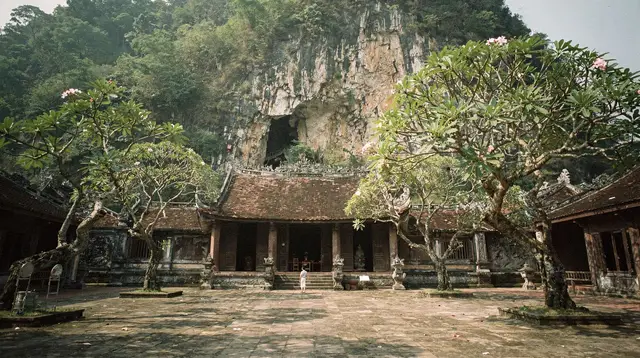
- Villages and terraced valleys along the route, home to several of the region’s ethnic minority communities, with rural roads winding between limestone hills.
- Mountain passes and viewpoints connecting the stops, similar in character to the switchback roads of Ha Giang, though generally quieter.
Because this is a border region, expect a mix of paved provincial roads and smaller village lanes, with road quality varying by season. Riders coming from Hanoi typically factor in a full day of travel each way, which is part of why the loop is usually sold as a two- to three-day package rather than a rushed overnight trip.
Guided loop options compared
Several operators run this route as a set-departure or private tour, with the main differences being trip length, mode of transport and whether trekking is included alongside the riding.
| Tour | Length | Style |
|---|---|---|
| Cao Bang loop covering the waterfall and surrounding villages | 2 days | Motorbike loop, waterfall and village focus |
| a 3-day loop of the region by bicycle | 3 days | Bicycle touring |
| a 3-day loop that adds guided trekking between village stops | 3 days | Loop plus trekking |
| a single-day trip out of Hanoi that also touches Ninh Binh | 1 day | Fast overview, minimal riding |
Riders who want more time on two wheels and less structure sometimes book an easy-paced Cao Bang loop run by a local rider group, which spreads the same core stops over a slower schedule. For a version built specifically around cave visits and village trekking rather than continuous riding, a longer 5-day trekking-focused loop covers more ground on foot between the same landmarks.
Shorter riders on a tight schedule sometimes pick a compact 2-day motorbike run to the waterfall and back, while those who prefer to add an extra day of buffer for weather or fatigue often choose the 3-day version of the same route instead.
As with any multi-day tour, check what is actually included in the tour before booking, since fuel, guide, meals and accommodation coverage vary between operators even on itineraries that look identical on paper.
Extending the loop: Ba Be Lake and Ha Giang combinations
Some operators build the Cao Bang loop into a longer itinerary rather than a stand-alone two- or three-day trip. Ba Be Lake, in neighbouring Bac Kan province, is a common extension: a three-day tour combining Ban Gioc waterfall with Ba Be Lake pairs the waterfall and cave stops with a stay by the lake, which sits within a national park.
Travellers who want to see both the northeast border region and the Ha Giang loop in a single trip, rather than two separate visits as described above, can also find combined itineraries: a multi-day route running from Ha Giang through to Cao Bang and Ban Gioc waterfall links the two provinces directly, and a longer seven-day itinerary out of Hanoi covering the Ha Giang loop, Cao Bang, Ban Gioc waterfall and Ba Be Lake strings together most of the northeast in one booking.
These longer combined trips are the exception rather than the rule described earlier in this guide — most independent riders still treat Ha Giang and Cao Bang as two separate loops — but they exist for travellers who have the time and want a guided operator to handle the logistics of linking the two regions.
For those who prefer to stay within Cao Bang province itself but want more flexibility on timing than the standard two- or three-day packages, options range from a two-day motorbike tour that also takes in the Khau Coc Cha pass to a single full-day tour focused on Ban Gioc waterfall and a nearby viewpoint for visitors with more limited time who still want to reach the falls.
Practical considerations before you go
A few things are worth checking regardless of whether you ride yourself or join a guided tour. Mountain weather in Cao Bang can change quickly, and mist or rain affects both riding conditions and visibility at viewpoints, so build in flexibility rather than a fixed hour-by-hour plan. Mobile signal is patchy in stretches of the border road, more so than around Hanoi or the main tourist towns, so downloading offline maps before setting out is a sensible precaution for self-drive riders.
Fuel stops are less frequent than on busier routes closer to Hanoi, another reason most riders plan the loop as a guided or semi-guided trip rather than an entirely improvised one. If altitude and cold matter to your packing, treat Cao Bang the same way you would treat Sapa or Ha Giang in the cooler months: layers that work for a warm valley floor in the day and a cold mountain evening.
Because the region sits directly on the border with China, standard travel documentation applies as it would anywhere else in Vietnam; there is nothing loop-specific to arrange beyond the motorbike licensing already covered above. Riders planning a broader trip through the northern mountains may also find it useful to compare general trekking and mountain-road guidance that applies across the region, such as trekking difficulty levels in northern Vietnam and riding in fog and mist season, both of which apply to Cao Bang’s passes as much as to better-known routes.
Who the Cao Bang loop suits
This route tends to suit travellers who have already done, or deliberately want to skip, the busier Ha Giang loop, and who are comfortable with a quieter, less infrastructure-heavy region. It is less suited to travellers on a first, short trip to northern Vietnam who want maximum sights per day, since travel time to and from Cao Bang eats into a short schedule; for that kind of trip, a shorter loop closer to Hanoi or a multi-day tour from Hanoi with more fixed infrastructure may fit better.
Travellers weighing a group tour against a private one for this kind of multi-day trip will find the same trade-offs apply here as elsewhere in the north: a group tour keeps costs down and adds a fixed itinerary, while a private tour or self-drive trip trades a higher cost for control over pace and stops. Our guide to ten days across Cao Bang and Ban Gioc sets out one way to give the region the longer, unhurried visit it rewards, rather than compressing it into the shortest possible loop.
Self-drive vs guided: the same rules as Ha Giang
Whether you plan to ride the Cao Bang loop yourself on a rented bike or join a guided group, the prerequisites are the same as for any self-drive route in northern Vietnam, and they matter more here than the scenery does. Our motorbike licence and insurance guide for Vietnam covers what foreign riders actually need: the difference between an international driving permit and a domestic licence recognised in Vietnam, and why many travel insurance policies exclude motorbike accidents entirely unless the rider holds the correct licence class.
This is not a formality. Riding a rental bike without the right paperwork can mean an insurer refuses to pay out after an accident, which is a serious risk on mountain roads with unpredictable traffic, loose gravel and steep drops.
If you are not a confident rider, or simply prefer not to deal with the licensing question, the guided motorbike and trekking tours above put an experienced local rider or driver in charge of navigation and let you ride pillion or travel by car instead, similar to the easy rider model used widely on the Ha Giang loop.
When to go
Cao Bang shares the same broad seasonal pattern as the rest of northern Vietnam’s mountains: a hot, humid, rain-prone summer with a real typhoon risk roughly between July and September, and a cool, often misty winter that can turn markedly cold at altitude compared with Hanoi. Autumn, roughly October and November, tends to bring the clearest, driest conditions for mountain riding, similar to what tends to work best on the Ha Giang loop.
Heavy rain affects both the roads and the waterfall itself, since Ban Gioc’s flow responds directly to rainfall upstream, so a trip planned around the wettest months carries more uncertainty than one timed for the drier season. Check current conditions with your operator close to departure rather than relying on a fixed calendar rule.
Getting there from Hanoi
Cao Bang town, the usual base for the loop, is reached from Hanoi by road, typically as part of a multi-day tour package that includes the transfer, or by public bus for independent travellers arranging their own riding once there. This is a longer transfer than the run to Ha Giang, which is part of why most visitors treat the two as separate, standalone trips rather than a single extended journey. If you are weighing where to spend limited time in the northern mountains, our guide comparing Sapa and Ha Giang is a useful reference point for how these northern loop destinations differ in character, even though it does not cover Cao Bang directly.
Planning your route
Most riders treat the Cao Bang loop as a dedicated two- to three-day trip in its own right, bookended by travel to and from Hanoi, rather than a side trip squeezed into a longer itinerary built around other destinations. If your main plan already centres on Ha Giang or the karst south around Ninh Binh, it is worth deciding early whether Cao Bang fits as a separate trip on a future visit rather than trying to add it to an already packed schedule.
For a broader sense of how much time northern Vietnam’s different regions deserve, our guide to how many days to plan for northern Vietnam is a good starting point before narrowing down to a route like this one.
The Cao Bang and Ban Gioc loop: questions travellers ask
Can I combine Ha Giang and Cao Bang in one trip?
They sit in the same broad region of northeast Vietnam but are treated as two distinct loops with their own start and end points in most itineraries, rather than one continuous route. Riders who want both usually plan two separate trips, or return to Hanoi between them.
Do I need a motorbike licence to ride the Cao Bang loop?
Yes, the same licence and insurance rules apply here as on any self-drive route in northern Vietnam. See our guide to motorbike licences and insurance in Vietnam before booking a self-drive trip or a rental bike.
Is Ban Gioc waterfall on the border with China?
Yes, Ban Gioc sits on the Quay Son river, which forms part of the border between Cao Bang province and China, and the waterfall is shared between the two countries.
How many days does the Cao Bang loop take?
Guided itineraries on this route are typically sold as 2-day or 3-day loops, with some longer trekking-focused versions extending further. The right length depends on how much time you want at Ban Gioc, Nguom Ngao cave and the villages along the way, rather than a fixed standard.
Is Cao Bang less crowded than Ha Giang?
Cao Bang sees noticeably fewer foreign riders and tour groups than the Ha Giang loop, which has become one of the north’s best-known motorbike routes. Roads, villages and viewpoints around Ban Gioc tend to feel quieter as a result.
Can beginners ride the Cao Bang loop?
Riding experience matters more than which specific loop you choose, since both Cao Bang and Ha Giang involve mountain roads, hairpin bends and mixed traffic. Less confident riders often join a guided tour with an easy rider or opt for a car-based itinerary instead.
Motorbike Loops and Countryside Excursions
Verified deep-linked GetYourGuide tours. Book through these links and we earn a small commission at no cost to you.
GetYourGuide does not provide a product photo for this activity — the image shows the meeting point, photographed by us.