Multi-Day Tours to Cao Bang and Ban Gioc Waterfall
What does a multi-day tour to Cao Bang and Ban Gioc actually cover?
It covers the far northeast of Vietnam on the Chinese border, built around Ban Gioc waterfall and Nguom Ngao cave, with stops at the Dong Van-style karst scenery en route. Because Cao Bang sits well beyond Ha Giang and Sapa, tours here run over several days rather than as a weekend loop, with more time on the road than most northern itineraries.
Why Cao Bang sits apart from the rest of the northern mountain circuit
Most first-time visitors to northern Vietnam build their mountain time around Sapa or the Ha Giang loop, both of which have become well-worn corridors with frequent buses, sleeper trains or a steady stream of rental bikes. Cao Bang is a different proposition.
It sits in the far northeast, hard against the Chinese border, past Ha Giang’s karst plateau rather than on the way to it, and it has never developed the same volume of tourist infrastructure. The result is a destination that rewards the trip but demands more of it: a longer, slower approach, fewer creature comforts along the way, and an itinerary that almost always runs across multiple days rather than a weekend dash.
This guide is about that structure — how multi-day tours to Cao Bang and Ban Gioc waterfall are typically built, why the road there behaves differently from other northern routes, and how to avoid the common mix-up between Ban Gioc and the smaller waterfalls travelers may have already seen elsewhere in the north. It does not compare group and private formats in detail — that comparison lives on its own page — but it covers everything else a traveler needs to plan a Cao Bang trip with realistic expectations.
Why the journey takes longer than Sapa or Ha Giang
Every northern Vietnam multi-day tour involves getting out of Hanoi and into the mountains, and the road matters as much as the destination. Sapa benefits from a well-established route and a night train option to Lao Cai. Ha Giang has become popular enough that transfer services run frequently and the roads into Dong Van and around the plateau have seen steady improvement. Cao Bang has neither advantage to the same degree. It lies further from Hanoi than either of those two, and the road there winds through a remoter stretch of the northeast with fewer expressway sections, so the province simply takes more travel time to reach and to move around inside.
Because of that, tour operators do not try to compress a Cao Bang visit into the kind of tight loop that works for a Ha Giang weekend. They build in more overnight stops, slower daily distances and a general assumption that a chunk of each day is spent in transit rather than at a single site.
Read how tour pace and transfer times are typically built into northern Vietnam itineraries for the general logic, and see the comparison of how many days different parts of the north tend to need if you are weighing Cao Bang against a shorter alternative. The practical upshot for planning purposes is straightforward: expect a Cao Bang tour to run as several days rather than one, and expect a noticeably larger share of that trip to be spent on the road than on a comparable Sapa or Ha Giang itinerary.
This is not a flaw in the itinerary design, it is a function of geography. The far northeast simply sits beyond the corridor that most northern Vietnam travel infrastructure has been built around, which is also exactly why it stays quieter than Sapa or the main Ha Giang loop.
Clearing up the Ban Gioc confusion
Ban Gioc is frequently mentioned in the same breath as other cascades that travelers encounter in the north — a stream glimpsed on a Sapa trekking day, a smaller fall along a Ha Giang loop side road, or a cave-adjacent cascade near Cat Ba. These get lumped together in casual conversation as though northern Vietnam has one generic “waterfall stop,” and that flattens what actually makes Ban Gioc distinct.
Ban Gioc is a wide, multi-tiered waterfall on the Quay Son river, straddling the international border between Cao Bang province and China, with a scale and setting that has no real equivalent elsewhere in the north. It is not a detour along the way to somewhere else; it is the destination that the Cao Bang route is built around. The waterfalls occasionally seen on Sapa or Ha Giang itineraries are smaller streams in different terrain, worth a stop but not comparable in scale or in the border setting that gives Ban Gioc its character.
Confusing the two matters for planning, because a traveler expecting a brief roadside stop will be surprised by how much time and how many kilometers a proper Ban Gioc visit actually involves, given everything above about the approach to Cao Bang. Treat Ban Gioc as a standalone multi-day destination, not as an add-on to a Sapa or Ha Giang trip, and the itinerary will make a lot more sense.
What a Cao Bang and Ban Gioc tour usually includes
Nearly every operator running trips into this province pairs Ban Gioc with Nguom Ngao cave, a short distance from the falls, and many extend the itinerary further into the wider Cao Bang geopark landscape — a stretch of limestone peaks, terraced valleys and villages belonging to several of Vietnam’s ethnic minority communities. A typical multi-day structure looks something like this:
| Typical day | Focus |
|---|---|
| Day 1 | Departure from Hanoi, travel toward Cao Bang town, first overnight |
| Day 2 | Ban Gioc waterfall and Nguom Ngao cave, often a homestay or lodge stay in the geopark area |
| Day 3 (longer tours) | Further geopark scenery, villages, or a motorbike loop section before returning toward Hanoi |
Shorter tours compress this into two days with an overnight near the falls, while longer options extend into a fuller geopark loop with an additional overnight. For a sense of how far a dedicated Cao Bang loop can be stretched, see the full-length Cao Bang and Ban Gioc loop itinerary, which covers the province in more depth than a standard multi-day tour.
a three-day geopark route that pairs Ban Gioc with a homestay stay deeper in the Cao Bang countryside is a good example of the longer format, giving an extra day to the surrounding karst and village scenery rather than turning around immediately after the falls. For travelers with less time, a two-day tour focused squarely on Cao Bang’s highlights keeps the trip to a single overnight while still reaching Ban Gioc and Nguom Ngao.
Road versus motorbike formats
Cao Bang tours split into two broad formats: seated transport in a car or minibus, and self-guided or guided motorbike travel. The road-transport format suits travelers who want to cover the distance comfortably and arrive with energy left for the falls and the cave, while the motorbike format suits those who see the ride itself as part of the appeal, similar in spirit to a Ha Giang loop motorbike trip but on quieter roads.
Riding yourself requires the right paperwork. Read the guide to motorbike license and insurance requirements in Vietnam before assuming a rental is straightforward, and compare the difference between an easy rider trip and self-driving if you are undecided. For a guided ride without doing the paperwork yourself, a two-day motorbike tour to Cao Bang and Ban Gioc with a local guide or the longer three-day motorbike version covering more of the geopark loop both keep a guide on hand for the ride.
Travelers who would rather stay off a motorbike entirely and combine Cao Bang with more of the north on the way have options too. a two-day route that links Ninh Binh’s karst scenery with Cao Bang and Ban Gioc stacks two very different northern landscapes into one seated-transport trip, while a two-day cultural immersion tour built around Cao Bang’s ethnic minority villages puts more weight on the communities living in the geopark rather than treating the waterfall as the sole objective.
Nguom Ngao cave and the geopark beyond the falls
Nguom Ngao cave sits only a short distance from Ban Gioc, and nearly every itinerary treats the two as a single stop rather than separate excursions. The cave runs deep into limestone that is part of the same karst system framing the waterfall, with chambers large enough to walk through on a lit path, and it gives a tour a change of pace after standing at the falls themselves — cool, enclosed, and quiet compared with the open river and border crossing traffic nearby.
For travelers who want the waterfall and the cave covered in a single unhurried day rather than split across a longer loop, a full-day tour to Ban Gioc waterfall that also takes in the nearby God’s Eye Mountain viewpoint packages both into one outing, useful for travelers who have already based themselves in Cao Bang town and want a single well-organized day rather than a multi-stop itinerary from Hanoi.
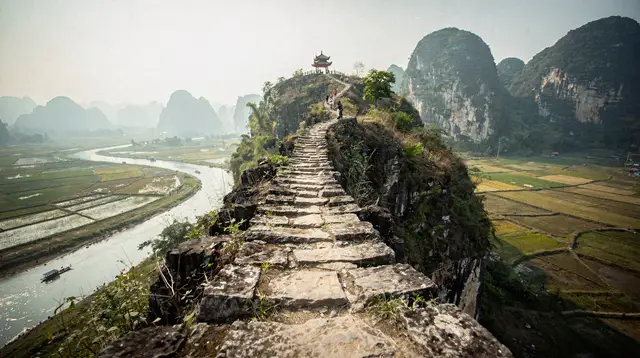
Beyond the cave, the wider Cao Bang geopark landscape is what separates a Ban Gioc day trip from a proper multi-day tour. The province is threaded with limestone peaks, terraced valleys carved by the Quay Son and other rivers, and villages belonging to several ethnic minority communities who farm the valley floors between the karst formations.
Longer tours use the extra days to move through this landscape rather than backtrack the same road twice, often via mountain passes that give sweeping views down over the terraces — the kind of scenery that, further west, defines routes like the Ha Giang loop but here sees a fraction of the traffic. a two-day motorbike route from Cao Bang over the Khau Coc Cha pass is built specifically around that pass-and-valley scenery rather than the waterfall alone, and suits travelers who have already seen Ban Gioc and want a second day dedicated to the geopark itself.
Extending toward Ba Be Lake
Some of the longer Cao Bang itineraries push further west toward Ba Be Lake, a large natural lake set among forested limestone hills in the neighboring province. It is not part of a standard two-day Ban Gioc trip, but it appears on extended routes that treat the northeast as a single loop rather than an out-and-back to the falls, pairing the border scenery of Cao Bang with the lake-and-forest landscape further along the route before looping back toward Hanoi.
a three-day tour that combines Ban Gioc waterfall with Ba Be Lake and a local guide is built around exactly that combination, giving a sense of how far a dedicated northeast loop can be stretched beyond the falls themselves. Travelers weighing whether to add this extra leg should treat it as a genuinely separate landscape rather than more of the same karst scenery — a lake and forest setting rather than the river-and-border character of Ban Gioc itself — and budget an extra day and a longer return drive for it.
Choosing between the shorter and longer formats
Not every traveler needs the full geopark loop, and operators price and pace their itineraries accordingly. A tight two-day format gets a traveler to Ban Gioc and Nguom Ngao and back with a single overnight, which suits anyone slotting Cao Bang into a wider northern Vietnam trip that also covers Ninh Binh or Ha Long Bay and cannot spare more than a couple of days on the far northeast alone. a two-day, one-night route to Ban Gioc waterfall via Ha Hoi is representative of that compressed format, prioritizing the falls and cave over the wider geopark detour.
A three-day or longer format, by contrast, suits travelers who see Cao Bang as a destination in its own right rather than a box to tick on a longer circuit — the extra day goes toward homestays, villages, and the mountain passes described above rather than simply resting after a long drive.
a two-day tour pairing Ban Gioc falls with a stay in a stone village nearby sits between the two formats, keeping the trip to two days while still building in a village stay rather than a standard hotel night. Whichever length is chosen, the underlying trade-off described earlier in this guide holds: more days in Cao Bang means less time spent purely in transit and more time actually in the geopark landscape that makes the province worth the detour.
What to check before booking
Because Cao Bang is further off the beaten path than Sapa or Ha Giang, a few practical checks matter more here than on a shorter, more established route.
- Confirm whether the tour is car-and-minibus based or motorbike based, since the two attract very different travelers and require different preparation.
- Ask what is included on transit days, since a large share of a Cao Bang itinerary is spent on the road rather than at a single sight — the guide to what a multi-day tour typically includes explains what to expect in general terms.
- Check the accommodation style for each night; homestays are common in the geopark area and differ considerably from a hotel stay in Cao Bang town.
- If riding is involved, confirm licensing and insurance requirements well in advance rather than assuming a rental agency will sort it on arrival.
- Ask how the operator handles the border-adjacent zone around Ban Gioc, since parts of it sit under local restrictions given the proximity to China.
For travelers who want to see Cao Bang alongside a wider stretch of the northeast rather than as a single out-and-back trip, a relaxed loop tour built around the Cao Bang region rather than a single waterfall stop spreads the days out over more of the province.
How Cao Bang fits into a wider northern Vietnam trip
Cao Bang rarely works as a traveler’s only stop in the north; it is more commonly added onto a longer trip that also covers Ha Giang, Ninh Binh or Ha Long Bay. Because it sits at the far edge of the region, it makes most sense either as a dedicated multi-day extension on its own, as shown above, or as one leg within a longer overall route — see the general guide to multi-day tours from Hanoi for how operators typically sequence a longer northern circuit.
Weather also plays a role in timing a visit. The mountains around Cao Bang follow the same broad seasonal pattern as the rest of the north — read the guide to the mountain climate around Sapa and Ha Giang for the general picture — with the clearer, drier autumn months generally making for easier travel on the winding roads into the province, and the falls carrying more water after the summer rains have passed.
Whichever format you choose, treat a Cao Bang and Ban Gioc trip as its own multi-day undertaking rather than a quick add-on to a Sapa or Ha Giang itinerary. The distance and the road are the trade-off for a corner of the north that still sees a fraction of the visitors those better-known routes do.
Boat Trips Through Trang An and Tam Coc
Verified deep-linked GetYourGuide tours. Book through these links and we earn a small commission at no cost to you.
GetYourGuide does not provide a product photo for this activity — the image shows the meeting point, photographed by us.