Vespa, Cyclo or Sidecar? A Guide to Two-Wheel Tours in Hanoi
What is a Vespa day tour in Hanoi?
A guided ride on the back of a vintage-style Vespa scooter, driven by a local rider, that links several neighbourhoods of Hanoi in a single outing. It is one of several two-wheel formats in the city, alongside night food-focused Vespa rides, cyclo tours around Hoan Kiem, sidecar tours and countryside motorbike days, each covered in its own dedicated guide.
The two-wheel tour family in Hanoi
Hanoi is a motorbike city before it is anything else, and a handful of tour formats turn that fact into a way of seeing the place rather than a hazard to dodge. Riding on the back of a vintage-style Vespa, driven by a local guide, is usually the easiest entry point: no driving skill required, a fixed route through several neighbourhoods, and a pace that sits somewhere between a walking tour and a car transfer. It is not the only option, though, and this guide exists to sort the family before sending you to the detail page that matches what you actually want.
The other formats worth knowing about are the cyclo tour around Hoan Kiem, a slow, pedal-powered ride concentrated in the Old Quarter; the sidecar motorbike tour, which swaps the scooter for a three-wheeled bike with an attached passenger seat; the evening Vespa food tour, built around street-food stops rather than sightseeing; and countryside two-wheel tours that leave the city entirely for rice-field and craft-village routes.
If none of that appeals, a guided tour designed for non-riders covers enclosed alternatives such as car or jeep-based sightseeing.
This page is the hub for that family. It explains what a daytime Vespa tour actually is, why it works as a first choice for most visitors, where it fits against the other formats, and the safety points — helmet use and insurance chiefly — that get skipped in the excitement of booking a scooter ride through Hanoi’s traffic.
What a Vespa day tour actually involves
The format is consistent across operators, even if the exact route differs: a local rider meets you, usually at a hotel in the Old Quarter, French Quarter or around West Lake, and you ride behind them for a loop that takes in several parts of the city over a few hours. You are a passenger the entire time — the rider handles the scooter, the traffic and the navigation, which matters in a city where crossing the street on foot already takes some acclimatising, let alone merging into a stream of motorbikes at an unmarked junction.
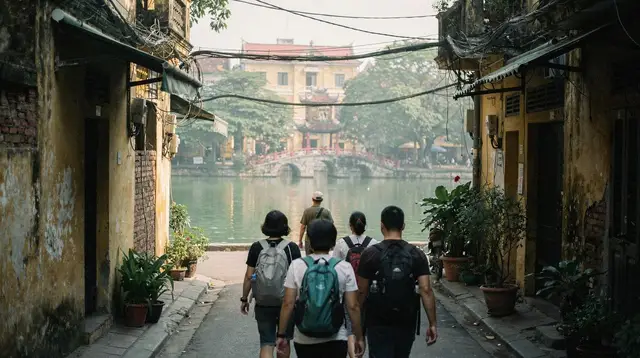
Routes typically link central districts that are each worth a stop on their own but awkward to connect on foot in one outing: the narrow lanes of the Old Quarter, the tree-lined streets and colonial buildings of the French Quarter, and often a loop around West Lake or through Ba Dinh district, where the Ho Chi Minh Mausoleum complex and the Temple of Literature sit. Because the rider is doing the navigating, a Vespa tour can string these together in a way that would otherwise mean several taxi rides or a long walk.
Where a Vespa tour differs from a general city tour by car is the exposure — no windows, closer to street level, and a much easier time threading through lanes a car cannot enter. Where it differs from walking is obvious: distance stops being a constraint, so a single outing can cover ground that would otherwise take a full day on foot.
Vespa versus the other two-wheel formats
The four formats overlap in spirit — someone else drives, you take in the city from the back of a vehicle — but they differ enough in pace, vehicle and focus that picking the wrong one is a common source of disappointment.
| Format | Vehicle | Typical focus | Best guide |
|---|---|---|---|
| Vespa day tour | Scooter, passenger behind driver | City sightseeing across several districts | This page |
| Vespa night tour | Scooter, passenger behind driver | Street food stops, evening atmosphere | Vespa night street food tour |
| Cyclo tour | Pedal-powered rickshaw | Slow loop around Hoan Kiem and the Old Quarter | Cyclo tour around Hoan Kiem |
| Sidecar tour | Motorbike with attached sidecar | City or countryside, seated rather than pillion | Sidecar motorbike tour |
| Countryside motorbike tour | Scooter or motorbike, pillion or self-drive | Villages, rice fields, roads beyond the city | Countryside two-wheel tour |
A cyclo tour suits travellers who want a slow, quiet ride and are happy to stay within a small radius of the lake. A Vespa tour suits travellers who want to see more of the city in a set window of time and don’t mind engine noise and traffic. A sidecar tour is worth considering for a different physical experience — sitting rather than gripping a driver’s shoulders — and is sometimes preferred by couples or by riders who find the pillion position uncomfortable over a longer route. Countryside tours are a different proposition again: they leave the dense city traffic behind for open roads, and the dedicated guide covers what that changes about pace and preparation.
None of these figures — distance, duration in hours, or price — are given here on purpose. They vary by operator, by route and by season, and a number stated on a hub page like this one goes stale fast. Check the specifics on the booking page for the tour you choose.
Self-drive is a different subject entirely
It is worth being direct about one confusion that comes up constantly: booking a Vespa tour is not the same as renting a motorbike and driving yourself. On a guided tour, the operator’s rider is licensed and responsible for the vehicle; you are a passenger with no licence requirement of your own. Self-drive rental in Hanoi is a separate activity, with its own rules around foreign and international licences, and insurers can and do refuse claims when those rules were not followed. If self-drive is what you actually want, the motorbike licence and insurance guide covers that ground properly — it is out of scope here, and this page will not tell you how to rent or ride your own bike.
For visitors who simply want to get from one point in the city to another rather than take a sightseeing tour, ordinary transport — ride-hailing apps, metered taxis, the metro or buses — is the better tool, and the getting around Hanoi guide lays out those options.
Helmets and insurance: the part people skip
This is the single most important practical point on this page. Helmet use is a legal requirement in Vietnam for every rider and every passenger on a motorbike or scooter, on any road, for any length of trip — including a short, guided sightseeing loop that feels more like an attraction than actual traffic. A tourist Vespa tour does not sit outside this rule. Any operator worth booking will hand you a helmet before the engine starts and expect it worn for the whole ride, not just in busier stretches.
Insurance is the second point, and it is less standardised. Whether the tour operator’s own insurance covers you as a passenger, and to what extent, varies by company, and it is a fair — even necessary — question to ask before booking rather than after something goes wrong. Separately, check your own travel insurance policy: some exclude motorbike or scooter travel altogether, some cover it only as a passenger and not as a rider, and the distinction matters even though you are not driving on a guided tour. None of this should discourage booking — accidents involving tourist Vespa tours are not common — but treating the helmet and the insurance question as settled by default, rather than confirmed, is the mistake to avoid.
A realistic day: where a Vespa tour fits
Most visitors slot a half-day or full-day Vespa tour into a broader Hanoi stay rather than building a day entirely around it. It pairs naturally with a Hanoi Full-Day City Tour Guide or half-day city tour built around the same central districts, since both cover similar ground with a different mode of transport, and pairs just as naturally with an early dawn ride before the streets fill up, when the Old Quarter and the lake are at their quietest.
If you are staying more than a couple of days, it is worth treating the daytime and evening Vespa formats as genuinely different outings rather than duplicates: the day version leans on sightseeing across several neighbourhoods, while the evening food-focused version leans on street stalls and a different route once the night markets are running. Doing both on the same trip is common precisely because they don’t overlap much.
For visitors who also want to see a craft village without arranging their own transport, some operators fold a short countryside leg — a rice-paper or folk-painting village, for instance — into a longer motorised outing, which is a lighter version of the fuller countryside two-wheel tours covered separately.
Booking notes
A standard city loop by vintage Vespa is the default starting point for most first-time visitors, covering several central districts with a local rider driving. For an early start before the traffic and heat build up, a dawn Vespa ride that ends with breakfast is a quieter version of the same idea.
Travellers who want to combine a scooter-based outing with a stop at a traditional craft village, without arranging separate transport, can look at a guided trip out to a rice-paper village and an ancient citadel site on the edge of the city.
Whichever tour you book, confirm pickup location and timing, ask directly about helmet provision and insurance coverage as a passenger, and check the current listing for group size, since some operators run these as private pairs and others as small shared groups. For neighbourhood context before you go — what’s actually in the Old Quarter versus the French Quarter versus the area around West Lake — the district guides linked above are the quickest orientation, and the Hanoi things-to-do hub lists the fuller range of activities in the city beyond two-wheel tours, including the vespa-cyclo-tours category this page sits under.
Vespa, cyclo, sidecar and countryside tours — questions travellers ask
Do I drive the Vespa myself?
No. On a standard Hanoi Vespa day tour, a local rider drives and you sit behind as a passenger. Self-drive motorbike rental is a separate activity with its own licence and insurance requirements, covered in the motorbike licence and insurance guide, and it is not what these guided tours offer.
Is a helmet compulsory on a Vespa tour?
Yes. Helmet use is a legal requirement for every rider and passenger on a motorbike or scooter in Vietnam, for any trip length. A reputable operator provides a helmet and expects it worn for the whole tour.
Does the tour operator’s insurance cover me as a passenger?
This depends on the operator and should be confirmed before booking, not assumed. Ask what is included, and check whether your own travel insurance policy also lists scooter or motorbike travel as covered.
How is a Vespa day tour different from a cyclo tour?
A Vespa tour is motorised and covers more ground at a faster pace, suited to seeing several districts in a few hours. A cyclo tour is pedal-powered, moves at walking pace, and stays concentrated around Hoan Kiem Lake and the Old Quarter.
What is the difference between a Vespa tour and a sidecar tour?
Both are guided, but a Vespa tour seats you behind the driver on a scooter, while a sidecar tour uses a three-wheeled motorbike with an attached passenger car — a different seating position, particularly noticeable on longer routes.
Can children or nervous riders join a Vespa tour?
Suitability varies by operator and by the individual passenger, and it is worth asking the tour provider directly before booking. Riders who prefer not to be on two wheels at all have enclosed alternatives covered in the guide to tours for non-riders.
Do Vespa day tours go outside Hanoi city?
Some do, some stay within the city. Routes that head into the countryside or craft villages are a distinct format from the classic in-city loop, covered in the countryside two-wheel tour guide.
Is a night Vespa tour the same experience as a day tour?
No. A daytime tour is built around sightseeing across neighbourhoods, while the evening version is built around street food stops and a different route once the night markets open.
Vespa and Cyclo Tours Through Hanoi
Verified deep-linked GetYourGuide tours. Book through these links and we earn a small commission at no cost to you.
GetYourGuide does not provide a product photo for this activity — the image shows the meeting point, photographed by us.