What Hanoi's Winter Air Actually Feels Like
Is Hanoi's air pollution bad in winter?
Hanoi's winter months bring a persistent grey haze from a mix of traffic exhaust, construction dust, regional crop burning and low-lying fog that traps everything close to the ground. It's a real, documented seasonal pattern that most visitors notice within a day or two, though it rarely stops anyone from sightseeing.
I’ll be honest: nobody warned me about this before my first winter trip to Hanoi, and it was the thing I ended up mentioning to almost everyone back home. Not the food, not the traffic, not the karst scenery — the sky. For most of my first week, it stayed a flat, pale grey from morning to night, the kind of grey where you can look straight at the sun without squinting because it’s just a soft disc behind a haze. It wasn’t fog exactly, and it wasn’t smoke exactly. It was somewhere in between, and it sat over the city the entire time.
A city, some traffic, and a lid on the sky
Hanoi’s winter haze is a documented, recurring seasonal pattern, not a one-off bad week. It comes from a combination of things stacking on top of each other at the worst possible time of year: heavy motorbike and vehicle traffic that never really stops, dust from the construction sites that seem to be on every other block, smoke drifting in from crop burning in the surrounding countryside, and — the part that makes it all worse — cool, still winter air that just doesn’t move much. In summer, heat and frequent downpours stir the atmosphere and wash it clean. In winter, that stillness works against the city: everything that gets put into the air tends to stay close to the ground instead of rising and dispersing.
I noticed it most in the way the light changed. Photos I took from the shore of Hoan Kiem Lake in the late afternoon came out soft and slightly washed-out, the far side of the lake barely visible through the haze. Long views — the kind you’d expect from a rooftop bar or a bridge over the Red River — were often just gone, swallowed into a pale wall. It’s not unpleasant, exactly, just muted, in a way that’s easy to notice if you’ve spent time in a city with sharper winter light.
What it actually feels like, day to day
For me, it was mild and manageable rather than alarming. A slightly scratchy throat by evening after a full day walking the Old Quarter, a bit more coughing than usual if I’d spent hours out on a motorbike taxi weaving through traffic, and a general sense of wanting a hot shower and clean air by the time I got back to the hotel. I don’t have any respiratory conditions, and it never stopped me doing anything I’d planned. Friends who travelled with asthma or a chest sensitivity felt it more, and were glad they’d packed their usual medication and a mask as backup.
Locals clearly live with this every winter. Mask-wearing on scooters is completely normal in Hanoi any time of year, for dust and sun as much as anything else, but I noticed it pick up noticeably once the cool season set in. Cafés and shops didn’t feel different, and nobody I spoke to treated it as anything unusual — just a known feature of the season, like the drizzle that comes with spring or the heat that comes with summer.
Not the same thing as mountain mist
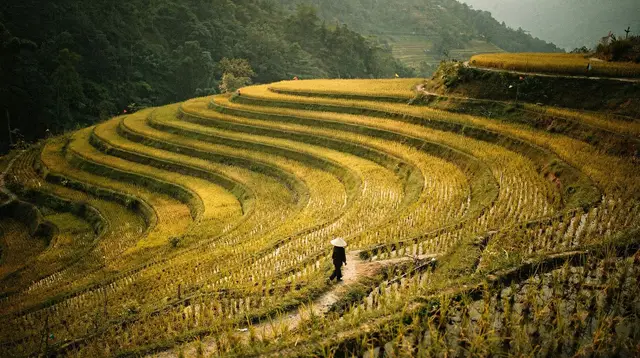
This is the part I think trips people up before they arrive, because Vietnamese travel photos from the north are full of soft white cloud, and it’s easy to lump it all together as “haze.” It isn’t the same. The mist that rolls through the terraced valleys around Sapa or the switchbacks of the Ha Giang loop is mountain cloud — moisture condensing at altitude, drifting through the Muong Hoa valley or settling over Mu Cang Chai and Pu Luong overnight.
It’s usually thickest at dawn and burns off through the morning as the sun warms the slopes, and it has nothing to do with traffic or construction dust. If anything, it’s one of the most photographed, most-loved parts of a trip north — the layered ridgelines fading into white, the terraces catching the first light. Hanoi’s winter haze is an urban, low-altitude, human-made thing that sits over the flat delta and doesn’t clear the same way.
The same goes for the coast and the bays. Out on Halong Bay or Lan Ha Bay, the air over open water behaves completely differently from the air trapped over the city — it moves, and any haze there is usually genuine weather, not the delta’s winter lid.
How I’d plan around it
I didn’t change my itinerary because of it, but a few small habits helped. I kept indoor half-days built in — a museum, the Temple of Literature, a long lunch — rather than stacking outdoor activity on outdoor activity every single day. I paid more attention on days I knew involved a lot of time in traffic, like transfers between Ba Dinh district sights or a long ride out toward Bat Trang, and packed a simple mask for those. And I stopped expecting the golden-hour skyline shots I’d seen online in October — Hanoi in winter has its own, quieter visual character, and I made peace with it.
If clean air and open views matter a lot to your trip, it’s worth weighing that against when you travel. Our best time to visit Hanoi guide walks through how each season actually feels, month by month, and it’s the page I wish I’d read before booking my first winter trip. Spring brings its own fine, persistent drizzle, summer brings heat, humidity and rain, and autumn — roughly October and November — is widely considered the clearest, most comfortable stretch of the whole year in Hanoi, which is worth knowing if visibility and easy walking days are a priority for you.
Getting out of the city helps
Honestly, the thing that helped most was simply leaving Hanoi for a few days. Heading out toward Thai Nguyen’s tea hills on a three-day tea culture trip through Thai Nguyen gave me a stretch of genuinely clear, open air and green hillsides that felt like a different country entirely. Further out, a two-day trip up to Sapa and the Muong Hoa valley below Fansipan was where I properly understood the difference between mountain mist and city haze — the valley below was clear enough most mornings to see terraces stretching for kilometres.
If waterfalls and forest air sound more appealing than another day of city traffic, a three-day nature trip out to the Na Hang waterfalls is a good way to properly clear your lungs, and even a straightforward two-day cruise out on Ha Long Bay puts you over open water, away from the delta’s stillness, for a night or two.
None of this is meant to scare anyone off a winter trip — I’ve been back since, and I’d happily go again. It’s simply something I’d rather know in advance than discover by surprise on day one, the way I did. Pack layers for the cool grey days, keep a mask in your bag if you’re sensitive to dust, and don’t judge the whole trip by Hanoi’s rooftop views alone — the clearer air is often just a few hours’ drive away.
Seasonal Guide
Verified deep-linked GetYourGuide tours. Book through these links and we earn a small commission at no cost to you.
GetYourGuide does not provide a product photo for this activity — the image shows the meeting point, photographed by us.