Hanoi Nightlife: Ta Hien Street and the Old Quarter Night Market
What is Hanoi nightlife actually like?
It centres on Ta Hien street in the Old Quarter, where plastic-stool bars spill onto the pavement into the night, and on a pedestrianised weekend night market through the surrounding streets. It is low-key and street-level rather than club-driven, and most of it winds down well before dawn.
Where Hanoi actually goes out at night
Hanoi is not a nightlife capital in the way Bangkok or Ho Chi Minh City sometimes gets marketed, and it does not try to be. What it has instead is something more particular: a dense, walkable Old Quarter, the “36 streets” of Hanoi, where one short street and a handful of surrounding blocks carry most of the after-dark energy in the city centre. If you are wondering where to go once the sun goes down and you have already eaten, this guide is about that specific corner of the city — Ta Hien street and the weekend night market around it — not about the water puppet theatre, live traditional music shows, or guided night tours of the wider city, which each have their own place on this site.
It is worth being clear from the start about what this page does not cover. The Thang Long Water Puppet Theatre and live traditional music performances are cultural shows with their own schedules and booking logic, covered separately. Bia hoi — the fresh draught beer sold by the glass on plastic stools — is a daytime and early-evening institution as much as a nighttime one, and it already has its own dedicated page under street food. And if what you want is someone else to drive the evening and narrate the city after dark, a organised night city tour is a different product, with its own guide. This page is about what happens if you simply walk into the Old Quarter after dinner and follow the crowd.
Ta Hien: the street everyone means
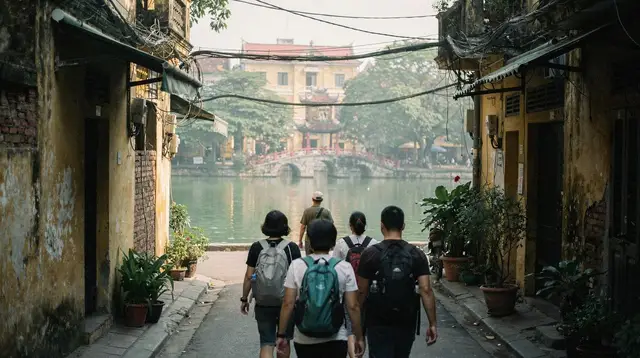
Ask any Hanoi local where to go for a drink after dark and the answer, more often than not, involves a short street called Ta Hien, tucked into the eastern half of the Old Quarter not far from Hoan Kiem Lake. By day it looks like any other Old Quarter street — narrow, motorbike traffic, shopfronts stacked with goods. By evening, especially from Thursday through Sunday, it transforms. Low plastic stools and tiny plastic tables spread out from bar doorways onto the pavement and partway into the road, beer and cheap cocktails move fast, and the crowd — a mix of backpackers, expats, local students and older regulars — settles in for the evening.
The unofficial centre of it all is the corner where Ta Hien meets Luong Ngoc Quyen, sometimes called “Beer Corner” by visitors. It is loud, a little chaotic, entirely informal, and exactly the kind of scene that resists a fixed schedule or a set price list — which is also why this page will not try to pin one down. What is true one week can shift the next as bars rotate promotions, and prices creep upward year over year the way they do everywhere in a fast-growing city. Go and see what is on when you arrive, and treat the description here as orientation rather than a program.
Ta Hien sits inside easy walking distance of most Old Quarter hotels, and it connects naturally to an evening that starts with food. Plenty of visitors work their way from an Old Quarter street food walking tour or an evening scooter food tour straight into Ta Hien once the eating winds down, since the geography barely requires a detour.
What the street actually feels like
There is no single “Ta Hien experience” — it depends heavily on which bar you land in and which night you show up. Some spots lean toward a backpacker-bar energy with loud music and drinking games; others are quieter, more of a spot to nurse a beer and watch the street go by. The street-side plastic stools are the great equaliser: cheap, informal, and available at more or less every bar along the strip, so hopping between them costs little more than standing up and walking a few metres.
If navigating an unfamiliar street scene solo is not your idea of a relaxed evening, there are guided options built specifically around this part of town.
an evening out that threads through the Old Quarter’s beer streets and local bars with a guide who knows which doors to walk through can take the guesswork out of a first night in the area, and it pairs naturally with the kind of street food most visitors want to try anyway.
The Old Quarter weekend night market — a common mix-up
Separate from Ta Hien, but overlapping with it in both geography and timing, is the Old Quarter’s pedestrianised night market. This is the point at which a lot of first-time visitors get confused, so it is worth stating plainly: the night market does not run every night. It operates on certain evenings of the week only, when a stretch of streets running roughly from Hang Dao down toward Dong Xuan Market is closed to motorbike and car traffic and lined with stalls selling clothing, souvenirs, snacks and toys. On the nights it is not running, those same streets are simply open roads again, busy with the usual Old Quarter traffic.
Because this guide is deliberately avoiding fixed schedules — market nights, opening times and any other detail that goes stale within a season — the practical takeaway is this: check locally, at your hotel or with a current source, on which nights the market runs before building an evening around it, rather than assuming it will be there.
When it is running, the market is a genuinely different register of nightlife from Ta Hien: family-friendly, browsing-paced, full of street snacks and the kind of small stalls that make Old Quarter markets and shops worth an evening in their own right, distinct from the daytime market at Dong Xuan. It draws a broad cross-section of Hanoi households out for an evening stroll as much as it draws visitors, which gives it a very different feel from the bar-heavy end of Ta Hien a few streets away.
Fitting the two together into one evening
Because Ta Hien and the night market sit close together and, on the nights the market runs, overlap in timing, a lot of visitors combine both into a single evening rather than treating them as separate outings. A common shape looks roughly like this: dinner somewhere in the Old Quarter, a wander through the night market streets if it happens to be running, then a slow drift toward Ta Hien as the market stalls start packing up and the bar crowd builds. None of that needs to be planned tightly — the whole area is compact enough that doubling back costs a few minutes, not a detour.
| Element | What it is | Typical evening role |
|---|---|---|
| Ta Hien street | Bar-lined street, plastic-stool seating | Main event, runs latest |
| Old Quarter night market | Pedestrianised stalls, certain evenings only | Earlier browsing, family-friendly |
| Bia hoi corners | Draught beer stools, daytime into early evening | Warm-up before the later crowd arrives |
| Water puppet show | Scheduled cultural performance | Separate booking, own page |
| Guided night city tour | Organised evening sightseeing | Separate product, own page |
If you would rather have company and a plan for the evening rather than improvising, a small-group option built around bars and live music is the closer match to the Ta Hien scene itself.
a small-group bar crawl through the Old Quarter’s livelier corners, moving between spots with music and a built-in social crowd suits travellers who want to meet people on the road rather than sit at a solo table, and it removes the question of which bar to pick first.
Where this fits against other options
It helps to be specific about what Ta Hien and the night market are not, so expectations line up with what you actually find. They are not a club scene — Hanoi has one, mostly clustered around the Old Quarter and West Lake, but it is modest and not the centre of gravity for most evenings out, and this page does not try to map it.
They are not a live-music venue circuit in the formal sense either; traditional music and dedicated performance venues run on their own schedules and are covered on their own guide. And they are not the daytime bia hoi ritual, which is really its own institution, drunk on stools scattered across the city from late morning onward and detailed on the street food page rather than here.
What Ta Hien and the night market share instead is informality and proximity — both sit inside a few blocks of each other in the Old Quarter, both cost little to simply show up and look at, and both work as a low-commitment way to spend an evening without booking anything in advance.
Practical notes for an evening out
A few things are worth knowing before heading out, without pinning down numbers that will only go stale.
Cash, not cards. Street-side bars and market stalls run on cash, in small denominations of the Vietnamese dong. This is not the part of the city where a card will get you far after dark — see the safety and scams guide for more on handling money in crowded tourist streets, since overcharging and short-changing are the realistic risks here, far more than anything violent.
Getting there and back. Most Old Quarter accommodation is within walking distance of Ta Hien. For anywhere further out, a ride-hailing app is the simplest way in and, more importantly, the simplest way home at the end of the night — see the getting around Hanoi guide for how that works in practice, including the fact that metered taxis and apps both operate fine late into the evening.
Crowds and noise. Ta Hien on a Friday or Saturday night is genuinely loud and genuinely crowded — that is the point of it, but it is worth knowing going in if you are hoping for something quieter. Earlier in the week, or earlier in the evening on any night, the same street is far more subdued.
Pace yourself with the rest of the trip. A late night on Ta Hien pairs awkwardly with an early departure the next morning, whether that is a Ninh Binh day trip, a Halong Bay transfer or an early flight home via Noi Bai. If the next day involves an early pickup, it is worth building that into how late the evening runs.
Unwinding afterward. If a loud night out is not quite your pace, or you would rather book something gentler for the following evening, a massage or spa session is a common way Hanoi visitors recover between busier days, and sits at the calmer end of the city’s evening options.
The wider picture
Ta Hien and the Old Quarter night market are, for most visitors, the accessible, low-key face of Hanoi nightlife — a street scene and a market rather than a club circuit, built around cheap plastic stools, street food and a crowd that shifts night to night. They sit inside the same few blocks as most of what makes the Old Quarter worth exploring after dark, close enough to fold into almost any evening plan without much extra logistics.
For a broader look at what else the district offers after sunset — shows, music, spas and organised tours among them — the shows and nightlife category rounds up the rest of that picture, while the things to do in Hanoi hub covers the daytime side of the same neighbourhood.
Hanoi nightlife: Ta Hien and the night market, answered
Is the Old Quarter night market open every night?
No. It runs only on certain nights of the week, when the streets around Hang Dao and Dong Xuan are closed to traffic and stalls set up along the pedestrianised route. On other evenings those same streets carry normal traffic, and there is no market.
What is Ta Hien street known for?
It is the informal centre of Hanoi’s evening scene, a short street in the Old Quarter lined with bars and street-side seating where the crowd, largely a mix of travellers and young locals, spills onto plastic stools at the corner with Luong Ngoc Quyen.
Is Ta Hien the same as bia hoi drinking?
They overlap but are not identical. Bia hoi is a style of fresh draught beer sold by the glass, drunk on stools through the day and evening across the city; Ta Hien after dark is a specific street scene, with bars, music spilling outdoors and a later, livelier crowd than the daytime bia hoi corners.
Are there nightclubs in Hanoi?
There is a small club and late-bar scene, mostly around the Old Quarter and West Lake, but it is modest by regional standards and not the focus of most visitors’ evenings, which tend to centre on street-level bars instead.
Is it safe to walk around the Old Quarter at night?
Violent crime is rare and the streets stay busy well into the evening, but pickpocketing, overcharging and minor scams do occur in crowded tourist areas, so keep the usual city-centre precautions in mind.
Do I need to book anything for a night out on Ta Hien?
No booking is needed to walk the street and pick a bar; it is an informal, walk-up scene. A guided evening bar crawl exists for travellers who would rather not navigate it solo, but it is optional.
What should I wear or bring for an evening out?
Casual, comfortable clothing is fine everywhere mentioned here; bring cash in small denominations, since street-side bars and stalls are not set up for cards, and keep valuables close in the crowd.
Shows and Nightlife in Hanoi
Verified deep-linked GetYourGuide tours. Book through these links and we earn a small commission at no cost to you.
GetYourGuide does not provide a product photo for this activity — the image shows the meeting point, photographed by us.