Vietnamese Coffee Culture: What I Learned Sitting Still in Hanoi
What makes Vietnamese coffee culture different?
Vietnam is one of the world's largest coffee producers, and in the north coffee is usually brewed slowly through a small metal phin filter and drunk sitting down, often for a long time, rather than grabbed to go. It is not always heavily sweetened — that depends entirely on how you order it.
The first morning I spent in the Old Quarter, I ordered a coffee expecting to drink it standing at a counter, the way I would back home, and carry on. Instead I watched everyone around me settle onto tiny plastic stools, set their phone face-down on an even tinier table, and simply stay. Nobody was in a hurry. That, more than any single drink, is what I now think of as Vietnamese coffee culture.
A country that grows what it drinks
Vietnam is one of the largest coffee producers on earth, and the plant most commonly grown here is robusta rather than the arabica more familiar to a lot of Western coffee drinkers — darker, stronger, and less acidic. I am not going to get into how much is grown or exported; that is a story for another page. What matters for a visitor to Hanoi is simpler: coffee is not an import here, and it does not behave like a luxury good you queue for. It behaves like something ordinary and constant, which is exactly why it has developed so many strange, specific little rituals around it.
The phin, and the patience it asks for
The instrument at the centre of northern coffee culture is the phin: a small metal filter that sits directly on top of your glass or cup. Ground coffee goes in, a metal disc weighs it down, hot water is poured over, and then nothing happens for several minutes except a slow, almost meditative drip. There is no way to rush a phin. You cannot really talk yourself into finishing quickly, because the coffee is still arriving one drop at a time as you drink your first sip of what has already pooled at the bottom.
I found this genuinely disarming the first few times. I am used to coffee as fuel — something you drink on the way to somewhere else. A phin coffee refuses that role. It asks you to sit through its own brewing, and by the time it is ready, you are already in the rhythm of the café rather than passing through it.
Egg coffee, yogurt coffee, and the inventions that followed
Hanoi has its own well-known variation: ca phe trung, egg coffee, where whipped egg yolk, sugar and condensed milk are beaten into something closer to a warm custard and poured over dark coffee. It sounds unlikely until you have tried it, and it is worth trying once with an open mind rather than a preconception either way. Less famous outside Vietnam, but just as common in the north, is yogurt coffee — coffee poured over or mixed with a spoon of plain yogurt, which gives it a tartness that plays off the bitterness of the coffee in a way I did not expect to like as much as I did.
What struck me is how these variations read less as gimmicks and more as evidence of a drink that people have kept experimenting with for a very long time, at home, without any tourist audience in mind. A short hands-on session, like the Coffee Class exploring Vietnamese coffee culture, is a reasonable way to see the mechanics of a phin and a few of these variations made properly, rather than guessing.
Correcting an assumption I arrived with
Before I got here, I had a fixed idea that Vietnamese coffee was always intensely sweet — thick with condensed milk, syrupy, one-note. That is true of one popular style, ca phe sua da, coffee with condensed milk over ice, and it is a great drink on a hot afternoon. But it is one option among several, not a rule. Order coffee black over ice (ca phe da) or hot and black (ca phe den) and you get something closer to a strong, unsweetened filter coffee. How sweet your cup ends up depends entirely on what you ask for and how it is made, not on some national preference for sugar. I wish someone had told me that before I spent my first week assuming every cup would taste like dessert.
Coffee as a place to sit, not a cup to carry
The bigger cultural difference, for me, was not the drink itself but what it is for. Cafés across the Old Quarter and around Hanoi are not designed for quick turnover. Low stools spill onto the pavement, tables are shared with strangers when the café is full, and people read, work, meet friends or watch the street go by for an hour or two without anyone hovering to clear the table. Coffee, in that sense, functions the way a park bench or a living room might elsewhere — a reason to stop moving.
That is quite different from the takeaway-cup habit I grew up with, where coffee is something you drink while doing something else. Here it is closer to the main activity. I started noticing how much of daily social life in Hanoi seems to happen over a coffee that takes forty minutes to finish rather than four — a catch-up between friends, a solo hour with a notebook, a pause between errands that turns into the actual point of the morning.
Where this fits into a visit
You do not need to seek out a single famous café to understand any of this — it is more useful to simply slow down wherever you end up, in the Old Quarter or a quieter corner nearby, and let a coffee take as long as it wants to. If you would rather have some structure around it, a guided walk that folds coffee stops into a wider look at street food and daily life, or an evening food tour by scooter, gives you context for what you are drinking alongside everything else on the street.
I have also found it useful to read a bit about northern versus southern Vietnamese food habits more broadly, since coffee culture is really just one expression of a larger, unhurried way of eating and drinking that runs through daily life here.
If you are curious about the country’s other great fermented, socially-anchored drink, bia hoi, the fresh draught beer sold by the glass on street corners, follows a similar logic: cheap, communal, and built around sitting rather than moving on. Between the two, you get a fairly complete picture of how Hanoi actually spends its downtime — and for a wider sense of local manners around both, a short read on etiquette and customs in Vietnam is worth ten minutes before you go.
For a first outing that ties coffee into a broader taste of the Old Quarter, including its markets and evening rhythm, or into the things to do around Hanoi more generally, I would treat coffee less as a checklist item and more as an excuse to stay somewhere a little longer than you planned. A two-day Old Quarter itinerary leaves plenty of room for exactly that kind of pause, and so does an evening spent among the city’s nightlife or its dedicated street food tours, where coffee is often just the first stop of several.
Going deeper than a single cup
If the short version above leaves you wanting more than one coffee and a description, there are a few ways to go further without turning it into a lecture. A hands-on coffee workshop with a local tasting covers more ground than a single demonstration, walking through the sweetened, black, egg and yogurt versions back to back so the differences actually land.
For a lighter option that still gets past the surface, a straightforward Hanoi coffee tasting lines up several styles side by side, which is a fast way to figure out which version you actually prefer before you spend the rest of your trip ordering it.
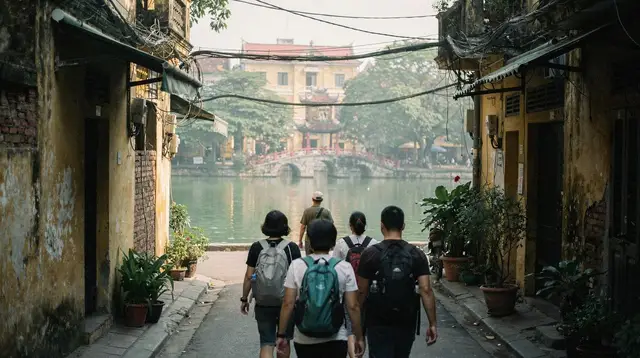
Coffee also makes an easy thread to pull into a wider walk. A walk through Hanoi’s hidden alleys built around coffee culture and local life puts the drink back into the setting it belongs in — narrow lanes, doorway stools, neighbours who have been running the same corner for years — rather than presenting it as an isolated tasting.
Vietnamese coffee culture: your questions answered
Is Vietnamese coffee always very sweet?
No. Sweetness comes from how you order it. Coffee with condensed milk (ca phe sua) is sweet and rich, but black coffee, hot or iced (ca phe den or ca phe da), is unsweetened unless you add sugar yourself.
What is a phin and how does it work?
A phin is a small metal filter that sits on top of a cup or glass. Ground coffee and a weighted disc go inside, hot water is poured over, and the coffee drips through slowly over several minutes rather than being brewed all at once.
What is egg coffee?
Ca phe trung is a Hanoi specialty made by whipping egg yolk with sugar and condensed milk into a thick, warm topping poured over dark coffee. It tastes closer to a light custard than to a standard cup of coffee.
Is yogurt coffee a real thing?
Yes, particularly in the north. Coffee is combined with plain yogurt, giving a tart, slightly cooling contrast to the bitterness of the coffee, and it is served alongside egg coffee on many menus.
Why do people sit so long over coffee in Hanoi?
Cafés here are set up as places to linger rather than to pass through quickly. Coffee tends to be a social anchor — for a chat, a rest, or simply people-watching — rather than a drink taken on the move.
Is coffee culture the same across all of Vietnam?
No. The habits described here are typically northern; the south, especially around Ho Chi Minh City, has its own café styles and pace, which is a separate subject from what you will find in Hanoi.
Can I learn to make Vietnamese coffee myself?
Yes, a short hands-on coffee class is a straightforward way to see a phin and a few local variations prepared properly, with someone explaining the steps as you go.
Street Food Tours and Vietnamese Cuisine Tastings
Verified deep-linked GetYourGuide tours. Book through these links and we earn a small commission at no cost to you.
GetYourGuide does not provide a product photo for this activity — the image shows the meeting point, photographed by us.